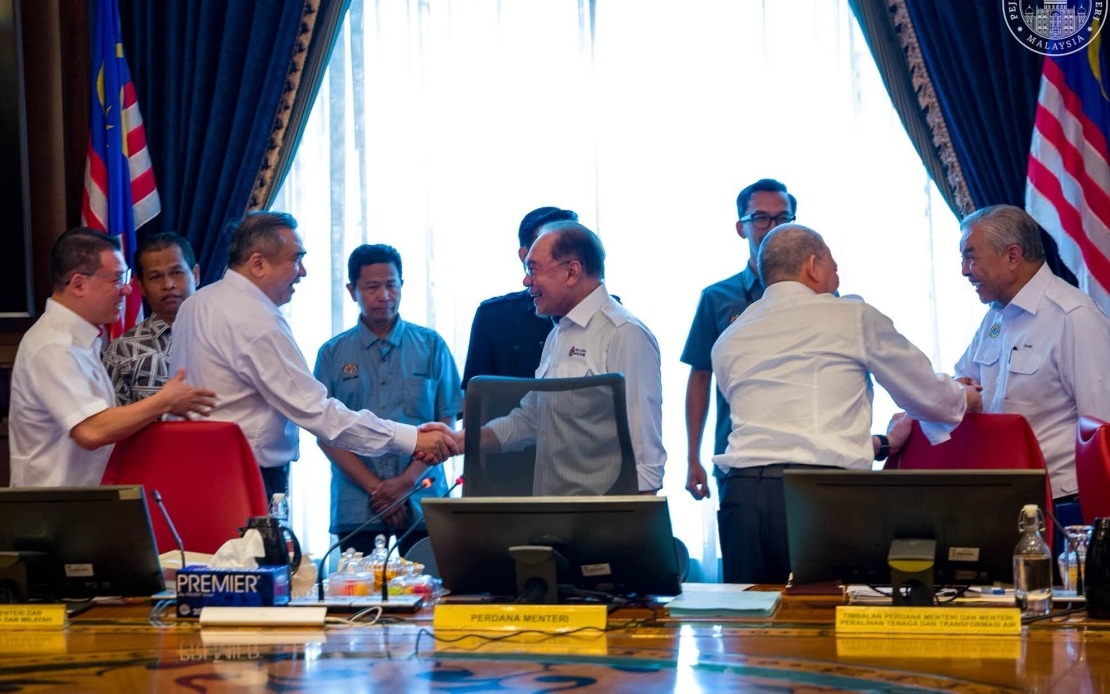
Prime Minister Datuk Seri Anwar Ibrahim has released a poetic message centred on themes of unity, discipline and solidarity at a particularly delicate moment for Malaysia's governing coalition. The four-line Malay pantun, shared on his official Facebook page, highlights the enduring value of friendship and collective consensus—sentiments that resonate deeply within traditional Malaysian culture and governance philosophy.
The post rapidly gained traction, accumulating more than 11,500 likes within two hours and generating over 1,700 comments. The enthusiastic online response suggests the message struck a chord with citizens, with several respondents replying in pantun themselves while many observers commended the Prime Minister's measured, statesmanlike approach. This digital engagement underscores how Anwar continues to leverage traditional cultural forms to communicate contemporary political messages to a diverse Malaysian audience.
Accompanying the pantun were photographs from a Cabinet meeting featuring Deputy Prime Minister Datuk Seri Dr Ahmad Zahid Hamidi and Transport Minister Anthony Loke, among others. All participants in the meeting appeared notably relaxed and convivial, visibly reinforcing the narrative of governmental harmony and collaborative spirit. Such imagery carries particular significance in Malaysian politics, where public displays of unity among senior figures carry symbolic weight beyond the immediate gathering.
The timing of this message deserves careful consideration. Malaysia's political landscape remains defined by the Federal Unity Government—an unprecedented coalition spanning Pakatan Harapan, Barisan Nasional and several other parties. This arrangement, while stabilizing the nation after years of political turbulence, remains inherently fragile, requiring constant reinforcement of shared commitment to national stability over factional interests.
Yet precisely this arrangement faces imminent strain. Pakatan Harapan and Barisan Nasional are currently waging vigorous electoral campaigns in Negeri Sembilan, competing directly despite their federal partnership. This apparent contradiction reflects Malaysia's complex political reality: coalitions can simultaneously cooperate at the national level while competing fiercely in state contests. The dynamic tests the durability of the Federal Government's foundational principle that partisan interests can be subordinated to broader governance imperatives.
In the Negeri Sembilan contest, Pakatan Harapan under Anwar's leadership is contesting all 36 state assembly seats, while Barisan Nasional, chaired by Ahmad Zahid, contests 25 constituencies and maintains an alliance with Perikatan Nasional. This configuration illustrates how Malaysian state elections can become laboratories for testing coalition stability and measuring shifts in electoral support. The results will provide crucial indicators of whether the Federal Government arrangement possesses genuine resilience or merely masks deeper fractures.
The Election Commission has scheduled early voting for July 28 and general polling for August 1, following the Negeri Sembilan State Assembly dissolution on June 5. This compressed campaign timeline intensifies pressures on all parties to mobilize supporters while managing the delicate balance between competitive vigour and maintaining coalition discipline. For Anwar, whose leadership proved pivotal in constructing the Federal Government, the political stakes in Negeri Sembilan extend beyond state representation into questions of his broader political authority.
Anwar's pantun message should be understood within this context as something more than merely poetic reflection. It represents a carefully calibrated political signal—a reminder to coalition partners, party activists and the broader electorate that fundamental commitments to national stability supersede short-term electoral ambitions. The Prime Minister is essentially enjoining all participants to remember that victory in Negeri Sembilan matters less than preserving the institutional arrangements that have brought relative political stability to Malaysia.
The choice of pantun as the communication vehicle demonstrates sophistication in political messaging. This classical Malay literary form carries associations with wisdom, tradition and cultural authenticity, rendering it more persuasive than purely modern political rhetoric might be. By embedding his message in a form rooted in Malaysian heritage, Anwar appeals to deeper cultural values and historical continuities that transcend contemporary partisan divisions.
For Malaysian and Southeast Asian observers, this episode illuminates enduring tensions within coalition governments across the region. Democracy in Malaysia, Thailand and other Southeast Asian nations increasingly involves complex multi-party arrangements where parties maintain distinct identities and policy preferences while cooperating on executive governance. These arrangements demand continuous negotiation, periodic reminders of shared purposes, and cultural mechanisms—like Anwar's pantun—that reinforce commitments to broader institutional stability.
The online response to Anwar's message suggests significant portions of the Malaysian public appreciate such reminders of political unity during contested elections. The enthusiastic engagement across social media indicates that themes of consensus and harmony retain genuine resonance beyond cynical partisan calculation. Whether this sentiment translates into voting patterns that reinforce rather than destabilize the Federal Government remains to be determined when Negeri Sembilan voters cast their ballots.
Ultimately, Anwar's poetic intervention reveals the sophistication required of contemporary Asian leaders navigating coalition governance. The message functions simultaneously as cultural expression, political reminder and strategic communication—demonstrating how modern Malaysian politics remains anchored in traditional forms while addressing urgently contemporary challenges. Whether such symbolic gestures can sustain coalition cohesion when electoral interests diverge substantially remains perhaps the most pressing question for Malaysia's political future.

