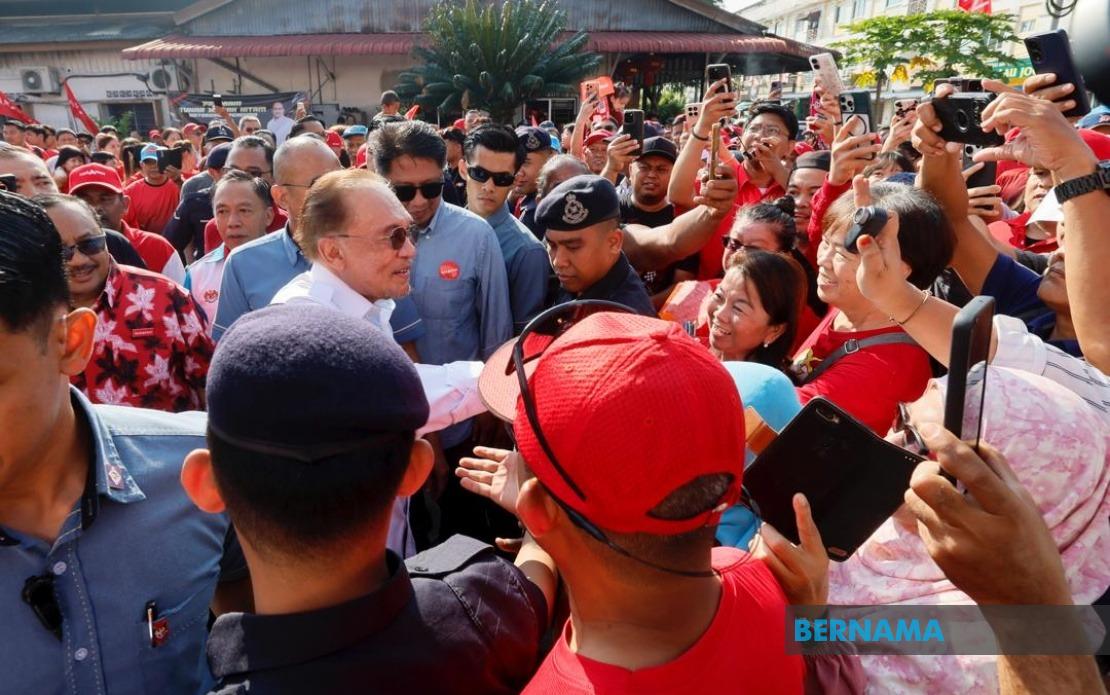
Prime Minister Datuk Seri Anwar Ibrahim's hands-on campaign appearance in Johor during the final week of the state election race has delivered a tangible lift to Pakatan Harapan's organisational efforts across several critical constituencies. The visit to Simpang Renggam parliamentary area, which encompasses the Machap and Layang-Layang state seats, came on the ninth day of campaigning and underscored the coalition's commitment to grassroots engagement ahead of polling on July 11. The intervention proved timely for a coalition seeking to consolidate support in a state where electoral dynamics remain fluid and voter sentiment continues to crystallise.
Nur Hafiz Roslan, contesting the Machap state seat for PH, characterised the Prime Minister's visit as pivotal for candidate morale and volunteer energy. Beyond the symbolic value of having the party chairman campaign alongside candidates, Roslan emphasised that Anwar's presence communicated a substantive message about the campaign's underlying philosophy. The candidate highlighted how the PH leader had reminded the team that their work must prioritise public service rather than partisan score-settling. This distinction carries particular weight in Malaysian electoral contexts, where voter cynicism towards self-serving political behaviour remains endemic and campaigns that position themselves as public-interest-focused often gain credibility.
Anwar's messaging to the campaign teams centred on a fusion of secular and spiritual language characteristic of PKR's appeal. He urged candidates and workers to approach their campaign duties as righteous acts—invoking the concept of amal soleh—while simultaneously framing political engagement as a service obligation rather than a power pursuit. Roslan's recounting of this guidance suggests a deliberate effort by the PH machinery to distance the campaign from personal ambition narratives, instead anchoring it to community welfare rhetoric. For campaign workers on the ground, such reframing can prove motivationally significant, especially in constituencies where voter fatigue with traditional political messaging runs high.
Roslan himself reinforced this service-oriented positioning, declaring that PH's presence in Simpang Renggam and the two state constituencies was entirely dedicated to meeting community needs without sectarian bias. The candidate's emphasis on impartial service delivery addresses a recurring concern among multi-ethnic and multi-religious constituencies—that political representation might become contingent on demographic identity rather than universal benefit. In the Malaysian electoral landscape, particularly in urban and semi-urban areas, this assurance often resonates more powerfully than conventional campaign appeals.
Guna Balakrishnan, the PH candidate for Layang-Layang, similarly credited the Prime Minister's visit with accelerating his community engagement momentum. Balakrishnan acknowledged that while local residents had already shown encouraging receptiveness to the campaign, the leadership endorsement from Anwar elevated both the profile of his candidacy and the perceived importance of the engagement process itself. The candidate further noted that Anwar had impressed upon him the accountability dimension of electoral mandates—that winning would entail tangible area development and community welfare improvements. This particular instruction suggests that PH's central leadership is attempting to reset expectations around electoral promises, positioning constituency development as a non-negotiable obligation rather than aspirational rhetoric.
The grassroots turnout at the 'PMX Santai Sarapan Bersama Masyarakat' programme demonstrated substantial community interest in the campaign messaging. More than 1,000 residents gathered for the casual breakfast engagement, indicating that the carefully curated informality of the event—conveyed through its deliberately relaxed format—successfully attracted diverse voters. The scale of attendance also suggests that curiosity about the Prime Minister's personal campaigning style, combined with underlying concern about the election outcome, motivated significant public participation. For campaign strategists, such numbers validate the utility of leadership-led grassroots events in mobilising voter turnout.
Chuan Chee Mei, a 48-year-old Simpang Renggam resident, articulated how direct observation of Anwar's campaign involvement shaped her voting inclination. Her statement that witnessing the Prime Minister's wholehearted support for candidates strengthened family confidence in PH's candidacy highlights the persuasive power of leadership endorsement at the local level. In the Malaysian context, where personality-driven politics remains influential despite the prevalence of party-based frameworks, such personal conviction drawn from leader visibility can materially affect household voting decisions. Chuan's reasoning suggests that perceived leader commitment to local campaigns carries particular weight among women voters, who often prioritise demonstrated attentiveness to constituency concerns.
Noor Takiyudin Salleh, aged 38, similarly interpreted the Prime Minister's approachability and the event's casual atmosphere as markers of authentic political engagement. His appreciation of both the informal programme design and the substantial crowd size suggests that voters increasingly value perceived authenticity in political interaction. The contrast between Noor's positive response to the relaxed setting and traditional formal campaign events indicates a generational or demographic shift in preferred political communication styles. His intention to vote for PH candidates, rooted in these observations, demonstrates how campaign mechanics and leadership demeanour can translate into electoral outcomes beyond policy discussions.
The competitive landscape facing Pakatan Harapan in Johor encompasses 172 candidates across 56 state seats, creating a saturated campaign environment where leadership visibility becomes a key differentiator. Anwar's presence in the final campaign week signals strategic prioritisation of constituencies where PH perceives expansion opportunities or requires consolidation against opposing coalitions. The timing of his Johor visit, with early voting scheduled for July 7 and main polling for July 11, reflects standard campaign practice of intensive leadership activity during the final ten days when voter attention peaks and media focus intensifies.
For Pakatan Harapan, the broader strategic implications of such grassroots campaign integration extend beyond the immediate Johor context. Leadership-led community engagement, when calibrated around accessible settings and authentic-seeming interaction, builds volunteer confidence and energises party machinery across multiple constituencies simultaneously. The apparent success of this particular campaign intervention, measured through volunteer motivation and public turnout, may inform PH's approach to future state-level campaigns and by-elections across Malaysia. The demonstrated receptiveness of voters to informal leadership engagement provides a template for adjusting national campaign strategies away from exclusively formal, televised formats.
The candidacy dynamics in both Machap and Layang-Layang, now bolstered by Prime Minister support, establish heightened expectations for PH performance in these constituencies. Voters attending the Simpang Renggam programme who subsequently translate campaign interactions into electoral support will contribute to measuring whether leadership-intensive grassroots strategies deliver commensurate ballot outcomes. Early voting commencing July 7 will provide initial indicators of whether Anwar's campaign intervention successfully converted community goodwill into votes, particularly among the engagement participants who received direct interaction with the party chairman.

