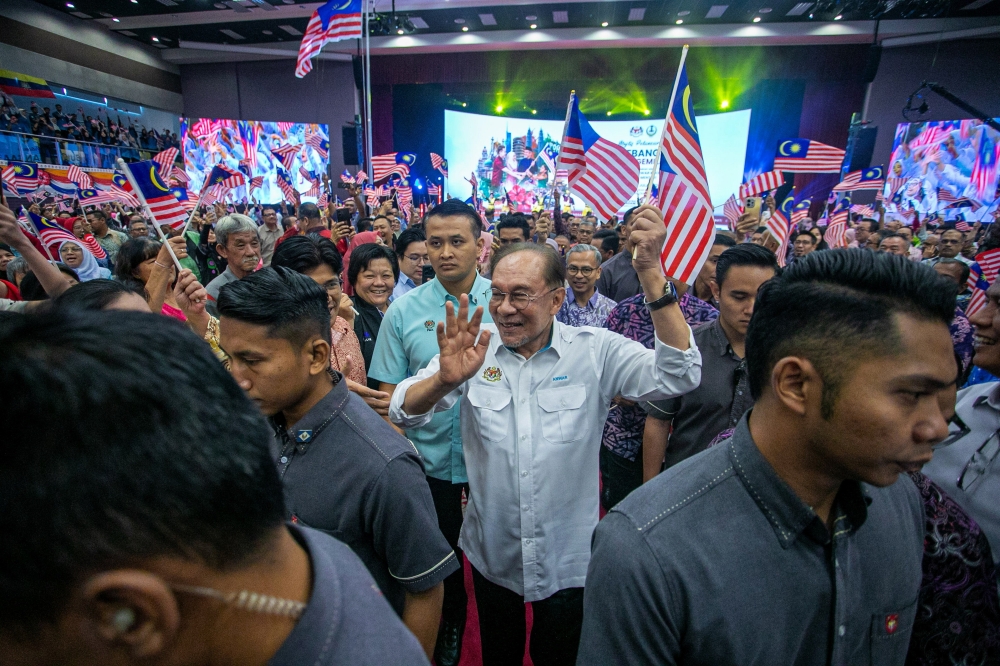
Prime Minister Datuk Seri Anwar Ibrahim has issued a measured but firm directive to government officials regarding their participation in political campaigning, instructing them to exercise their democratic rights while adhering strictly to established electoral regulations. Speaking in Ipoh on July 19, Anwar emphasised that holding ministerial or senior government positions carries inherent responsibilities that must be balanced against the freedom to engage in partisan political activity. His remarks reflect an ongoing tension within Malaysian politics between the rights of government officials to campaign and the need to maintain institutional neutrality and public confidence in state institutions.
The Prime Minister's guidance addresses a persistent challenge in democracies where senior elected officials occupy dual roles as both party operatives and stewards of public institutions. Anwar's message targets individuals throughout the government apparatus—from federal ministers to state-level administrators—signalling that the boundaries governing campaign conduct apply uniformly regardless of rank or proximity to the Prime Minister himself. This inclusive framing suggests concerns may have arisen about officials at various administrative levels blurring the distinction between their official duties and party political activities. The emphasis on personal responsibility places the onus on individual officials to navigate these grey areas with integrity rather than relying on detailed regulatory guidance.
Malaysia's electoral framework prohibits civil servants from engaging in partisan political activity, a constraint rooted in principles of administrative impartiality and service to the nation rather than to any political party. However, elected government ministers occupy a different category—they must represent their constituents and parties while simultaneously executing ministerial functions. This dual mandate creates genuine operational complexity. Anwar's reminder acknowledges this ambiguity by neither prohibiting nor explicitly endorsing campaign participation, instead stressing that officials must remain cognisant of where permissible political engagement ends and improper conduct begins. Such conduct might include using state resources for campaign purposes, leveraging official positions to pressure support, or neglecting ministerial duties for campaign activities.
The timing of Anwar's statement carries significance within the broader Malaysian political context. With regular electoral cycles and the possibility of snap elections always present, political campaigns represent an ongoing feature of the landscape rather than discrete, temporally bounded events. Government officials face constant temptation to exploit their positions and access to resources for party advantage. The Prime Minister's intervention suggests either recent incidents of boundary-crossing or a proactive attempt to establish clear expectations before such issues emerge. In either case, the message sends a signal that his administration takes institutional integrity seriously and expects subordinates to exercise restraint and judgment.
From a practical standpoint, distinguishing between legitimate campaign activity and improper conduct requires nuance. A minister attending party functions and delivering speeches to mobilise voters falls within acceptable bounds. However, that same minister directing civil service resources toward campaign logistics, using government vehicles and facilities for party purposes, or implicitly pressuring subordinate officials to support particular candidates would constitute violations. The line between these scenarios often appears blurred in real-world circumstances, particularly in local and state-level contexts where government administration and party politics intertwine more visibly. Anwar's statement effectively delegates responsibility for navigating this ambiguity to individual officials, trusting their judgment and professional integrity.
The warning also reflects Anwar's positioning as a leader concerned with governance standards and institutional credibility. By publicly reminding officials of their obligations, he creates a record of explicit guidance that insulates his administration against criticism should campaign-related transgressions occur. Should officials subsequently engage in questionable activities, the government can demonstrate that leadership had clearly articulated expectations. This approach also differentiates his tenure from periods when such guidance was less forthcoming, positioning his administration as more attentive to institutional norms. Whether such positioning translates into substantive enforcement remains another matter, though the explicit public statement suggests at least rhetorical commitment to principle.
For Southeast Asian observers, Anwar's remarks underscore a broader challenge facing the region's democracies. As political competition intensifies and stakes rise, governing parties face mounting pressure to leverage state machinery for electoral advantage. This pressure afflicts both established and emerging democracies, with varying degrees of resistance and regulatory capacity. Malaysia's democratic maturation has depended partly on institutional checks and professional civil service traditions, though these have periodically faced strain. Anwar's reminder represents an attempt to reinforce these traditions at a moment when informal pressures might be encouraging their erosion. The effectiveness of such reminders ultimately depends on the credibility and consistency of enforcement.
Meanwhile, opposition parties and civil society observers will likely scrutinise government activities carefully, watching for evidence that officials have disregarded the Prime Minister's guidance. Any apparent violations could trigger public complaints, media coverage, and calls for disciplinary action against officials. This creates reputational incentive for compliance beyond what formal regulations alone might generate. The public nature of Anwar's statement means that subsequent failures to maintain boundaries become more visible and politically costly. Officials aware of this scrutiny face practical disincentive to exploit their positions, even absent formal penalties. Such mechanisms of transparency and reputational consequence often prove more effective than regulatory provisions alone in maintaining institutional standards.
Looking forward, the sustainability of these standards will depend on senior leadership's continued commitment and willingness to address violations when they occur. One-off statements, however clear, provide only temporary guardrails. Institutions develop through repeated reinforcement of norms and consistent consequences for violations. Should Anwar's government maintain this approach—regularly reiterating expectations and addressing breaches—it could strengthen institutional culture around campaign conduct. Conversely, if the statement proves merely performative, its credibility will diminish, and officials may interpret subsequent silence as tacit permission to operate within wider boundaries. The broader trajectory of Malaysian democracy may depend significantly on how this particular principle becomes embedded in practice.

