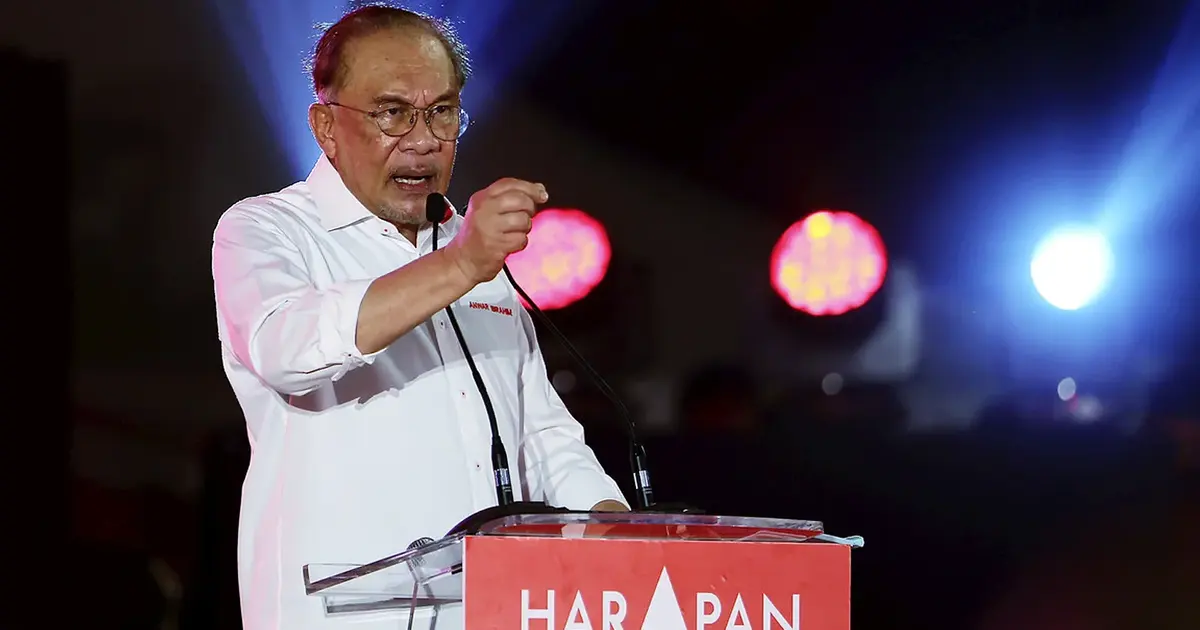
Prime Minister Anwar Ibrahim, speaking in his capacity as Pakatan Harapan chairman, has issued a firm directive to all contesting parties to refrain from drawing the Negeri Sembilan royal institution into the state election discourse. The warning signals growing concern within the ruling coalition about the potential for sensitive constitutional matters to become entangled with partisan politics during what promises to be a closely watched regional poll.
Anwar's appeal addresses a longstanding principle in Malaysian politics whereby matters touching on the monarchy—a pillar of the nation's constitutional framework—are generally kept beyond the reach of electoral competition. The Negeri Sembilan royal institution, centred on the institution of the Yang di-Pertuan Besar as the state's ruler, carries particular constitutional significance within the federation's system of constitutional monarchy. By explicitly cautioning against politicisation, Anwar underscores the government's view that such institutions must remain insulated from the rough-and-tumble of campaign messaging.
The timing of this directive reflects a broader sensitivity within Malaysian politics regarding the monarchy's role. State elections in Negeri Sembilan inevitably touch on matters of governance, administration, and constitutional authority—all domains where the Duli Yang Maha Mulia maintains ceremonial and symbolic prerogatives. Anwar's statement serves as a preventive measure, seeking to establish clear boundaries before campaign rhetoric potentially escalates in ways that could appear disrespectful or constitutionally problematic.
For Malaysian readers accustomed to the interplay between democracy and monarchy, this caution may resonate with familiar debates about where democratic competition ends and institutional reverence begins. The Negeri Sembilan context is particularly relevant given the state's unique constitutional arrangements and the role of the royal institution in state governance. Unlike federal elections, state polls directly engage with local governance structures where the ruler maintains ceremonial involvement in official proceedings and constitutional formalities.
Anwar's intervention also reflects the position of Pakatan Harapan more broadly, which has sought to project itself as a coalition committed to constitutional propriety and institutional respect. By preemptively discouraging parties from raising royal-related issues in campaigns, the coalition attempts to set a tone of restraint that may also serve its electoral interests by preventing competitors from exploiting sensitivities around constitutional matters for political gain.
The warning carries implications for how opposition parties conduct their campaigns in Negeri Sembilan. Should rival coalitions or independent candidates approach the election, they will understand that any messaging perceived as critical of or dismissive toward the royal institution could trigger backlash—not merely from coalition supporters, but potentially from segments of the electorate who view such criticism as fundamentally inappropriate. This creates an implicit constraint on campaign discourse that extends beyond typical party-political boundaries.
For Southeast Asian observers, Malaysia's approach to ring-fencing royal institutions from electoral politics offers a contrast to democratic systems where constitutional heads of state face more direct public scrutiny. The Malaysian model reflects a constitutional design that positions the monarchy as standing somewhat apart from partisan competition, a principle that Anwar's statement seeks to reinforce during the Negeri Sembilan campaign.
The directive also addresses practical campaign management concerns. Election periods can generate passionate rhetoric, and party workers at grassroots level may inadvertently cross lines of propriety when making arguments about state governance or leadership. By issuing clear guidance from the highest levels of the governing coalition, Anwar aims to ensure message discipline and prevent isolated incidents from escalating into broader constitutional controversies.
Negeri Sembilan's particular status as a state with a functioning, active royal institution means that such warnings carry concrete significance. The state's chief executive must work within a constitutional framework that recognises the ruler's position, and campaign discussions about governance necessarily operate within that established framework. Anwar's statement reinforces that this framework itself—and the institution it protects—should not become contested terrain during electoral competition.
Looking forward, the warning establishes a baseline expectation that all parties will navigate the Negeri Sembilan election within what might be termed constitutional proprieties. Whether this appeals prevents all sensitivity around royal matters remains uncertain, but it signals that the government views institutional respect as non-negotiable even amid intense electoral competition. For voters in Negeri Sembilan, the directive suggests they can expect campaigns to focus on substantive governance issues rather than constitutional questions about the state's royal institution.

