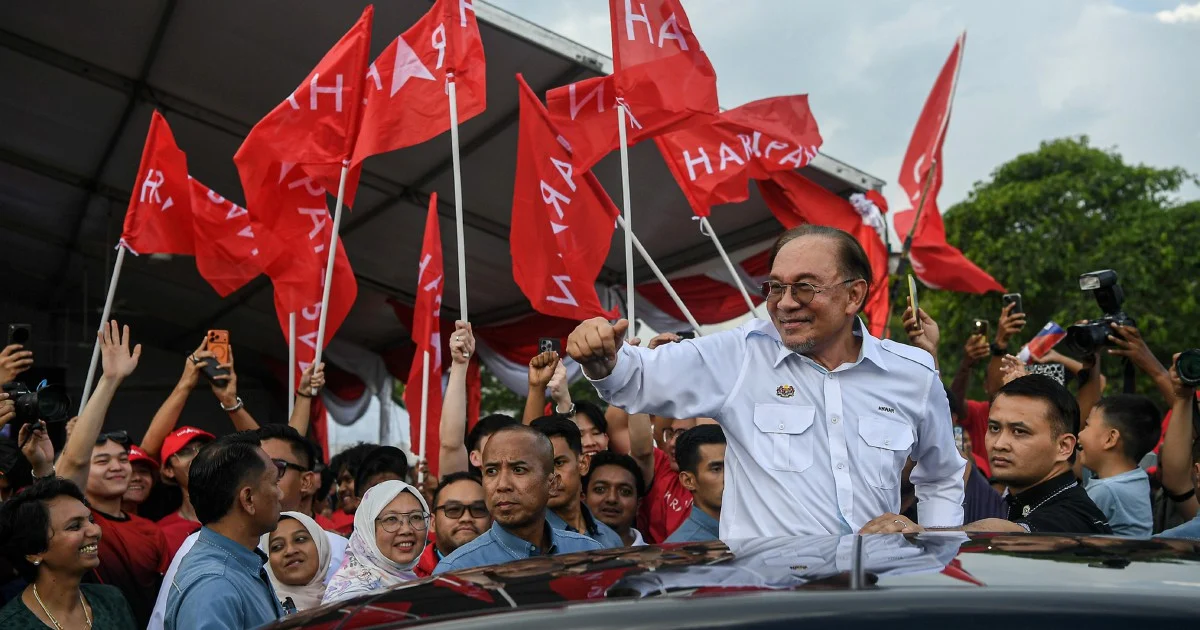
Prime Minister Datuk Seri Anwar Ibrahim delivered a pointed rebuke to his political rivals during an address in Segamat, denouncing those who distance themselves from the Democratic Action Party as demonstrating immaturity and disregard for democratic foundations. Speaking in his capacity as chairman of Pakatan Harapan, the ruling coalition's leading voice made clear that excluding DAP from political engagement represents not principled disagreement but rather a failure to honour the electoral choices made by Malaysian voters across successive elections.
The statement carries particular significance within Malaysia's contemporary political landscape, where the multi-ethnic composition of Pakatan Harapan has frequently become a flashpoint for opposing factions. DAP, predominantly supported by urban Chinese voters, has historically faced accusations from rival politicians and certain media outlets concerning its intentions and influence within government structures. These narratives have periodically resurfaced during election campaigns and policy debates, often employed as mobilisation tactics among particular voting blocs.
Anwar's intervention suggests growing frustration within the ruling coalition regarding what leadership perceives as bad-faith political tactics designed to delegitimise coalition partners rather than engage substantively on policy grounds. The distinction matters considerably: accepting DAP's electoral mandate, regardless of personal or organisational differences, reflects what democratic systems require of their practitioners. Conversely, systematic efforts to isolate a coalition partner from public forums effectively challenge not that partner's specific positions but rather the legitimacy of voters' choices in returning DAP representatives to parliament.
This confrontation between inclusive and exclusionary political frameworks reflects broader regional tensions. Throughout Southeast Asia, multiethnic democracies struggle with balancing diverse community interests whilst maintaining national cohesion. Some countries have pursued model-minority frameworks emphasising intercommunal cooperation as essential to stability; others have allowed identity-based grievance politics to dominate discourse. Malaysia's experience suggests that repeated normalisation of exclusionary rhetoric, even when not matched by formal policy discrimination, gradually weakens democratic institutions and increases polarisation.
For Malaysian voters, particularly those residing in key marginal constituencies where coalition politics determine electoral outcomes, Anwar's statement carries strategic weight. General elections over the past decade have demonstrated that DAP's electoral base commands sufficient parliamentary representation to make or break majority governments. The party won 40 seats in the 2022 elections despite contesting only 45 constituencies, reflecting concentrated support and efficiency in translating votes into representation. This mathematical reality means that coalition governments formed without DAP support face significant parliamentary constraints.
The timing of Anwar's remarks also warrants consideration, as they emerge amidst ongoing discussions regarding potential coalition realignments ahead of future electoral contests. Malaysia's coalition politics remain fluid, with various permutations of partnerships regularly canvassed within political circles. Whether Anwar's defence of DAP reflects confidence in the coalition's stability or represents a reaction to specific recent incidents suggesting wavering commitment remains subject to interpretation. Either reading points toward underlying fragility within the Pakatan Harapan arrangement that deserves closer attention.
Opposition parties have occasionally adopted rhetoric suggesting incompatibility with DAP participation in government, particularly when appealing to constituencies with specific communal concerns. Such messaging carries implicit arguments about governance legitimacy and representation that extend beyond mere party competition. When political figures consistently signal that particular coalition members lack standing for public engagement, they necessarily invite their supporters to question whether electoral mandates bestowing parliamentary authority upon those members carry full legitimacy.
Regional comparisons illuminate the stakes. Thailand has experienced repeated democratic breakdowns partly attributable to elite rejection of electoral outcomes perceived as unfavourable; Myanmar's military coup followed contested elections in which civilian parties sought to translate parliamentary majorities into political authority. While Malaysia's institutions remain substantially more resilient than these examples, the underlying tensions deserve serious consideration. Democratic systems survive through tacit agreements to accept electoral verdicts and engage rival political formations through recognised institutional channels rather than through calculated marginalisation.
Anwar's invocation of maturity as the relevant standard for political behaviour suggests he views this matter as extending beyond partisan advantage into questions of systemic health. Whether opponents interpret his intervention as a genuine appeal to democratic principle or as defence of coalition necessity remains unclear. What seems evident is that Malaysian politics cannot indefinitely sustain scenarios where major parliamentary parties face systematic exclusion from public platforms and policy discussions by rivals controlling different electoral coalitions. Such arrangements eventually corrode the shared understanding that democratic competition occurs within defined institutional boundaries respecting electoral outcomes.
For observers monitoring Malaysia's democratic trajectory, these tensions merit continued attention as potential indicators of institutional stress. Coalition governments inherently require managing diverse partners whose interests do not perfectly align, creating constant pressure toward either dissolution or genuine negotiation of shared frameworks. Anwar's intervention suggests Pakatan Harapan's leadership recognises that allowing systematic delegitimation of any coalition member threatens the entire structure's viability.

