Prime Minister Datuk Seri Anwar Ibrahim has issued a firm reminder to all political parties to refrain from drawing Malaysia's royal institutions into electoral disputes, stressing that such matters should be resolved through mature political discourse rather than by invoking the sanctity of the monarchy. Speaking in Alor Gajah on June 24, Anwar underscored the importance of maintaining respect for the constitutional role of the Malay Rulers, particularly as the nation heads towards electoral contests that naturally generate intense political rivalries and competing narratives.
The Prime Minister's intervention came in response to remarks attributed to Amanah president Datuk Seri Mohamad Sabu during Pakatan Harapan's candidate announcement in Johor, which observers interpreted as critical commentary touching upon royal sensitivities. Rather than allow such incidents to escalate into wider constitutional tensions, Anwar sought to establish a clear boundary between legitimate political competition and actions that could undermine the revered position of the monarchy within Malaysia's constitutional framework. His statement reflected growing concern about the potential for electoral campaigns to descend into rhetoric that exploits or misappropriates royal symbolism.
Anwar's position carries significant weight given Malaysia's complex constitutional landscape, where the monarchy serves as a crucial stabilising institution above partisan politics. The separation of the royal establishment from electoral contestation represents a fundamental principle of Malaysia's constitutional monarchy system. By publicly articulating this expectation, Anwar was essentially calling upon the political class to exercise restraint and recognise that certain institutions transcend partisan advantage. This approach stands in contrast to scenarios in other democracies where political actors occasionally attempt to mobilise reverence for national symbols for electoral gain.
The timing of Anwar's comments is particularly relevant given Malaysia's pattern of frequent electoral cycles at both federal and state levels. With various political coalitions competing intensely for voter support, the temptation to invoke national or constitutional symbols—including the monarchy—has occasionally surfaced in campaign rhetoric. By establishing this clear demarcation, the Prime Minister sought to create a shared understanding that electoral competition, however vigorous, must respect certain redlines that protect constitutional institutions from politicisation. Such clarity is especially important in a multiethnic, multireligious democracy where the institution of the Malay Rulers carries particular constitutional and symbolic significance.
The incident also reflects the ongoing dynamics within Pakatan Harapan itself, where coalition partners occasionally pursue independent political messaging. Amanah, as a predominantly Malay-Muslim party within the broader coalition, operates within a political space where religious and royal sensibilities command considerable attention. The party's remarks during the candidate announcement event, whether intentionally or not, touched upon territories that required careful navigation. Anwar's intervention functioned partly as an internal coalition correction, signalling to all partners that electoral messaging must navigate these sensitivities responsibly.
From a broader Southeast Asian perspective, Malaysia's emphasis on maintaining institutional respect during elections offers a comparative model of political maturity. While competitive democracies throughout the region experience intense electoral contests, the explicit protection of non-partisan institutions represents a safeguarding mechanism against institutional degradation. Thailand's experiences with political instability partly stemmed from repeated incursions into the space surrounding the monarchy, whereas Malaysia's constitutional convention of keeping such institutions beyond electoral contestation has contributed to relative political stability. Anwar's reminder effectively reinforces this convention during a critical electoral period.
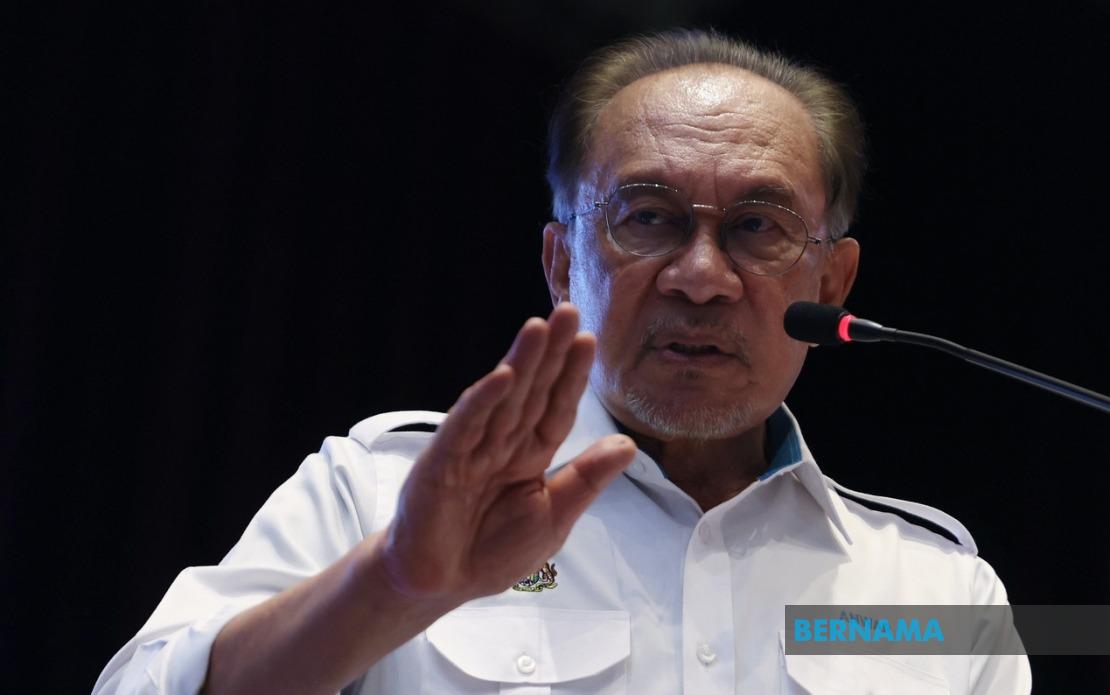
The Prime Minister's remarks were delivered during an official engagement with civil servants at the Public Works Department's Centre of Excellence for Engineering and Technology in Alor Gajah, where he was accompanied by Chief Secretary to the Government Tan Sri Shamsul Azri Abu Bakar. The presence of other senior officials, including Melaka Chief Minister Datuk Seri Ab Rauf Yusoh and Deputy Higher Education Minister Adam Adli Abd Halim, underscored the institutional weight behind his message. This official setting amplified the statement beyond immediate campaign politics, positioning it as a matter of governmental and constitutional principle rather than partisan positioning.
The incident highlights an important distinction in Malaysian political culture between legitimate policy disagreements and invocations of constitutional symbols. Political parties may vigorously contest policies, governance approaches, and electoral platforms without reference to royal institutions. However, when rhetoric begins to suggest criticism or commentary concerning the monarchy itself—whether explicitly or through implication—it crosses into territory that requires particular caution. Anwar's intervention essentially articulated this distinction for the benefit of all political contestants, reminding them that electoral competition operates within constitutional boundaries.
For voters and observers monitoring Malaysian politics, such interventions by the Prime Minister serve an educative function, reinforcing expectations about the acceptable scope of electoral discourse. In democracies where institutions remain robust and respected, political actors generally internalise such boundaries without requiring constant reminders. However, the regularity with which such clarifications must be issued suggests ongoing temptation among some political figures to transgress these boundaries for perceived electoral advantage. Anwar's statement attempts to raise the political cost of such transgressions by publicly articulating government expectations.
Looking forward, this episode may influence how political coalitions moderate their campaign rhetoric across various electoral contests in coming months. While competitive elections necessarily involve strong partisan messaging, the preservation of institutional respect remains a collective responsibility. Anwar's intervention, delivered with the authority of the Prime Minister's office, should serve as a cautionary signal to all parties that attempting to mobilise royal sentiments or criticise royal institutions for electoral purposes will encounter governmental and public disapproval. Such norms, when consistently reinforced, strengthen rather than constrain democratic practice by ensuring that electoral competition remains focused on policy and governance rather than constitutional fundamentals.