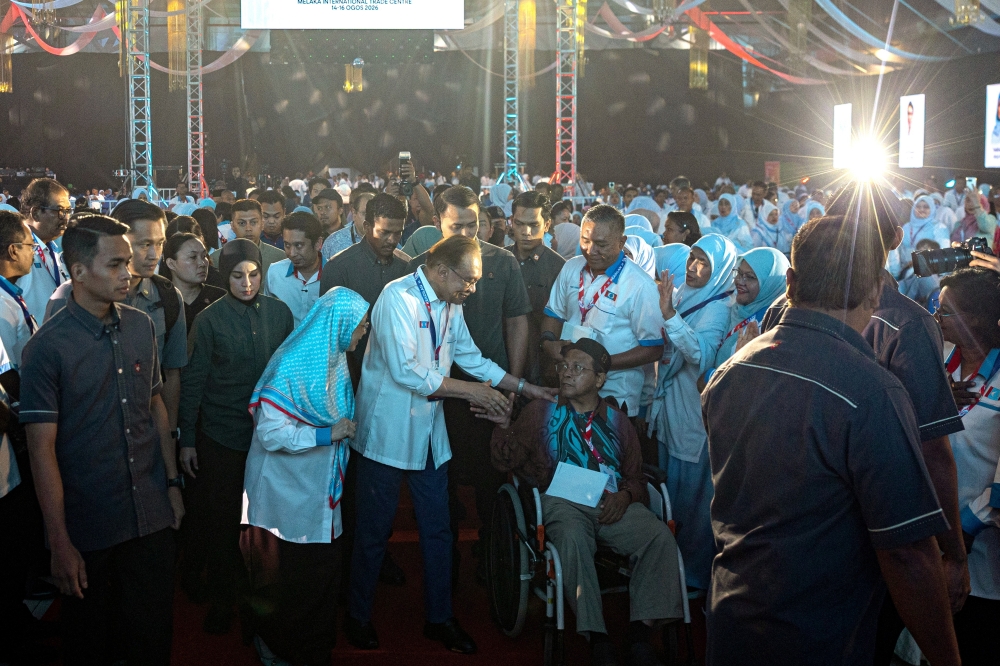
Prime Minister Datuk Seri Anwar Ibrahim has cautioned his PKR party that any future decisions involving Umno must be anchored in the interests of ordinary Malaysians rather than driven by lingering political hostility or partisan emotion. Speaking to party delegates gathered in Melaka, the PKR president struck a measured tone on the sensitive matter of the ruling coalition's composition, emphasising that rational governance must take precedence over historical grievances or electoral calculations rooted in anger.
This statement carries considerable weight within the Malaysian political landscape, where the relationship between PKR and Umno remains delicate and historically fraught. The two parties, despite their current partnership within the Pakatan Harapan and Barisan Nasional coalitions, have spent decades in bitter opposition. Their cooperation has been repeatedly tested by competing interests, differing ideological positions, and lingering distrust stemming from the dramatic events of recent years. Anwar's remarks suggest a recognition that sustainable governance requires moving beyond emotional responses to political developments.
The timing of these comments is significant, arriving at a moment when coalition politics in Malaysia continues to evolve unpredictably. Since the formation of the Madani administration, the delicate balancing act between different political factions has required constant calibration. The inclusion of Umno in government structures has remained controversial within segments of PKR and the broader Pakatan Harapan ecosystem, with many party members viewing the arrangement as a compromise with an adversary rather than a genuine alliance of shared principles.
Anwar's emphasis on people's welfare as the primary consideration for political decisions reflects a broader principle that political leaders should use as their lodestone. The PM appears to be positioning governance effectiveness and public benefit as the criteria through which coalition arrangements should be evaluated, rather than allowing historical animosity or internal party sentiments to dictate outcomes. This framework could potentially reshape how Malaysian political leaders approach cross-party cooperation, suggesting that pragmatism grounded in public service should supersede partisan loyalty.
The reference to avoiding decisions made "in anger" carries implicit recognition that Malaysian politics has often been driven by reactive rather than proactive thinking. Past coalitional breakdowns and political crises have frequently resulted from emotional responses to perceived slights or shifting factional interests. By explicitly warning against this pattern, Anwar appears to be advocating for a more institutionalised and rational approach to coalition management that prioritises institutional stability and policy delivery.
For PKR delegates, this message signals the party's commitment to maintaining the current coalition arrangement for as long as it serves broader societal interests. It also establishes a marker for how internal debates about political partnerships should be conducted within the party. Rather than allowing discussions to centre on resentment or historical wrongs, the focus should remain on whether continued cooperation delivers tangible benefits to Malaysian citizens through improved governance, economic performance, and social advancement.
The statement also implicitly addresses concerns among PKR membership who remain uncomfortable with Umno's presence in government. These delegates represent a constituency that fought against Umno for years and view the party as fundamentally opposed to their political vision. By appealing to rational assessment of governance outcomes, Anwar is essentially asking party members to evaluate the coalition based on results rather than ideology or historical identity.
From a Southeast Asian perspective, Malaysia's experience with coalition politics under pressure offers lessons relevant to other regional democracies navigating similar challenges. The region has seen numerous instances where coalitions have collapsed due to inability to manage inter-party tensions or failure to maintain focus on shared governance objectives. Anwar's approach of deliberately prioritising outcomes over emotions could serve as a model for how political leaders might stabilise fragile governing arrangements across Southeast Asia.
The practical implications of this philosophy extend to specific policy areas where PKR and Umno interests might diverge. Whether addressing economic distribution, religious and cultural issues, or federal-state relations, the PM's framework suggests that decisions should be made through cost-benefit analysis of public impact rather than through factional bargaining or ideological purity tests. This approach requires considerable maturity from coalition partners and a willingness to subordinate ego and historical grievance to collective responsibility.
Looking forward, Anwar's comments establish expectations for how coalition disputes should be handled within the government. Rather than allowing disagreements to spill into public recrimination or emotional declarations, the framework he has outlined suggests that differences should be resolved through discussion of measurable impacts on public welfare. This could theoretically strengthen coalition durability by providing agreed-upon criteria for resolving conflicts.
The effectiveness of this approach, however, depends on consistent application and genuine commitment from all coalition partners. PKR must demonstrate that it is indeed evaluating Umno's participation based on governance outcomes, while Umno must prove through policy delivery that its inclusion strengthens rather than weakens the administration. Both parties must resist the temptation to use coalition tensions as electoral fodder or opportunities for factional scoring.
Ultimately, Anwar's message reflects a maturing understanding that Malaysian democracy's stability depends less on perfect ideological alignment between partners and more on their shared commitment to responsible governance. By explicitly rejecting anger-driven decision-making and anchoring coalitional choices in public welfare, the PM has articulated a principle that could reshape how Malaysian politics approaches collaboration. Whether this vision can be sustained amid the pressures of electoral competition and factional interests remains the central question for Malaysia's political future.

