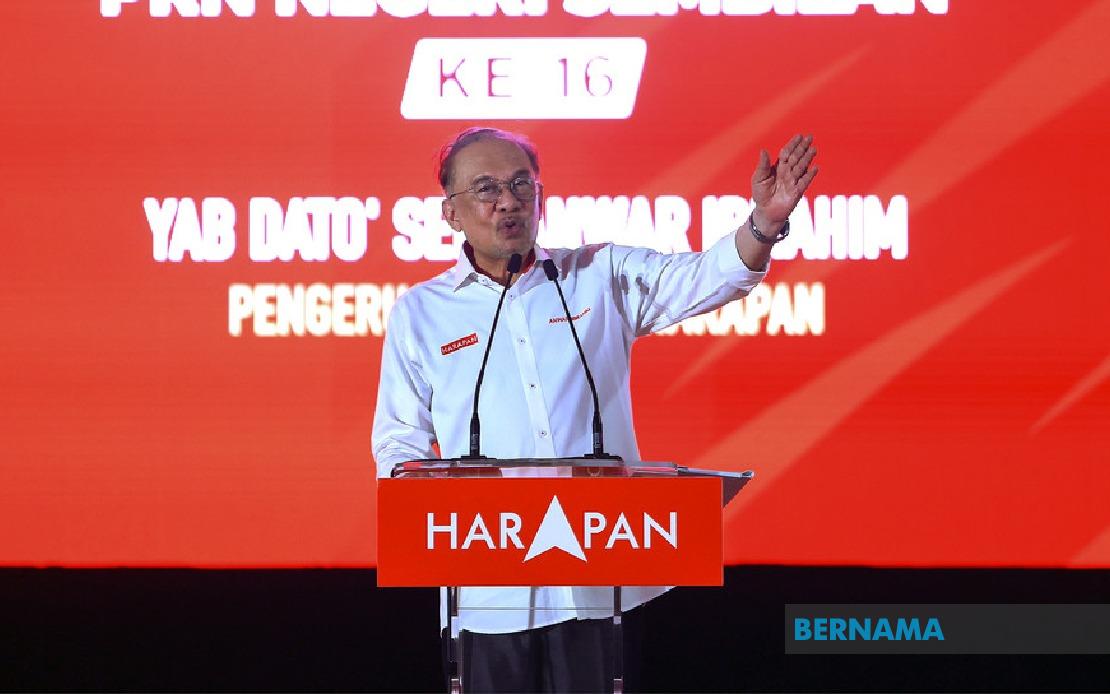
Prime Minister Datuk Seri Anwar Ibrahim has made a direct appeal to voters in Negeri Sembilan to sustain their backing for Pakatan Harapan in the forthcoming state election, arguing that electoral continuity is essential for preserving the momentum of ongoing development work. In remarks shared on social media ahead of the 16th Negeri Sembilan state election, Anwar stressed that the coalition's retention of power would guarantee the preservation of initiatives that have benefited residents across the state.
The Prime Minister, who also chairs the Pakatan Harapan coalition, emphasised the productive relationship that has emerged between state and federal administrations over recent years. This collaborative framework, he suggested, has created the institutional capacity and political alignment necessary to launch and sustain substantial infrastructure and development programmes. Anwar acknowledged, however, that considerable work remains outstanding and that interrupting this progress would undermine the long-term prosperity of Negeri Sembilan's communities.
Anwar's intervention is a significant show of personal political capital in support of Menteri Besar Datuk Seri Aminuddin Harun, whom he described in notably warm terms as leading the state with integrity, humility, and strong administrative responsibility. The appeal signals that the federal leadership views the Negeri Sembilan contest as a critical test of the coalition's electoral appeal in a state where Pakatan Harapan has governed since 2018. By framing the election explicitly around governance quality and programme continuity rather than partisan rhetoric, Anwar attempted to position the PH candidacy as the safer choice for voters concerned with stability.
For Malaysian observers, the timing and tone of Anwar's message reveals the underlying anxieties within the federal administration. State elections in Malaysia often serve as mid-term assessments of governing coalitions, and Negeri Sembilan presents an opportunity for the opposition to demonstrate momentum or for Pakatan Harapan to consolidate support. The emphasis on development delivery reflects a shift in political communication towards outcomes-based messaging, acknowledging that Malaysian voters increasingly judge parties on tangible improvements to infrastructure, services, and economic opportunity rather than ideological positioning alone.
The Negeri Sembilan contest also carries broader implications for the stability of Anwar's federal government. Pakatan Harapan's parliamentary majority remains mathematically vulnerable, with several MPs either from coalition partners whose commitment is conditional or from constituencies where political sentiment remains volatile. A strong performance in Negeri Sembilan would provide psychological reinforcement and demonstrate that the coalition retains electoral credibility beyond its urban strongholds. Conversely, territorial losses would embolden opposition parties and potentially trigger recalculations among coalition partners about their political future.
Aminuddin Harun's track record as Menteri Besar has been marked by relative stability compared to neighbouring states, and he has cultivated a reputation for low-profile, technically competent administration. This contrasts sharply with the turbulent leadership transitions and governance crises that have characterised other state governments. Anwar's commendation of Aminuddin's qualities—integrity, humility, and responsibility—appears designed to transfer this positive reputation onto the coalition brand and to suggest that re-election would preserve an island of good governance in an otherwise politically chaotic landscape.
The electoral calendar for Negeri Sembilan is now firmly established. Nominations will take place on Saturday, with early voting scheduled for July 28 and general polling on August 1. This compressed timeline means that campaigning will be intense and focused, leaving little opportunity for extended public debates or voter persuasion through extended discourse. Instead, parties will likely concentrate on mobilising their existing support bases while making targeted appeals to swing voters in marginal constituencies. The speed of the election cycle also advantages the incumbent administration, which can point to specific projects and achievements, whereas opposition parties must construct forward-looking narratives about alternative governance models.
For Southeast Asia more broadly, the Negeri Sembilan election reflects a region-wide pattern in which incumbent governments are increasingly emphasising development delivery and infrastructure investment as central to their political legitimacy. From Indonesia to Thailand to Vietnam, governing coalitions have attempted to offset political criticism through tangible improvements in public services and economic opportunity. This development-focused political narrative differs from earlier phases of democratic competition in the region, when ideological and ethnic-nationalist appeals dominated. The shift suggests that voters across Southeast Asia are becoming more sophisticated consumers of political messaging and more demanding in their expectations that governments translate electoral mandates into material improvements.
Anwar's appeal also underscores the personalised nature of Malaysian politics, in which prime ministerial endorsements carry substantial weight in state contests. The decision to issue a public appeal through social media rather than through formal party machinery signals confidence in his political standing and perhaps an attempt to demonstrate continued relevance and influence at a time when factional tensions within both Pakatan Harapan and the broader political system remain evident. The appeal's emphasis on trust—asking voters not to abandon the path already travelled—frames the election as a question of reliability and continuity rather than as an opportunity to punish the government for policy disagreements or administrative failings.
The broader context for this election includes ongoing concerns about economic management, inflation, and cost of living pressures that have characterised political discourse across Malaysia. While Anwar's message focuses on development project continuity, implicitly voters will also be assessing whether the state government's economic policies and fiscal management have adequately addressed household financial stress. If opposition parties can effectively translate generalised economic anxiety into electoral support, even a development-focused campaign by Pakatan Harapan may struggle to overcome underlying dissatisfaction. The election will therefore test not only voters' confidence in specific personalities and past achievements, but also their assessment of whether current governance has delivered equitable economic benefits.

