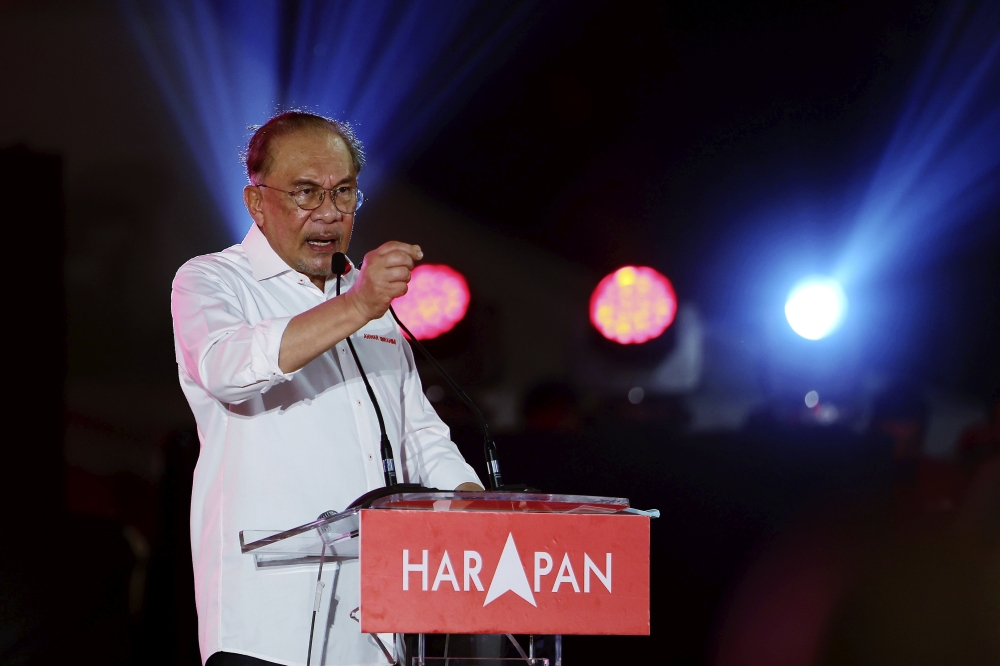
Prime Minister Datuk Seri Anwar Ibrahim made a direct appeal to the electorate of Negeri Sembilan on Tuesday, encouraging them to preserve the Pakatan Harapan coalition's political mandate as a prerequisite for maintaining momentum on development initiatives throughout the state. Addressing a gathering in Seremban, the capital, Anwar framed electoral support for his coalition as instrumental to ensuring that infrastructure projects, economic programmes, and social services remain on track without disruption caused by political transition or shifting administrations.
The timing of Anwar's remarks underscores growing recognition within ruling circles that voter sentiment in several states remains fluid, particularly in constituencies where Pakatan's parliamentary majority depends on steady coalition dynamics. Negeri Sembilan, a state with nine parliamentary seats, occupies strategic importance in the broader Malaysian electoral landscape. The prime minister's direct engagement with local voters signals that Kuala Lumpur is attuned to potential shifts in regional political preferences and is actively mobilising support through high-level presence.
Anwar's emphasis on development continuity reflects a core campaign strategy employed by governing coalitions worldwide: positioning incumbency as a guarantee of stability and progress. By connecting electoral mandates to tangible outcomes—completed highways, expanded water infrastructure, improved healthcare facilities—the prime minister taps into voter expectations that governance ought to deliver measurable improvements in daily life. This messaging becomes particularly potent in states like Negeri Sembilan, where population growth and urbanisation create demands for modernised public services and economic opportunities.
The appeal also carries implicit warnings about the risks of fragmentation. Should voters turn to opposition parties or splinter coalitions, Anwar suggests, development pipelines could face delays, funding uncertainties, or policy reversals. This argument assumes that voters are primarily concerned with material outcomes rather than ideological positions or grievances—an assumption that has proven broadly accurate in Malaysian electoral history, though not universally. The legitimacy of this framing depends significantly on whether Pakatan's tenure has indeed delivered visible improvements that residents can acknowledge.
Negeri Sembilan's political complexion has traditionally been contested, with the Pakatan coalition holding sway in several constituencies but facing competition in others. The state's demographic composition—blending urban centres with rural agricultural communities—creates diverse policy priorities that no single administration can entirely satisfy. Urban voters may prioritise transport connectivity and job creation, while rural constituents focus on agricultural support, commodity prices, and rural connectivity. Anwar's development-centred messaging attempts to appeal across these divides by arguing that sustained governance allows coordinated attention to disparate needs.
The prime minister's engagement in Negeri Sembilan also reflects broader coalition maintenance challenges. Within the Pakatan framework, tensions occasionally surface between component parties over seat allocations, policy emphasis, and credit-claiming. Visits by senior national leaders to state-level campaigns reinforce central authority and remind local parties that their electoral fate remains tied to the coalition's national performance and image. Anwar's presence thus serves both to mobilise voter support and to signal to coalition partners that party unity remains paramount.
Development projects mentioned in such appeals typically encompass infrastructure modernisation, employment initiatives, and public service enhancement. In Negeri Sembilan specifically, ongoing initiatives might include transportation corridors linking the state to the Klang Valley, expansion of industrial zones, healthcare facility upgrades, and educational infrastructure. These projects typically require sustained funding, coordinated planning across multiple agencies, and political continuity to navigate implementation challenges. Switching administrations could theoretically slow project advancement through shifts in priorities or funding allocation, though in practice Malaysian state governments often inherit and continue predecessors' major initiatives regardless of party affiliation.
The opposition's likely counter-argument would emphasise that change itself brings benefits—fresh perspectives, reduced corruption, or reoriented priorities toward underserved communities. Opposition parties typically argue that entrenched administrations become complacent or self-serving, and that electoral rotation serves accountability. Whether voters find such arguments persuasive depends on their assessment of current performance and their faith in opposition alternatives. Anwar's messaging implicitly assumes that continuity appeals more powerfully than change, at least among sufficient voter cohorts to secure victory.
From a Southeast Asian perspective, Malaysia's electoral dynamics reflect patterns visible across the region. Incumbent coalitions increasingly rely on development narratives to secure voter loyalty, particularly as urbanisation and rising education levels create electorates demanding accountability for tangible improvements. This strategy has proven effective in some contexts but has also triggered backlashes when promised development fails to materialise or when inequality persists despite headline growth figures. Anwar's Negeri Sembilan appeal thus participates in a broader regional conversation about whether development continuity or political renewal better serves constituent interests.
The prime minister's call represents standard practice in competitive democracies: senior leaders campaign actively to maintain electoral support and communicate policy achievements directly to voters. Whether such appeals prove decisive depends on numerous factors—local grievances, opposition momentum, intra-coalition tensions, and broader national sentiment regarding the government's overall performance. As Malaysian voters contemplate electoral choices, Anwar's argument that development requires continuity will compete with alternative visions offering change or reform. The outcome will reveal how voters weigh stability against transformation in their political calculus.

