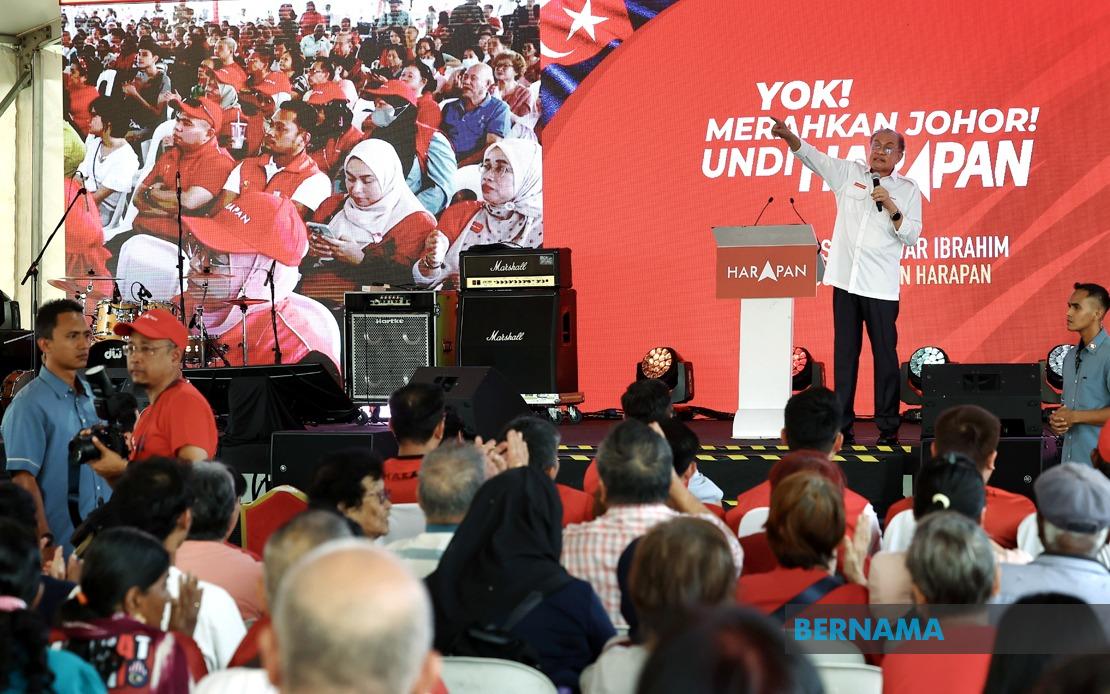
Prime Minister Datuk Seri Anwar Ibrahim has made an explicit appeal to candidates vying in the upcoming Johor state election to cease leveraging former Prime Minister Datuk Seri Najib Razak's imprisonment as a political weapon during their campaigns. Speaking at a Pakatan Harapan gathering in Kulai on July 10, Anwar struck a notably pragmatic tone, arguing that continued politicisation of Najib's incarceration represents a distraction from the substantive policy challenges facing the nation.
Anwar's remarks reflect an attempt to redirect electoral discourse away from personalised attacks rooted in past governance failures and towards forward-looking policy commitments. The timing of his intervention, delivered while campaigning in support of PH candidates preparing for the Johor election, suggests an awareness that excessive focus on Najib—despite the gravity of the 1MDB scandal—may undermine the coalition's ability to present a cohesive vision for economic recovery and social development. This calculation points to a maturing political strategy that recognises voter fatigue with retrospective blame-trading.
Central to Anwar's argument is the persistent financial burden imposed by the 1MDB crisis. The Prime Minister pointedly noted that the government currently carries a debt obligation of RM51 billion stemming from the 1MDB scandal, a sum that represents an enormous opportunity cost. Rather than allow this figure to become abstract campaign rhetoric, Anwar translated it into tangible social implications: schools that could be built, hospitals that could be expanded, infrastructure projects that could be completed, and direct assistance for impoverished communities that remains unfunded due to debt servicing obligations. This reframing grounds the legacy of Najib-era mismanagement in contemporary material hardship rather than historical recrimination.
The underlying message carries particular significance for Malaysian voters, who face persistent concerns about cost of living, educational quality, and healthcare accessibility. By connecting the 1MDB debt to constrained public spending, Anwar attempts to demonstrate how past corruption directly impairs current policymaking capacity. However, the appeal also contains an implicit recognition that voters may be more motivated by solutions to present economic difficulties than by revisiting past scandals. The distinction matters profoundly in electoral politics, where candidates must balance accountability narratives with forward momentum.
Anwar's insistence that "enough is enough" regarding Najib—a prisoner serving his sentence—suggests an effort to project statesmanship and judicial finality. By asserting that Najib is "now in prison," Anwar appears to argue that the legal system has run its course and further political invocation of the case represents either vindictiveness or evasion of more pressing governance challenges. This positioning may appeal to swing voters who view constant political warfare as exhausting and counterproductive, particularly in a state like Johor where coalition preferences have shifted in recent elections.
The campaign event brought together a cross-section of PH figures, including Youth and Sports Minister Mohammed Taufiq Johari, demonstrating the coalition's commitment to mobilising its machinery in this crucial state contest. The presence of PKR Youth chief Muhammad Kamil Abdul Munim and Bukit Batu candidate Arthur Chiong Sen Sern underscored the involvement of party grassroots in articulating this message, suggesting the directive to deprioritise Najib-focused attacks may carry internal party sanction.
From a regional perspective, Anwar's intervention reflects broader Southeast Asian patterns wherein younger administrations seek to transcend governance crises through forward-looking policy platforms rather than extended reckonings with predecessors. Yet the RM51 billion figure looms as inescapable evidence that such transitions cannot simply sidestep historical accountability. The challenge for PH lies in acknowledging past failings without allowing them to consume political space needed for addressing inflation, employment insecurity, and public service deficits.
For Malaysian voters, particularly in Johor, Anwar's message implicitly poses a choice between retributive politics and regenerative governance. By asking campaigners to abandon Najib-focused attacks, the Prime Minister signals confidence that PH's record on economic stabilisation and social spending justifies electoral support without requiring constant reference to the previous administration's failures. Whether this gambit succeeds depends largely on whether economic indicators and visible public goods delivery persuade voters that the government deserves continued mandate despite unresolved questions surrounding systemic reform and prosecutorial outcomes.
The Johor state election thus becomes a barometer not only of coalition strength but also of Malaysian voters' appetite for political maturation beyond scandal-driven discourse. Anwar's intervention suggests the PH leadership believes such maturation serves its electoral interests, a calculation rooted in evidence that prolonged focus on Najib may alienate centrist voters whose economic concerns supersede historical grievances. Whether this strategy will prove effective across Johor's diverse constituencies remains uncertain, but it reflects a deliberate reorientation of campaign priorities toward substantive policy differentiation.

