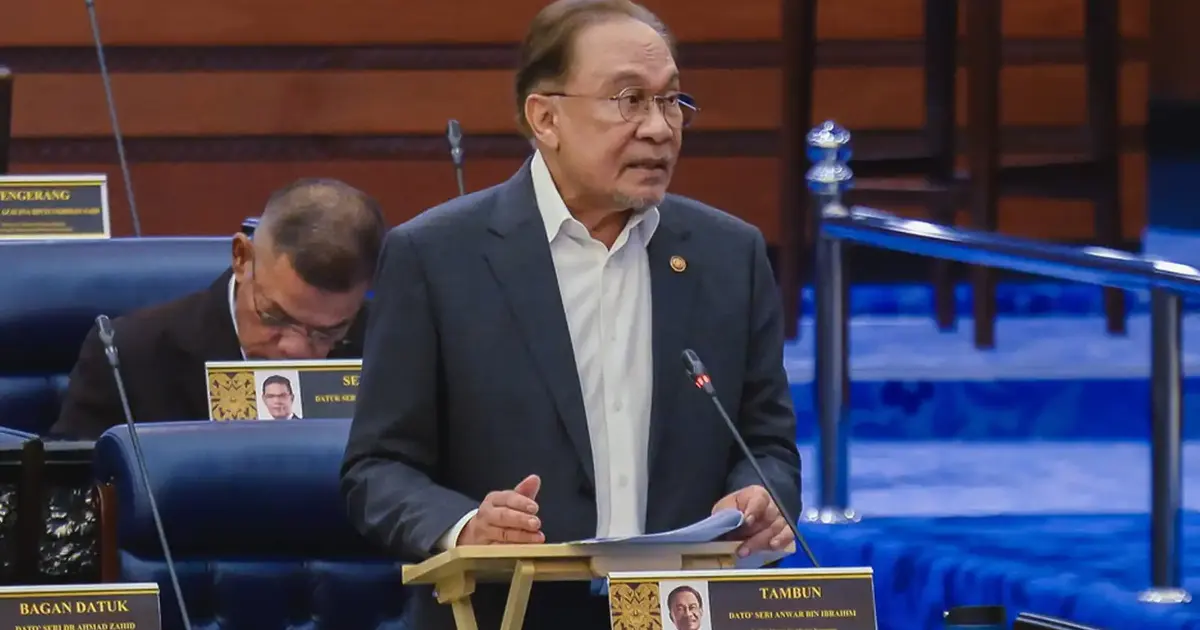
Prime Minister Anwar Ibrahim has drawn a clear line on federal responsibility, declaring that Putrajaya will not bear the financial burden when state governments face cost escalations on projects they have independently undertaken or sanctioned. The statement reflects a more disciplined approach to managing the nation's fiscal relationships between federal and state administrations, with significant implications for how development projects are planned and funded across Malaysia.
Anwar's position addresses a persistent tension in Malaysia's federal structure: the extent to which the central government should absorb unexpected expenses arising from state-level decisions. His remarks underscore a shift towards greater accountability at the state level, requiring regional administrators to exercise rigorous cost management and realistic budgeting from the outset. This stance has emerged as part of broader efforts to restore fiscal prudence following years of substantial deficits and mounting public debt.
The Prime Minister specifically emphasised that any requests for additional federal allocations or fresh loans to cover mounting project costs cannot be treated as automatic entitlements. Instead, such requests would require fresh negotiations that must account for the original terms, project specifications, and the circumstances that led to budget increases. This approach places the onus on state governments to justify why initial estimates proved inadequate and to demonstrate that enhanced allocations represent genuine necessity rather than poor planning.
The clarification arrives at a pivotal moment for Malaysia's development landscape. Multiple large-scale infrastructure projects conceived during previous administrations are now underway or entering critical phases, with some experiencing the familiar phenomenon of cost inflation. From transportation hubs to urban renewal initiatives, state governments have inherited or initiated ventures where budget assumptions made years ago may no longer reflect current economic realities, material costs, and labour rates. Anwar's statement effectively signals that states cannot simply pass these complications upstream to federal coffers.
For state administrators, particularly those in opposition-governed territories, the implications are substantial. Chief ministers and state exco members must now factor into their planning the reality that Putrajaya will scrutinise any supplementary funding requests with considerable rigour. This necessitates more conservative initial estimates, enhanced contingency planning, and realistic appraisals of project scope before commitments are made. States that proceed with insufficiently funded initiatives will face difficult choices: abandoning projects mid-stream, seeking private sector partnerships, or absorbing costs through reduced spending elsewhere.
The federal government's position also reflects lessons learned from past instances where projects ballooned in cost, creating pressure on federal finances and occasionally ensnaring Putrajaya in disputes over responsibility and accountability. By establishing clearer boundaries now, the administration aims to instil greater discipline across the entire project cycle, from conception through completion. This includes expectations that states conduct thorough feasibility studies, secure realistic quotations, and maintain adequate project management oversight.
From a Southeast Asian perspective, Malaysia's approach mirrors practices increasingly adopted by regional governments grappling with similar fiscal pressures. Countries across the region have confronted challenges when subnational units accumulate deficits or expect central governments to rescue poorly managed ventures. Anwar's position aligns Malaysia with international best practices emphasising fiscal responsibility at all governance levels and the principle that decision-makers must bear the consequences of their choices.
The statement also carries political dimensions. Opposition-ruled states may interpret the policy as potentially disadvantageous, fearing that Putrajaya might apply stricter scrutiny to their funding requests compared to federal territories or ruling-coalition states. Conversely, Anwar's administration can present the approach as evidence of principled governance, applying consistent standards regardless of partisan affiliation. The test of evenhandedness will lie in how this policy is implemented across different state administrations in coming months and years.
State governments that depend heavily on federal transfers and allocations face particular challenges under this new framework. Poorer states, in particular, may struggle to absorb unexpected cost increases without federal support, potentially leading to project deferrals or incomplete delivery of essential services. This dynamic may necessitate more sophisticated risk-sharing mechanisms or public-private partnership structures that distribute financial burdens more intelligently between public and private entities.
Looking forward, Anwar's declaration will likely reshape how states approach major infrastructure planning and tender processes. Procurement teams will face pressure to secure genuinely competitive bids and avoid awarding contracts to suppliers with weak delivery track records. State governments may also invest more heavily in project management expertise, employ tighter contractual provisions with developers, and implement more rigorous systems for tracking and controlling expenditures throughout project lifecycles.
The broader fiscal implications extend to Malaysia's medium-term economic outlook. By preventing federal budgets from being repeatedly raided to cover state cost overruns, the central government preserves flexibility for other priorities: investment in national infrastructure, debt management, and social spending. This disciplinary approach, if consistently applied, could gradually improve Malaysia's fiscal metrics and enhance the credibility of budget forecasts.
Anwar's statement ultimately reflects a philosophy that governance maturity requires accepting responsibility for one's decisions and avoiding moral hazard incentives that encourage reckless spending at subordinate levels. Whether this approach will transform state-level fiscal behaviour remains to be seen, but the message from Putrajaya is unmistakable: state governments must learn to live within realistic budgets, or face the consequences of their own miscalculations.

