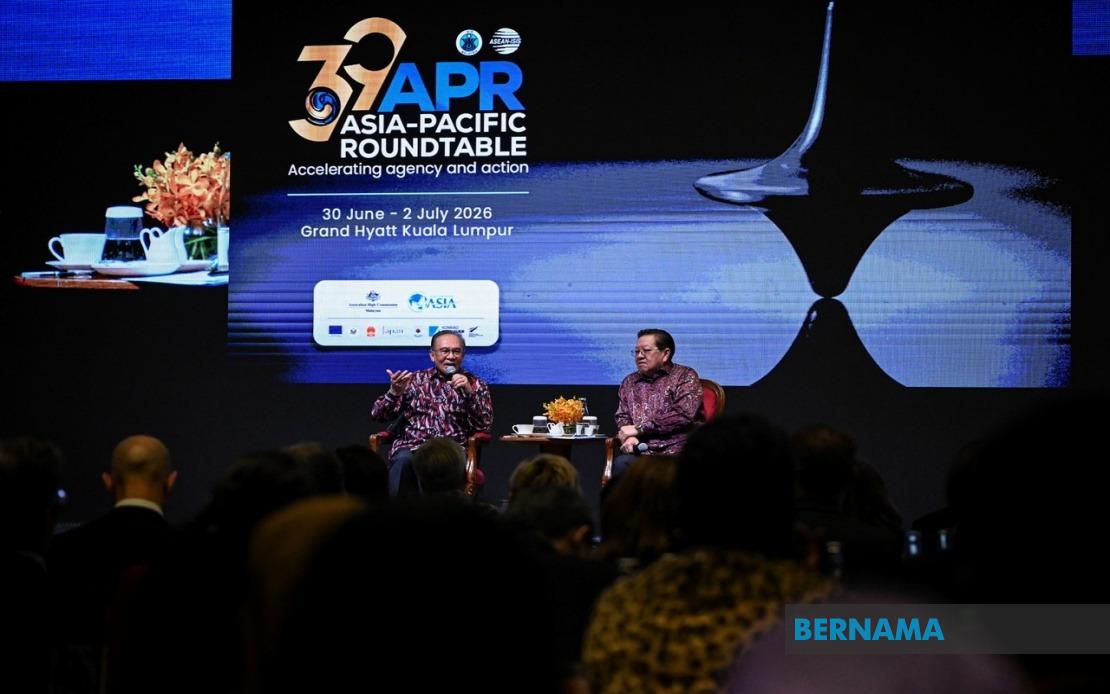
Prime Minister Datuk Seri Anwar Ibrahim has placed domestic governance reform at the centre of Malaysia's national agenda, arguing that any credible international engagement must rest on a foundation of strong institutions and transparent leadership at home. Speaking at the 39th Asia-Pacific Roundtable in Kuala Lumpur, Anwar outlined a vision where Malaysia demonstrates to the world that Muslim-majority democracies can successfully combine religious values with pluralism and democratic principles, a message with particular resonance as regional tensions continue to shape geopolitical conversations.
The Prime Minister identified four pillars underpinning his administration's domestic priorities: institutional strengthening, anti-corruption drives, economic redistribution to narrow wealth gaps, and universal access to education and healthcare. These commitments reflect a deliberate strategy to consolidate public confidence in governance structures, a crucial prerequisite for any government seeking to exercise soft power regionally or globally. Anwar's framing suggests that Malaysia's international credibility depends directly on demonstrating tangible progress on these domestic fronts, a calculation that resonates with how neighbouring countries and development partners assess governance capacity.
Central to Anwar's articulation was the distinction between Malaysia's willingness to engage international issues and the sequencing of priorities. Rather than positioning global advocacy as an immediate concern, he emphasised that the nation's energies must concentrate on building institutional capacity and addressing citizen welfare. This approach stands in contrast to the activism some observers might expect from a leader of Anwar's international stature and prior experience in global forums. The implicit message to both domestic constituencies and international audiences is that Malaysia's voice in regional and world affairs will carry greater weight once its internal foundations are consolidated.
An intellectual dimension to Anwar's remarks emerged through his invocation of Edward Said, the renowned Palestinian-American scholar. By characterising many global conflicts not as civilisational clashes but as products of mutual ignorance and prejudice, Anwar positioned understanding and education as antidotes to international tension. This framing has particular relevance for a nation like Malaysia, where narratives about religious and cultural difference can either inflame or moderate public sentiment. The Prime Minister's argument implies that investing in domestic education and cross-community understanding generates spillover benefits for regional stability.
The invocation of the Quranic concept of "li ta'arafu"—which translates roughly as "to know one another"—underscores Anwar's theological grounding for an approach emphasising appreciation over mere tolerance. This distinction matters substantively: tolerance implies passive acceptance, while appreciation suggests active engagement with difference. For Malaysia's multiracial and multireligious fabric, this philosophy offers a normative vision that moves beyond the transactional management of communal relations. The concept gains importance amid recurring episodes where political rhetoric has tested social cohesion, suggesting that institutional and spiritual frameworks for genuine intercommunal understanding remain works in progress.
The MADANI framework that Anwar referenced represents the government's overarching development blueprint, integrating technological progress with humanistic values. By emphasising this dual focus, the administration positions itself as neither rejecting modernity nor subordinating human dignity to technical advancement—a balance Southeast Asian societies increasingly seek. The framework's explicit inclusion of race, religion, and cultural appreciation signals that economic development divorced from social harmony would constitute failure in Malaysia's context. This holistic approach distinguishes Anwar's vision from purely technocratic governance models.
For the broader Southeast Asian context, Anwar's statement carries implications extending beyond Malaysia's borders. As the region navigates great power competition, internal polarisation, and rapid technological change, the Malaysian leader's emphasis on getting domestic governance right before projecting power internationally offers an implicit critique of approaches that prioritise geopolitical positioning over institutional integrity. Nations across the region grapple with similar tensions between international ambition and domestic consolidation, making his argument potentially influential in regional discourse.
The timing of these remarks at the Asia-Pacific Roundtable—a prestigious forum bringing together senior policymakers, academics, and strategic thinkers—suggests Anwar was directly addressing the international community's expectations of Malaysia. By clearly delineating that governance strengthening constitutes the primary responsibility, he manages expectations about Malaysia's immediate international activism while signalling long-term commitment to principled global engagement. This positioning allows Malaysia to maintain strategic autonomy without appearing isolationist or indifferent to regional challenges.
Corruption eradication emerges as particularly salient within this narrative. Southeast Asian nations have long struggled with perceptions of institutional capture and elite self-enrichment, undermining their soft power and development prospects. By elevating anti-corruption work to co-equal status with education and healthcare provision, Anwar signals that addressing these deep structural issues takes precedence over grand geopolitical statements. The implicit message is that a government cannot credibly champion democratic values internationally while tolerating endemic corruption at home.
The emphasis on inequality reduction reflects economic anxieties that cut across Malaysia's communal divisions. Rising cost of living, employment precarity, and wealth concentration have emerged as politically volatile issues, potentially more immediate to voters' concerns than international positioning. By explicitly committing to reducing inequality, Anwar frames governance reform not as an abstract institutional project but as delivering material improvements to ordinary Malaysians. This grounding in tangible outcomes distinguishes his governance agenda from purely rhetorical commitments.
Looking forward, the success of Anwar's governance agenda will shape not only Malaysia's domestic trajectory but also its regional influence. A government that demonstrably strengthens institutions, reduces corruption, and expands access to quality services builds the credibility to speak authoritatively on global issues. Conversely, if governance improvements prove elusive, Malaysia's international activism risks appearing hollow. This dynamic means that the domestic reform agenda and international positioning are fundamentally interconnected rather than sequential phases.
The Prime Minister's remarks ultimately reflect a sophisticated understanding that soft power flows from institutional strength and demonstrated commitment to principles. By centering governance reform as Malaysia's foremost responsibility, Anwar positions the nation not as a declining player seeking relevance through activism, but as a developing democracy consolidating its foundations for sustained influence. For Southeast Asian observers and Malaysia's international partners, this message suggests a government prioritising long-term credibility over short-term positioning—a calculus that could reshape how the region engages with contemporary challenges.

