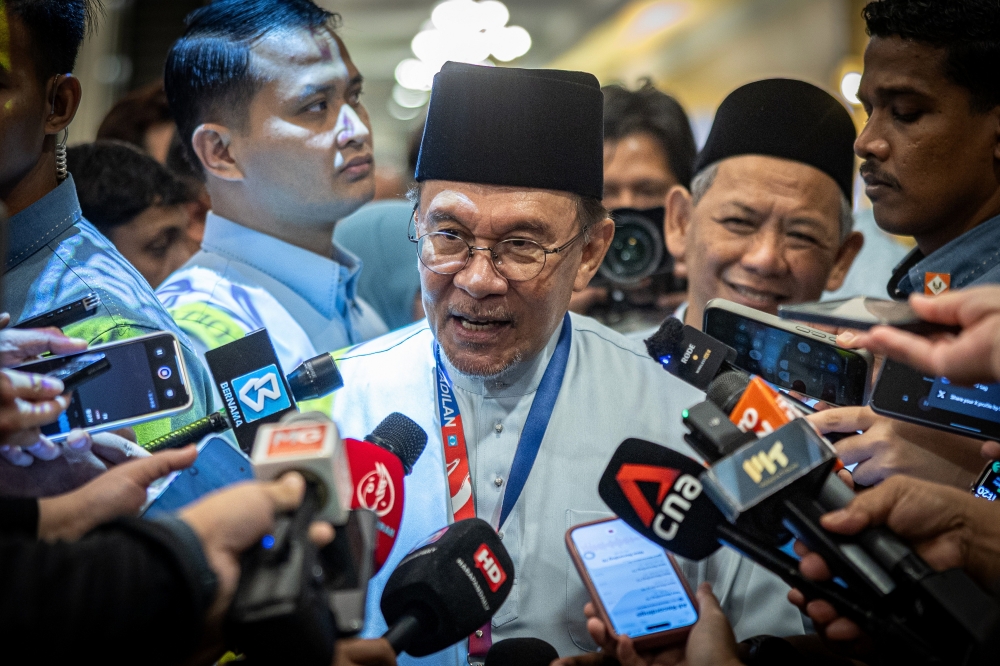
Prime Minister Datuk Seri Anwar Ibrahim has firmly pushed back against suggestions that tensions exist within his leadership circle, particularly regarding his relationship with Deputy Prime Minister Datuk Seri Zahid Hamidi. Speaking in Melaka, Anwar characterised his approach to governance as fundamentally rooted in peaceful resolution and institutional respect, signalling that speculation about fractious relationships between senior cabinet members misrepresents how his administration operates. His remarks came in response to recent comments by Minister Khairy Jamaluddin that had fuelled talk of discord at the apex of government.
The Prime Minister's statement carries significance beyond mere denial, reflecting a deliberate messaging strategy aimed at reassuring both the public and coalition partners that despite occasional policy disagreements, the ruling administration maintains structural stability. In the Malaysian political context, where perceptions of leadership unity directly influence investor confidence, currency stability, and electoral momentum, such clarifications serve a crucial stabilisation function. Anwar's emphasis on the "peaceful path" suggests an intentional contrast with historical periods of Malaysian governance marked by public acrimony and factional warfare within ruling coalitions.
Zahid Hamidi, who leads the United Malays National Organisation (UMNO), represents a substantial bloc of parliamentary support upon which Anwar's coalition government depends. The Deputy Prime Minister's position as second-in-command, combined with his party's significant parliamentary representation, means that any genuine deterioration in their working relationship would carry profound implications for government stability. Anwar's swift and direct rejection of rift narratives therefore addresses not only media speculation but also tacit concerns among coalition members about whether the administration can maintain cohesion through its term.
Khairy Jamaluddin's earlier comments, which functioned as the catalyst for Anwar's clarification, reflect the complex dynamics within Malaysia's multiethnic, multi-party coalition government. The Health Minister's remarks appear to have been interpreted by observers as suggesting underlying tensions, possibly stemming from differing approaches to policy implementation or coalition management. However, Anwar's response indicates that what might appear as disagreement at the ministerial level should be understood as the normal functioning of a cabinet system where ministers maintain distinct portfolios and occasionally divergent viewpoints.
The Malaysian political landscape has historically suffered from leadership crises rooted in genuine personal and ideological antagonism. Anwar's insistence on democratic and transparent dialogue mechanisms positions his administration as departing from those precedents. By framing governance disputes as issues to be resolved through conversation rather than confrontation or institutional maneuvering, he appeals to voter fatigue with the destabilising factional conflicts that have periodically convulsed Malaysian politics over recent decades.
The broader context for these remarks includes the delicate equilibrium Anwar maintains among his coalition partners. His administration represents a historically unprecedented alliance bringing together parties with competing interests and ideological orientations. Pakatan Harapan's core supporters, UMNO members, and representatives of smaller coalition partners do not always align on policy priorities. Yet sustaining government requires that such differences be managed within acceptable bounds rather than spilling into public confrontation that undermines collective credibility.
Anwar's emphasis on peaceful governance also resonates with his established personal narrative, which has incorporated themes of reconciliation and bridge-building following his previous political setbacks. His willingness to work alongside former rival Zahid represents a pragmatic political calculation but also aligns with rhetoric emphasising maturity and institutional responsibility. This positioning distinguishes his leadership from more adversarial political figures who might exploit factional tensions for personal advantage.
For regional observers, Anwar's stance reflects broader Southeast Asian trends toward coalition politics and consensus-building governance models. Unlike parliamentary systems with dominant single-party majorities, Malaysia's complex ethnic and religious composition has increasingly necessitated multiparty arrangements. The success or failure of these coalitions substantially influences regional stability and economic performance. Anwar's articulation of a commitment to internal harmony therefore carries implications extending beyond domestic Malaysian politics into ASEAN-wide considerations of regional stability.
The clarification also addresses international investor concerns about political stability. Malaysia's capital markets, currency valuations, and foreign direct investment flows respond sensitively to perceptions of governmental coherence. Public disputes suggesting leadership dysfunction trigger currency volatility and capital flight. Anwar's dismissal of rift claims, coupled with his reaffirmation of working relationships with key coalition figures, functions as a stabilisation signal directed toward international financial communities and trade partners.
Moving forward, Anwar's responses to such speculation will likely establish patterns for how his government addresses internal disagreements. Should he consistently frame policy differences as productive rather than destructive, and emphasise dialogue over confrontation, this approach may gradually reshape expectations about Malaysian coalition governance. However, sustaining this messaging requires that the administration actually deliver on promises of transparent decision-making and democratic consultation. Any perception that declarations of unity mask authoritarian cabinet control or exclusion of coalition partners would rapidly undermine credibility.
The significance of Anwar's Melaka remarks ultimately extends beyond rebuttal of individual speculation. His articulation of how his administration should operate—transparently, dialogically, and within democratic bounds—establishes benchmarks against which his government's actual performance will be measured. For Malaysian voters and regional observers, these statements represent commitments that shape expectations about the character of his leadership and the political culture his administration promotes.

