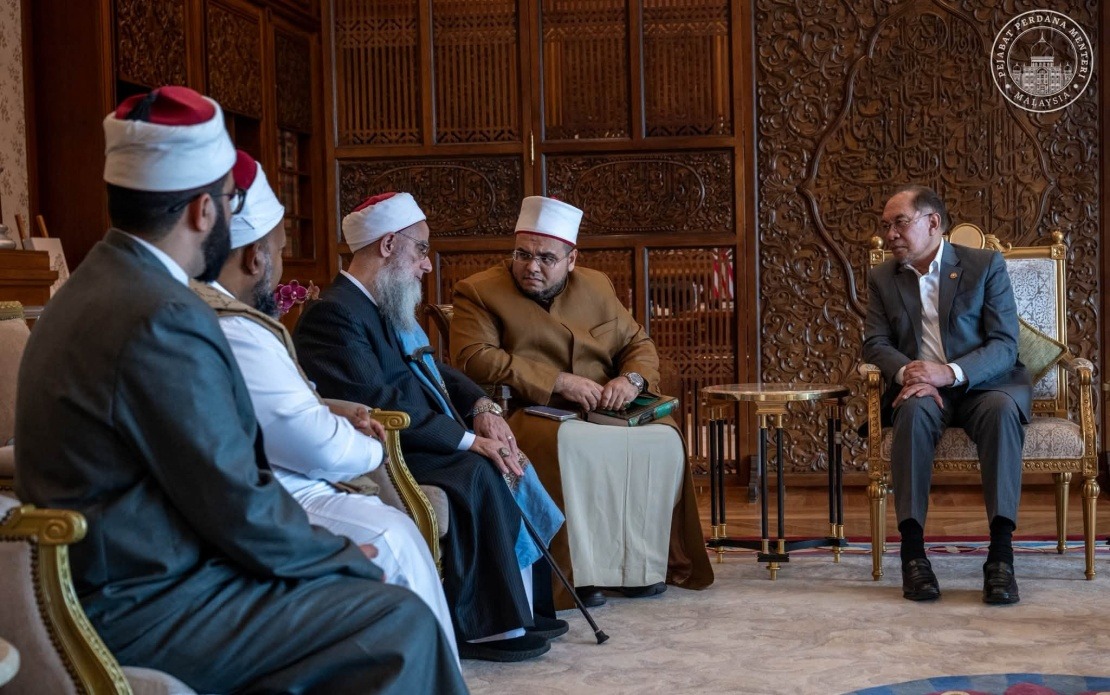
Prime Minister Datuk Seri Anwar Ibrahim received a visit from Sheikh Dr Mustafa An-Nadwi Al-Hasani Mansurah, a prominent Islamic scholar from Egypt, at his Putrajaya office on July 20. The encounter reflects Malaysia's continued engagement with influential Islamic thinkers and scholars from the broader Muslim world, underscoring the nation's positioning as a hub for interfaith dialogue and Islamic intellectual discourse in Southeast Asia.
Anwar took to social media to express his appreciation for the visiting scholar, highlighting Sheikh Dr Mustafa's credentials as a respected authority in Islamic studies with particular expertise in hadith—the recorded traditions and sayings of Prophet Muhammad. The Prime Minister's characterisation of the scholar emphasised not merely academic rigour but a holistic approach to learning that integrates moral and ethical dimensions, qualities he suggested were increasingly rare in contemporary discourse.
Sheikh Dr Mustafa's scholarly lineage carries considerable weight in Islamic circles. He represents a direct intellectual descent from Sheikh Abul Hasan Ali al-Nadwi, a twentieth-century Islamic scholar and preacher of international repute who influenced generations of Muslim thinkers and activists across Asia, the Middle East, and beyond. This connection positions the Egyptian scholar within a respected tradition of Islamic learning that emphasises balance, moderation, and the cultivation of character alongside intellectual development.
In his remarks, Anwar articulated a broader philosophical concern about contemporary society, suggesting that sensationalism and shallow engagement increasingly displace genuine learning and reflection. His observation about knowledge arriving "like the morning dew, quiet, gentle, yet capable of bringing life" reflects a poetic sensibility aligned with classical Islamic educational philosophy. This framing resonates with Malaysian audiences cognisant of concerns about information overload, social media-driven discourse, and the erosion of contemplative thinking in the digital age.
The visit coincided with Sheikh Dr Mustafa's broader engagement with Malaysian audiences during his time in the country. Beyond the formal meeting with the Prime Minister, the scholar conducted knowledge sessions aimed at addressing contemporary issues from an Islamic perspective. Such exchanges represent a form of soft power diplomacy, where Malaysia leverages its multicultural credentials and Islamic institutions to host and host international religious figures, thereby enhancing its standing as a moderate voice within the Muslim world.
Anwar's emphasis on exchanging views on current affairs suggests substantive discussion beyond ceremonial pleasantries. Given Malaysia's ongoing navigation of complex domestic political dynamics, questions of national unity, and regional tensions, the presence of internationally respected Islamic scholars offers valuable intellectual resource. The Prime Minister's openness to such engagements signals his administration's commitment to grounding policy considerations in broader Islamic thought and ethical frameworks.
Particularity noteworthy is Anwar's public request for Sheikh Dr Mustafa's prayers and counsel regarding Malaysia's unity and prosperity. This gesture acknowledges the symbolic authority religious scholars command in Muslim societies whilst simultaneously appealing to values of communal well-being that transcend partisan politics. In a nation where religious sentiment carries considerable weight in public discourse, such invocations carry real political significance beyond their spiritual dimensions.
The visit also illustrates the active networks through which Islamic intellectuals and political leaders across the Muslim-majority world maintain connection and dialogue. Egypt, as the Arab world's most populous nation and home to Al-Azhar University—one of Islam's most prestigious institutions—occupies a central position in these networks. Engagement with prominent Egyptian scholars signals Malaysia's aspiration to participate meaningfully in broader Islamic intellectual currents rather than remaining peripheral to discussions shaping Islamic thought.
For Malaysia specifically, such encounters reinforce the nation's carefully cultivated image as a moderate Islamic democracy capable of hosting diverse viewpoints whilst maintaining social cohesion. The Prime Minister's public recognition of the scholar's emphasis on wisdom and moderation aligns with Malaysia's diplomatic messaging, particularly as it navigates regional geopolitical complexities and addresses both domestic religious constituencies and international observers concerned about Islamic radicalism.
The exchange between Anwar and Sheikh Dr Mustafa also underscores the intellectual dimension of Islamic leadership in contemporary Malaysia. Rather than religion being confined to ceremonial roles or social welfare provision, the Prime Minister's engagement with advanced Islamic scholarship suggests a vision where Islamic intellectual traditions inform governance and policy deliberation. This approach appeals to educated Muslim constituencies whilst positioning Malaysia as intellectually serious about Islam rather than merely instrumentalising it for political purposes.
Moving forward, such visits may generate tangible outcomes including collaborative research, exchange of scholars, or joint initiatives addressing contemporary challenges from Islamic ethical perspectives. Malaysian universities and Islamic institutions could benefit from exposure to international expertise in fields ranging from Quranic studies to Islamic finance and bioethics. The relationship between Egypt and Malaysia in intellectual and religious spheres remains underdeveloped compared to their economic and diplomatic ties, suggesting significant untapped potential.
Ultimately, Anwar's reception of Sheikh Dr Mustafa reflects a broader Malaysian interest in anchoring the nation within global Islamic intellectual discourse whilst simultaneously demonstrating that Islamic engagement need not conflict with pluralism, moderation, or democratic values. In a region facing diverse security challenges and ideological pressures, such intellectual diplomacy serves as both a practical tool and a powerful symbol of Malaysia's commitment to representing a progressive, thoughtful Islamic perspective.

