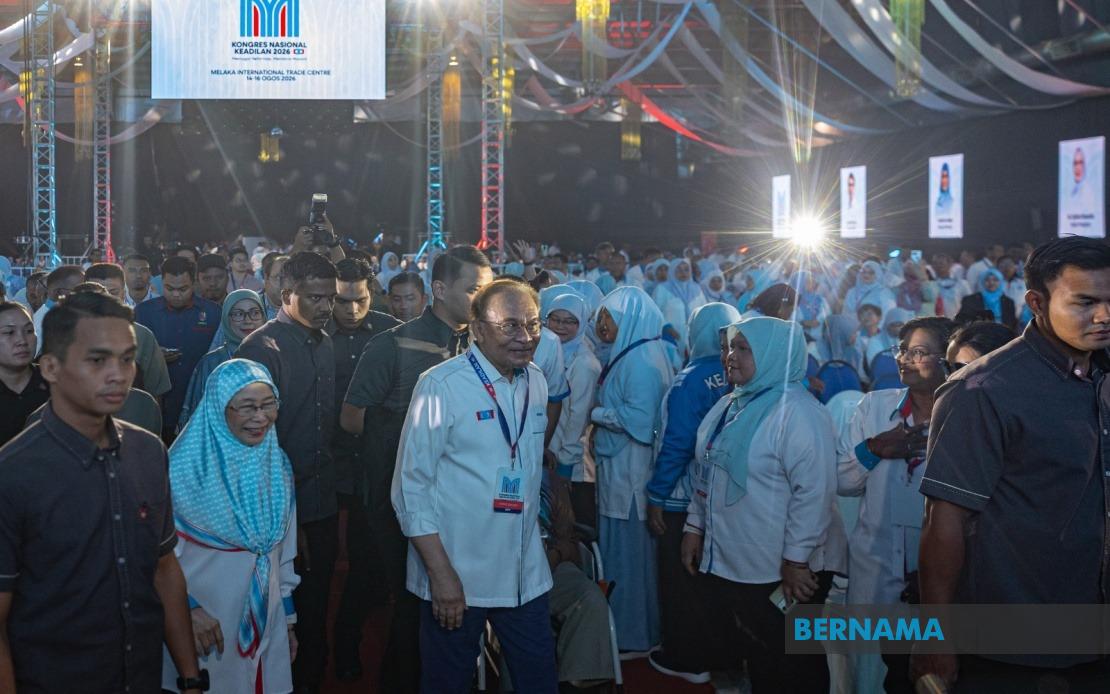
Prime Minister Datuk Seri Anwar Ibrahim has doubled down on his commitment to the Unity Government's partnership with UMNO-Barisan Nasional, signalling that preserving political stability and advancing the country's economic agenda will supersede internal party tensions. Speaking at the Parti Keadilan Rakyat National Congress 2026 in Melaka on August 16, Anwar emphasised that the coalition arrangement, despite recent friction, remains the optimal framework for delivering tangible improvements to Malaysians' living standards and prosperity.
The Prime Minister's remarks come at a delicate juncture for the multiparty government, which has weathered several political storms since its inception following the 2022 general election. Anwar's explicit defence of the UMNO-BN alliance suggests a calculated determination to shield the coalition from further destabilisation, even as voices within PKR and allied parties have occasionally questioned the wisdom of continuing the arrangement. By framing cooperation as a matter of national duty rather than convenience, Anwar sought to reposition the discussion around governance priorities and away from the personalised grievances that sometimes dominate Malaysian political discourse.
The timing of this statement carries significance for Malaysia's political trajectory. Regional observers have noted that coalition governments in Southeast Asia frequently fracture when partners prioritise narrow partisan interests over shared governance objectives. Anwar's intervention suggests an awareness that maintaining the current federal arrangement requires deliberate, sustained commitment from all coalition members, particularly PKR as the dominant party within the governing bloc. His emphasis on wisdom and careful deliberation signals to coalition partners that any dramatic shifts in political alignment would represent a calculated choice, not a reactive response to momentary controversies.
Anwar's insistence that political decisions must be grounded in national interest rather than personal ambition or factional anger reflects broader lessons from Malaysia's political history. The country has experienced multiple coalition realignments, some driven by legitimate policy disagreements but others precipitated by disputes over ministerial portfolios, personal rivalries, or perceived slights. By explicitly rejecting these drivers, Anwar positioned the Unity Government as fundamentally different in character—oriented toward outcomes rather than entitlements. This rhetorical move carries practical implications, as it establishes a benchmark against which coalition members can be measured in their conduct.
The sustainability of any multiparty government depends heavily on its constituent parties perceiving tangible benefits from continued participation. Within Malaysia's context, these benefits extend beyond ministerial positions to encompass policy influence, resource allocation to constituencies, and the ability to advance party-specific agendas within the broader governing framework. Anwar's emphasis on economic growth as a unifying principle suggests an attempt to shift the coalition's focus toward shared prosperity metrics—employment figures, wage improvements, business confidence—that transcend party boundaries and appeal directly to voters.
PKR's position within this coalition presents particular complexities. As the largest party in the federal government, PKR members harbour expectations of significant policy influence and senior appointments. However, the power-sharing arrangement necessitates substantial accommodation of UMNO-BN interests, which can generate frustration among PKR cadres who remember the party's decades in opposition and who view this period as an opportunity for more decisive leadership. Anwar's exhortation to party members to prioritise stability signals his awareness of these internal tensions and his determination to manage them through moral suasion and appeals to national duty.
For UMNO-BN, Anwar's reaffirmation of partnership provides reassurance after periods of uncertainty. Following decades of uncontested dominance, UMNO's reduced role in federal government represents a significant adjustment. The party's acceptance of this diminished position depends partly on confidence that coalition partners view the arrangement as permanent rather than expedient. Anwar's willingness to defend the partnership publicly strengthens UMNO's negotiating position on specific policy matters and resource distribution, as it clarifies that the Prime Minister perceives value in maintaining the relationship beyond the next electoral cycle.
The broader regional context amplifies the significance of Anwar's stance. Several Southeast Asian governments have collapsed or fractured recently due to coalition instability, generating economic uncertainty and policy paralysis. By publicly committing to coalition stability, Anwar sends signals to investors, international partners, and domestic businesses that Malaysia's political framework provides a reliable foundation for economic planning and investment. This stability dividend extends beyond sentiment to concrete outcomes—companies are more likely to commit to long-term operations and expansion in jurisdictions perceived as politically predictable.
Yet beneath Anwar's stability rhetoric lie genuine governance challenges. The Unity Government encompasses parties with distinct constituencies, policy preferences, and long-term visions for Malaysia. Managing these differences while delivering on economic promises requires constant negotiation and occasional compromise on fundamental issues. Anwar's framing of cooperation as a choice—"we choose to continue working with UMNO-BN"—suggests an element of active will rather than passive acceptance, acknowledging that maintaining the coalition demands deliberate effort and periodic recommitment.
The implications for Malaysian politics extend to the anticipated transition toward the next general election, likely within the next two to three years. Anwar's comments function partly as a signal to potential coalition partners, wavering party members, and the electorate that the current arrangement represents not a temporary expedient but a considered political choice rooted in governance principles. This positioning could prove crucial in negotiating post-election coalitions, as it establishes precedent for prioritising stability and broader national interest over narrow advantage.
Moving forward, the actual test of Anwar's commitment to Unity Government stability will emerge through concrete decisions on resource allocation, policy direction, and ministerial appointments. Coalition partners will assess whether stability rhetoric translates into genuine accommodation of their interests, or whether PKR's superior numbers gradually translate into de facto dominance that marginalises coalition partners. The success of Malaysia's multiparty experiment—and by extension, the credibility of Anwar's statement—ultimately depends on whether all partners perceive sufficient benefit from continued cooperation to outweigh the temptation of pursuing advantage through coalition realignment.

