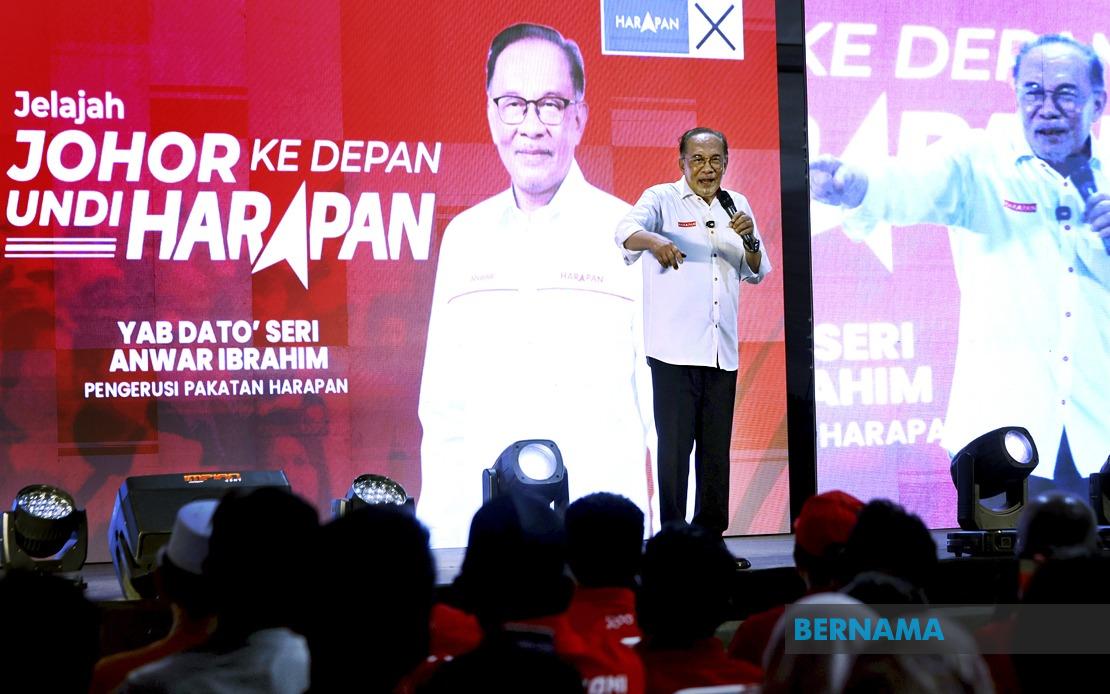
Prime Minister Datuk Seri Anwar Ibrahim has drawn a firm line under what he characterises as an era of systematic plunder and self-serving governance, signalling that the MADANI Government will tolerate no exceptions when pursuing anti-corruption objectives. Speaking at a campaign rally in Sungai Mati during the Johor State Election mobilisation, Anwar articulated a vision of leadership stripped of the transactional networks and patronage systems that have long characterised Malaysian politics, framing ethical conduct as the paramount criterion for public office regardless of ethnic or communal identity.
The Prime Minister's remarks struck at the heart of a recurring tension in Malaysian governance: the intersection of political identity and personal integrity. By explicitly stating his willingness to support capable and honest leaders from all communities while rejecting the corrupt regardless of background, Anwar positioned himself as advocating for a merit-based rather than identity-based political order. This framing carries particular significance in Johor, a state with a complex political history and significant Malay-Muslim demographic composition, where appeals to ethnic loyalty have historically shaped electoral behaviour. His insistence that voters should evaluate candidates on character rather than sectarian appeals represents a challenge to entrenched voting patterns that often prioritise communal solidarity over governance standards.
Central to Anwar's message was a stark indictment of the practice whereby political power has been instrumentalised for private accumulation. The practice of channelling state contracts toward family members, awarding tenders to spouses, or leveraging public office to enrich immediate associates constitutes what Anwar termed the "culture of plunder." This terminology echoes language long used by anti-corruption advocates and civil society observers to describe the systematic conversion of state resources into personal wealth. By elevating this framing into the Prime Minister's public discourse, Anwar signalled that dismantling such patronage networks represents a central governance priority rather than a peripheral concern.
The anti-corruption commitment extends beyond rhetorical flourish. Anwar provided an explicit guarantee that individuals found to have engaged in corrupt practices would receive no protection from the government during his administration. This assurance directly addresses longstanding anxieties within Malaysia's electorate regarding selective enforcement of anti-corruption laws and the perception that political connections insulate the privileged from accountability. The guarantee's significance lies partly in its unconditional character—Anwar did not hedge his commitment with qualifications regarding party membership, political loyalty, or factional affiliation, thereby theoretically creating exposure even for allies should they engage in misconduct.
The administrative dimension of Anwar's anti-corruption agenda involves systematic reform of Malaysia's bureaucratic infrastructure. Rather than pursuing isolated prosecutions, the Prime Minister emphasised the need to "clean up" entrenched systems, suggesting that institutional redesign and procedural reform represent necessary complements to individual accountability mechanisms. This systemic approach recognises that corruption often reflects structural incentives and institutional vulnerabilities rather than merely individual moral failings. Such thinking aligns with international best practice in anti-corruption work, which increasingly emphasises institutional strengthening alongside enforcement measures.
Anwar's comments arrived amid intensifying political contestation in the lead-up to the Johor State Election, where 172 candidates were positioned to contest 56 state assembly seats. The Prime Minister framed opposition attempts to generate political pressure as reflections of narrow personal agendas focused on reclaiming federal government control rather than genuine governance concerns. This rhetorical move simultaneously delegitimises opposition critiques while positioning the government as motivated by abstract principles rather than partisan advantage—a narrative that invites scrutiny regarding the selective application of anti-corruption resources.
The temporal context matters considerably. Malaysia's contemporary political landscape remains marked by unresolved corruption cases involving former administrations and ongoing investigations touching various political circles. Anwar's absolutist rhetoric regarding zero tolerance and protection establishes a yardstick against which his government's actual enforcement practices will inevitably be measured. The credibility of anti-corruption commitments ultimately hinges upon consistent application regardless of political convenience, a standard that has historically proven challenging for Malaysian administrations across the political spectrum.
The ethnic and communal dimensions of Anwar's appeal warrant careful attention. By emphasizing his openness to capable leaders from all backgrounds while maintaining uncompromising standards on integrity, he attempted to navigate between competing pressures: the desire to broaden his political coalition beyond traditional bases and the reality that Malaysia's electoral politics remain substantially organised along communal lines. His specific reference to welcoming honest Malay and Chinese leaders reflected an implicit acknowledgement that such assurances remain necessary to overcome voter hesitations rooted in identity-based political socialisation.
Johor's particular significance in this campaign reflected both symbolic and structural considerations. As a state with substantial Bumiputera demographics, historically competitive electoral dynamics, and strategic importance within the national political architecture, Johor outcomes carry implications extending beyond state-level governance. The concentration of campaign activity—Anwar completed fifteen engagements across two days, culminating in eight programmes on the single day referenced—underscored the government's assessment of Johor's importance for gauging broader electoral momentum.
The coherence between Anwar's anti-corruption messaging and the MADANI Government's broader governance agenda remains a focal point for Malaysian political analysis. Whether the administration can translate rhetorical commitments into sustained institutional change and consistent enforcement practices will significantly shape not only the credibility of contemporary Malaysian governance but also the trajectory of public confidence in state institutions during a period of substantial political flux and contested legitimacy narratives.

