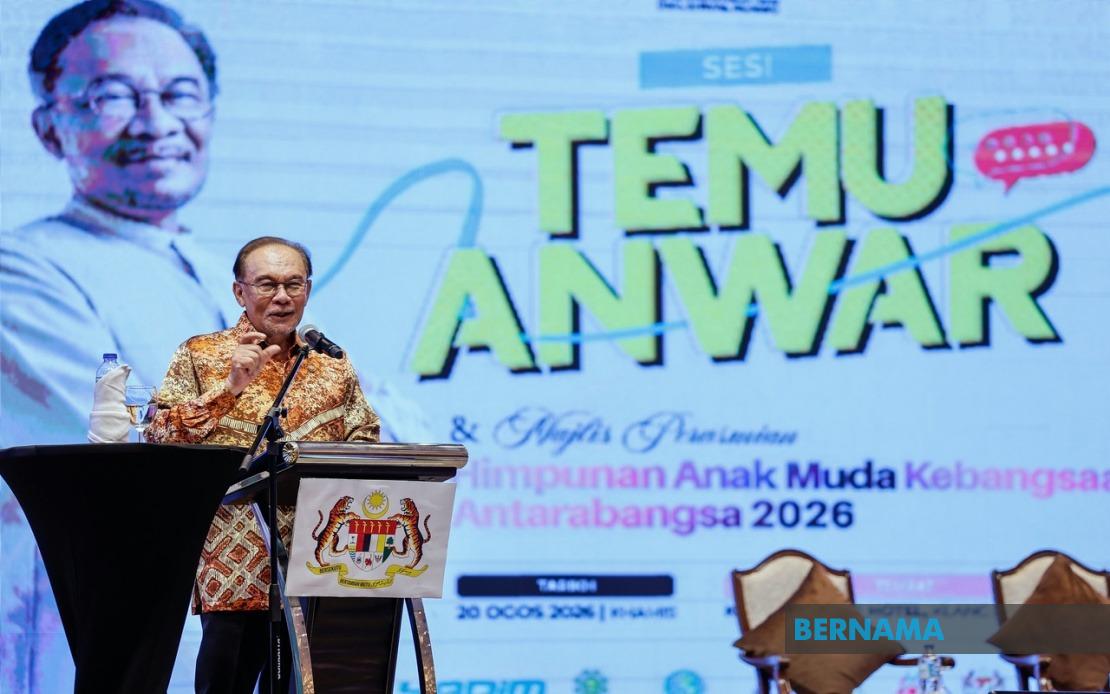
Prime Minister Datuk Seri Anwar Ibrahim has indicated that a sequence of major policy announcements will be rolled out across three key dates, beginning with the eve of National Day on August 30, followed by a Malaysia Day address in Kuching on September 16, and concluding with measures outlined during Budget tabling in early October. Speaking at a town hall session during the opening ceremony of Himpunan Anak Muda Antarabangsa (HAMKA) 2026 in Klang, the Prime Minister declined to elaborate on the specifics of these announcements but acknowledged their significance for the nation's direction.
The timing of these announcements appears deliberate, capitalising on major national occasions to communicate government initiatives directly to the public. By anchoring policy unveilings to National Day and Malaysia Day, the government reinforces these celebrations as moments of national renewal and progress. The staggered approach—spreading announcements across late August, mid-September, and early October—suggests a coordinated communications strategy designed to maintain sustained public attention and media coverage over a concentrated period.
The Prime Minister's remarks came in response to a youth participant's question regarding government efforts to protect workers in the gig economy, a sector that has grown substantially across Malaysia and the broader Southeast Asian region. This line of questioning reflects growing concerns among younger Malaysians about employment security, income stability, and social safety nets in an increasingly fragmented labour market where traditional full-time employment is becoming less common.
To address gig economy challenges, the government has already established the Malaysian Gig Economy Commission (SEGiM) and is developing fresh legislation focusing on small business protections. These initiatives represent an acknowledgment that existing labour frameworks, designed for earlier economic models, require updating to accommodate modern working arrangements. The creation of SEGiM specifically signals that gig work is no longer treated as a peripheral concern but rather as a structural feature of Malaysia's economy requiring dedicated institutional attention.
Anwar emphasised that despite ongoing debates about whether current support measures adequately serve gig economy participants, the government remains committed to enhancing protections for this workforce. The acknowledgment of criticism—that existing assistance falls short of actual needs—demonstrates openness to the reality that policy responses must evolve as employment patterns shift. This stance mirrors global conversations about balancing innovation and economic flexibility with worker protections, an increasingly critical issue for developing economies like Malaysia attracting technology-driven investment.
The Prime Minister also addressed youth entrepreneurship concerns, particularly regarding access to financing for graduates wishing to start businesses. He highlighted the National Entrepreneurial Group Economic Fund (TEKUN) as an existing mechanism available to aspiring young entrepreneurs, yet acknowledged structural barriers within the current application framework. Specifically, Anwar pointed to the requirement that applicants demonstrate prior business experience before qualifying for financing—a criterion that inherently disadvantages first-time entrepreneurs, typically younger individuals seeking initial capital.
This policy gap represents a tension between risk management and economic opportunity creation. Requiring a track record effectively locks newcomers out of traditional financing channels, potentially pushing them toward informal lending or discouraging entrepreneurial ambition altogether. By publicly acknowledging that this criterion requires reassessment, Anwar signalled willingness to recalibrate policies in light of evolving economic conditions and changing employment trends. Such flexibility is particularly important as Malaysia competes regionally for young talent and seeks to cultivate a dynamic entrepreneurial ecosystem.
The breadth of the Prime Minister's responses—spanning gig economy protections, entrepreneurial financing, and broader youth welfare—underscores recognition that Malaysia's younger generation faces compounding pressures distinct from earlier cohorts. Young Malaysians navigate a landscape characterised by higher education costs, competitive labour markets favouring specialised skills, housing affordability challenges, and greater income volatility. Government responsiveness to these realities, demonstrated through both existing programmes and willingness to revise frameworks, carries weight in maintaining public confidence among voters aged under 40.
From a regional perspective, Malaysia's approach to gig economy regulation and youth employment support carries implications for Southeast Asia more broadly. As countries like Thailand, Indonesia, and the Philippines grapple with similar workforce transformations, Malaysian policy developments—particularly institutional innovations like SEGiM—may serve as reference points for neighbouring governments. Malaysia's relative institutional maturity and resource capacity position it to pioneer frameworks that other regional economies may subsequently adapt.
Anwar's commitment to listen and incorporate feedback—repeated multiple times during his remarks—represents a strategic communication posture that extends beyond mere rhetoric. Youth-focused town halls like HAMKA provide platforms for direct engagement with constituency concerns, offering policymakers real-time insight into emerging issues affecting younger demographics. This bottom-up input mechanism, when genuinely integrated into decision-making, can yield policies that reflect actual lived experience rather than assumptions about youth priorities.
The government's apparent intent to announce significant measures across three separate occasions suggests that these initiatives may encompass distinct policy areas—possibly addressing gig economy protections in one announcement, fiscal or entrepreneurial measures in another, and broader economic direction during Budget tabling. This sequential revelation strategy allows each announcement to receive individual media and public attention rather than competing for focus if released simultaneously.
Ultimately, Anwar's statements reflect the government's recognition that maintaining youth engagement and support requires tangible policy adaptation, not merely symbolic gestures. The concrete focus on gig economy protections, entrepreneurial financing mechanisms, and welcoming of critical feedback suggests substantive policy work underway. The coming weeks will determine whether these announced measures deliver meaningful improvements for Malaysia's younger workers and entrepreneurs, or whether they prove incremental adjustments to fundamentally inadequate frameworks.

