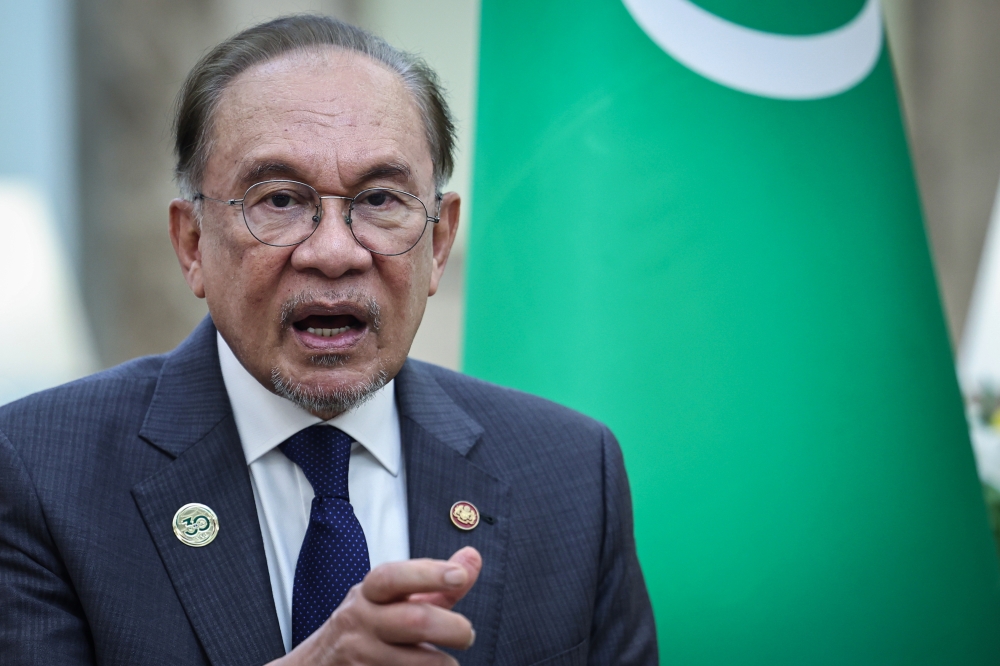
Prime Minister Datuk Seri Anwar Ibrahim has expressed profound sorrow at the death of Professor John L. Esposito, one of the Western world's most influential scholars of Islam, whose decades-long career fundamentally shaped how non-Muslims understand Islamic civilization and contemporary Muslim societies. The Prime Minister's statement underscores the deep intellectual connections that exist between Malaysia's leadership and prominent figures in Islamic studies who have dedicated their lives to fostering cross-cultural dialogue.
Esposito, whose scholarly work spanned several decades from leading universities in North America, became renowned for his nuanced and sympathetic approach to understanding Islam beyond stereotypes and political rhetoric. His extensive publications, including seminal works examining the relationship between Islam and democracy, Islam and politics, and the diversity within Muslim-majority societies, established him as an essential voice in bridging conceptual gaps between Eastern and Western perspectives. For many policymakers and intellectuals in Muslim-majority nations, Esposito's scholarship provided crucial counterarguments to Orientalist narratives that had long dominated Western academic circles.
The Prime Minister's characterization of Esposito as a "true friend to the Muslim world" reflects how scholars of his caliber have gained influence and affection across Islamic societies through their principled commitment to accuracy, fairness, and intellectual integrity. Anwar's tribute acknowledges that genuine understanding between civilizations does not emerge from political rhetoric alone but requires patient scholarly work that demands rigorous engagement with primary sources, historical context, and the lived experiences of Muslim communities. This recognition carries particular significance given Malaysia's own aspirations to position itself as a bridge nation facilitating dialogue between different religious and cultural traditions.
Esposito's most impactful contribution may have been his systematic dismantling of the notion that Islam and democracy are inherently incompatible—a thesis that gained currency in certain Western policy circles, particularly following geopolitical upheavals in the Middle East. Through careful historical analysis and contemporary case studies, Esposito demonstrated that Islamic and democratic values could coexist and that many Muslims actively sought to establish governance systems that honored both Islamic principles and democratic participation. This scholarship proved invaluable for Muslim-majority nations attempting to develop political frameworks that reflected their societies' values while navigating international expectations and domestic diversity.
Beyond his academic output, Esposito distinguished himself through his dedication to interfaith initiatives and his willingness to engage in public intellectual discourse on contentious topics. He participated in high-level dialogues, contributed to policy discussions, and served as an educator whose teaching influence extended far beyond traditional classroom settings. His work established template frameworks for how non-Muslim scholars could approach Islamic civilization with respect while maintaining critical scholarly standards—a balance notoriously difficult to achieve in polarized contexts.
For Malaysia specifically, Esposito's death represents a loss to the intellectual infrastructure supporting constructive Muslim-Western engagement. The country has increasingly sought to position itself as a moderate voice within the Muslim world, and scholars like Esposito provided validation for the compatibility between Islamic faith and progressive governance, pluralistic societies, and interfaith cooperation. His research and public statements repeatedly affirmed that Muslim-majority democracies were not anomalies but represented authentic expressions of how Islamic communities could organize themselves.
The Prime Minister's tribute also illuminates how Malaysia's political leadership continues to value international intellectual partnerships, particularly with figures who have used their platforms to counteract harmful misconceptions about Islam. In an era when misinformation about Muslim societies spreads rapidly through digital channels, the passing of scholars who built their reputations on meticulous research and fair-minded analysis leaves a void in the institutional memory of credible Islamic scholarship within Western academia.
Esposito's legacy extends to the numerous students, researchers, and policymakers whose thinking he influenced across multiple continents. His institutional affiliations and collaborative networks created lasting structures for sustained intellectual engagement between Muslim and Western scholars. Many contemporary specialists in Islamic studies were directly or indirectly shaped by his methodological approaches and his insistence on centering Muslim voices in discussions about their own societies and religions.
The passing of such figures raises important questions about how Malaysia and other Muslim-majority nations can cultivate and support intellectual voices within their own academic systems that might achieve equivalent influence in shaping global discourse. While Esposito's contributions were invaluable precisely because they came from outside the Muslim world and thus carried particular persuasive weight in Western contexts, the sustainability of positive Muslim-Western relations ultimately depends on Muslim societies developing their own robust intellectual traditions capable of engaging in sophisticated dialogue with global academic communities.
Anwar's public mourning reflects broader recognition across the Islamic world that intellectual figures like Esposito served as crucial intermediaries during periods of heightened tensions and misunderstandings. His passing marks the end of an era when a single scholar's comprehensive body of work could achieve such widespread influence in shaping policy discussions and public understanding. The challenge ahead lies in identifying and nurturing new scholars capable of carrying forward the work of building genuine intercultural understanding grounded in scholarly rigor and genuine respect for the traditions being studied.

