Prime Minister Datuk Seri Anwar Ibrahim has committed to amending the Tabung Haji Act 1995 as part of a broader initiative to reinforce institutional integrity within Malaysia's public sector. Speaking in his capacity as both Prime Minister and Finance Minister, Anwar described the legislative change as a critical safeguard to preserve the confidence that Malaysian Muslims place in one of the nation's most significant trust institutions. The move reflects the MADANI Government's stated determination to tackle weaknesses in institutional frameworks that have accumulated over decades of governance.
The Tabung Haji, formally established under the 1995 Act, manages the savings and pilgrim funds of millions of Malaysian Muslims and serves as a crucial financial mechanism for facilitating Hajj journeys to Mecca. The institution's role extends beyond religious significance into economic territory, as it mobilizes substantial capital that influences Malaysia's broader financial ecosystem. By signalling amendments to its governing legislation, Anwar has positioned the initiative as an accountability measure rather than a fundamental restructuring, suggesting that the government views existing legal provisions as insufficient for contemporary governance standards.
While Anwar did not elaborate on specific amendments during his statement, the emphasis on safeguarding trust implies that the government intends to address vulnerabilities or gaps in regulatory oversight. This approach carries particular weight given historical controversies surrounding Tabung Haji's financial performance and management decisions that have occasionally drawn scrutiny. For Malaysian Muslims who represent approximately 70 percent of the population, assurances about institutional protection carry substantial political and social resonance, extending beyond financial considerations to questions of faith-based institutional autonomy and religious community welfare.
Paralleling the Tabung Haji amendment, Anwar announced an equally significant proposal to completely repeal the Universities and University Colleges Act 1971, or AUKU, without replacing it with successor legislation. This declaration represents a dramatic shift in higher education governance, as AUKU has historically served as the statutory framework regulating Malaysian universities and controlling student political activism. The Prime Minister's insistence that no replacement law should maintain restrictions on student expression signals a deliberate move toward liberalizing campus political discourse, a priority that has gained momentum within reform-oriented political circles over the past decade.
The AUKU repeal carries implications far beyond university campuses. Student movements have historically functioned as catalysts for broader democratic participation and social change across Southeast Asia, and Malaysia's restrictions under AUKU have been cited by civil society organizations as impediments to youth political engagement. By removing this legislation entirely without substitution, Anwar is essentially placing faith in institutional self-regulation rather than legislative constraint, a philosophical position that underscores the MADANI Government's broader positioning as a reform administration that prioritizes trust and individual agency over command-and-control structures.
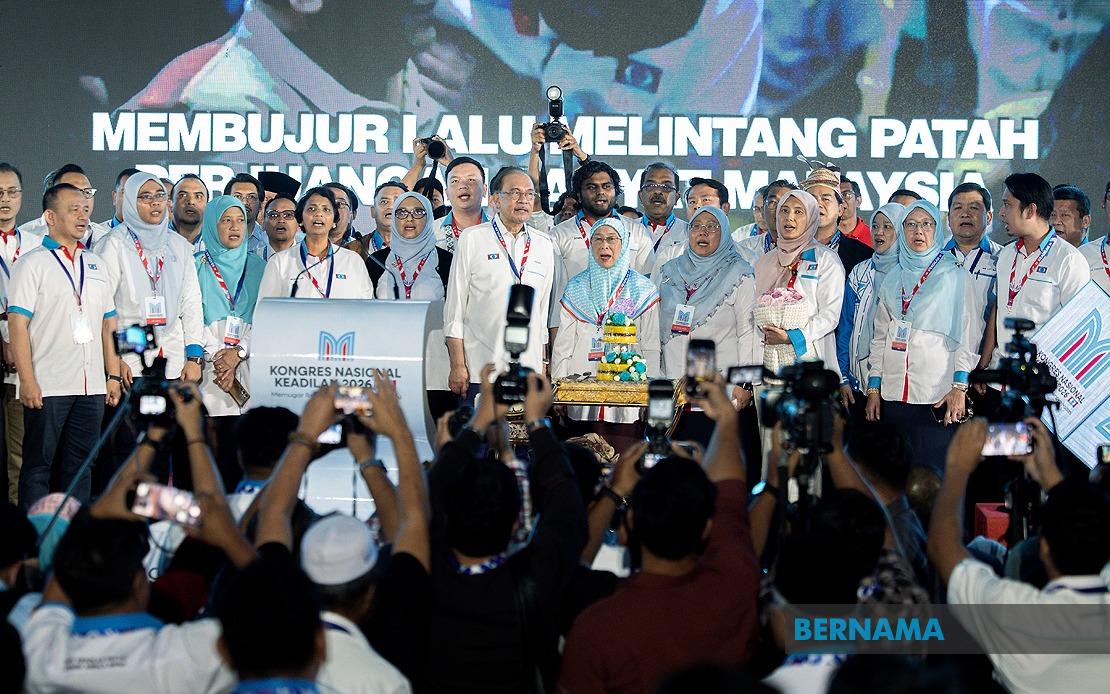
These governance announcements emerged during the 2026 Parti Keadilan Rakyat National Congress, where Anwar, serving as PKR president, articulated the party's foundational philosophy. He emphasized that PKR has deliberately selected an ideological path centered on principles and courage, rejecting the temptation to compromise reform commitments in order to consolidate political power. This framing suggests that the Tabung Haji and AUKU initiatives should be understood not as isolated administrative reforms but as expressions of a governing philosophy that prioritizes institutional renewal as essential to democratic legitimacy.
Anwar also addressed the question of how the government distributes resources and attention across politically diverse landscapes, explicitly stating that opposition-led states deserve equivalent government support and investment as those controlled by the ruling coalition. This statement carries particular relevance for Malaysian federalism, where historical patterns have sometimes resulted in resource allocation favoring coalition-controlled territories. By publicly committing to needs-based rather than partisan distribution of government services, Anwar is attempting to redefine the relationship between national government and subnational political entities, potentially establishing a precedent that transcends immediate electoral calculations.
The emphasis on translating economic growth into improved quality of life for all citizens regardless of political affiliation or geographic location reflects a governance model that seeks to separate development outcomes from partisan identity. For Malaysia's diverse population encompassing multiple ethnic and religious communities across different states, such a commitment addresses longstanding concerns about equitable resource distribution and whether national prosperity benefits are shared inclusively. The framing also suggests that the MADANI Government views its legitimacy as contingent on delivering tangible improvements in living standards rather than primarily on factional loyalty or electoral dominance.
With respect to PKR specifically, Anwar articulated a vision of the party as a platform for cross-ethnic, cross-religious, and cross-regional struggle for justice and reform. He stressed that party strength should not become an instrument for personal enrichment, family advancement, or patronage networks, but rather a mechanism for advancing collective Malaysian interests. This rhetoric, while appearing aspirational in nature, addresses persistent critiques that Malaysian political parties frequently become vehicles for individual accumulation of power and resources rather than genuine ideological commitment.
The interconnection between these governance initiatives—the Tabung Haji amendment, the AUKU repeal, resource allocation fairness, and party institutional philosophy—reveals a government attempting to construct coherent narrative around institutional renewal and trust restoration. However, the practical implementation of these commitments will ultimately determine whether they represent meaningful transformation or rhetorical positioning. For Malaysian observers and the broader Southeast Asian region, the extent to which these promised reforms actually materialize will provide crucial indicators about the MADANI Government's capacity to translate reform rhetoric into institutional practice.

