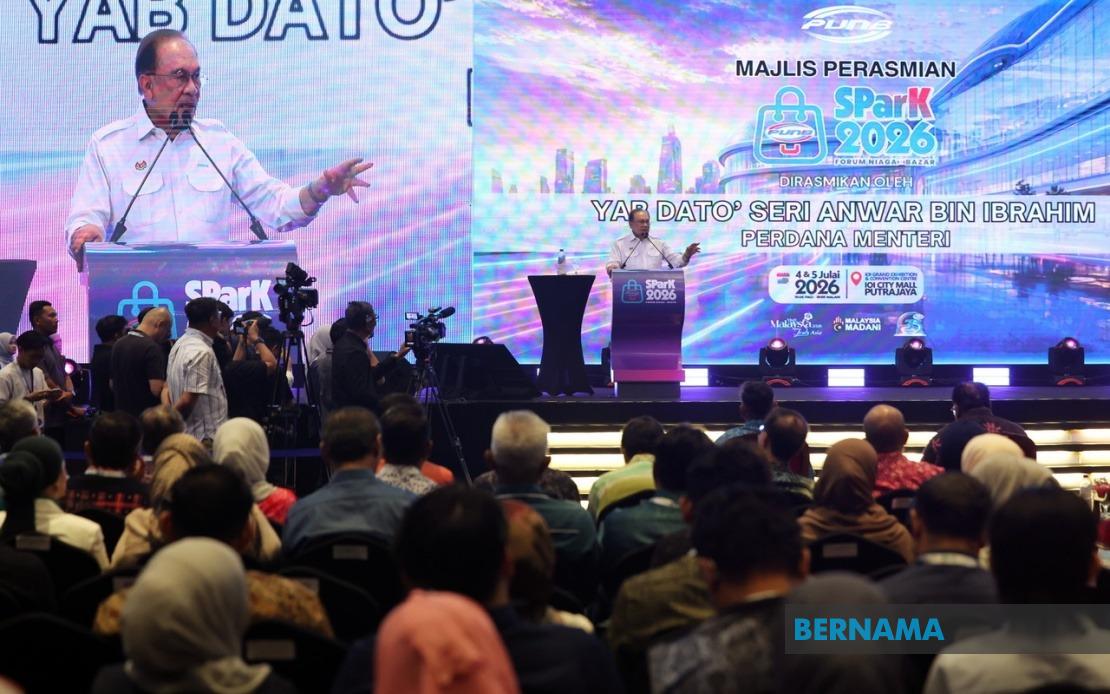
Prime Minister Datuk Seri Anwar Ibrahim launched a strong critique against the entrenched system of using political backing and support letters to approve business financing, declaring that this long-standing practice must cease immediately. Speaking at the SPaRK 2026 event organised by Perbadanan Ushanan Nasional Bhd (PUNB) in Putrajaya, Anwar, who also holds the Finance Minister portfolio, framed the issue as a structural problem that has corroded the effectiveness of government economic support mechanisms and contributed significantly to entrepreneurial failure rates across Malaysia.
The Prime Minister identified the root of the problem as a systemic reliance on informal channels and personal connections rather than objective merit-based criteria. He pointed out that loans and grants have historically been distributed based on proximity to decision-makers or endorsements bearing various political colours, a practice he characterised as destructive to the nation's economic development objectives. This approach, he argued, essentially masked the failure of government agencies to properly evaluate loan applications, shifting responsibility away from institutional accountability and towards individual gatekeepers with vested interests.
Anwar drew attention to the distinction between legitimate business failures and those attributable to misallocation of resources. While acknowledging that market forces and economic conditions inevitably result in some business closures, he stressed that the government could not accept losses stemming from the misuse of public funds through poorly vetted lending decisions. This nuanced position recognises the inherent risks of entrepreneurship while simultaneously demanding greater rigour in how state resources are deployed to support new ventures.
The Prime Minister cited documented cases illustrating the scale of the problem, describing instances where recipients of government assistance used funds for lifestyle enhancement rather than genuine business development. Examples included relocating offices to more prestigious locations and purchasing vehicles—expenditures that prioritised appearances over operational sustainability. These outcomes, occurring before the businesses eventually collapsed, exemplified how inadequate screening mechanisms allowed unsuitable recipients to access public money that could have supported genuinely committed entrepreneurs.
Central to Anwar's message is the principle that government assistance should flow exclusively to individuals demonstrating both serious entrepreneurial intent and demonstrable business capability. He framed this as a matter of basic governance responsibility, emphasising that transparency and genuine commitment must become non-negotiable prerequisites for accessing state-backed financing. This shift would represent a significant departure from decades of practice where political and personal considerations often outweighed business fundamentals in lending decisions.
The implications of this stance extend beyond simple loan management reform. By directly challenging the machinery of political patronage embedded in business financing, Anwar is signalling an attempt to depoliticise resource allocation in a manner that could reshape the entire entrepreneurship support ecosystem. However, such reform faces substantial institutional resistance, as vested interests in the current system—spanning multiple political levels and bureaucratic tiers—would resist more stringent evaluation processes that limit their influence over fund distribution.
For Malaysian entrepreneurs, the announcement suggests potential long-term benefits if implemented rigorously. Fairer access to financing based on business merit rather than political connections could improve capital allocation efficiency and create more competitive conditions for entry into government-supported schemes. Conversely, those accustomed to leveraging political networks may experience considerable disruption, potentially triggering resistance that could slow or dilute implementation efforts.
The broader economic context reinforces the urgency of Anwar's message. Malaysia's entrepreneurship development has historically relied heavily on state support mechanisms, yet productivity and survival rates of government-backed ventures remain problematic compared to regional peers. Misallocation driven by cronyism directly contributes to this underperformance, representing a drag on broader economic competitiveness and growth potential. Addressing this systematically could unlock significant gains in resource efficiency across the small and medium enterprise sector.
Implementation will require establishing objective assessment frameworks independent of political influence, building institutional capacity to evaluate business viability beyond informal endorsements, and creating accountability mechanisms that penalise poor lending decisions. Such structural changes demand sustained commitment and protection from political pressure, challenges that have historically proven difficult for Malaysian government agencies to maintain over extended periods.
Anwar's intervention reflects broader governance commitments made by the current administration regarding meritocracy and anti-corruption measures. However, translating rhetoric into institutional practice requires more than ministerial directives—it necessitates legislative reforms, bureaucratic restructuring, and cultural shifts within agencies accustomed to existing arrangements. The success or failure of this initiative will serve as a revealing indicator of the government's capacity to implement genuine systemic reform against entrenched interests and established practices.

