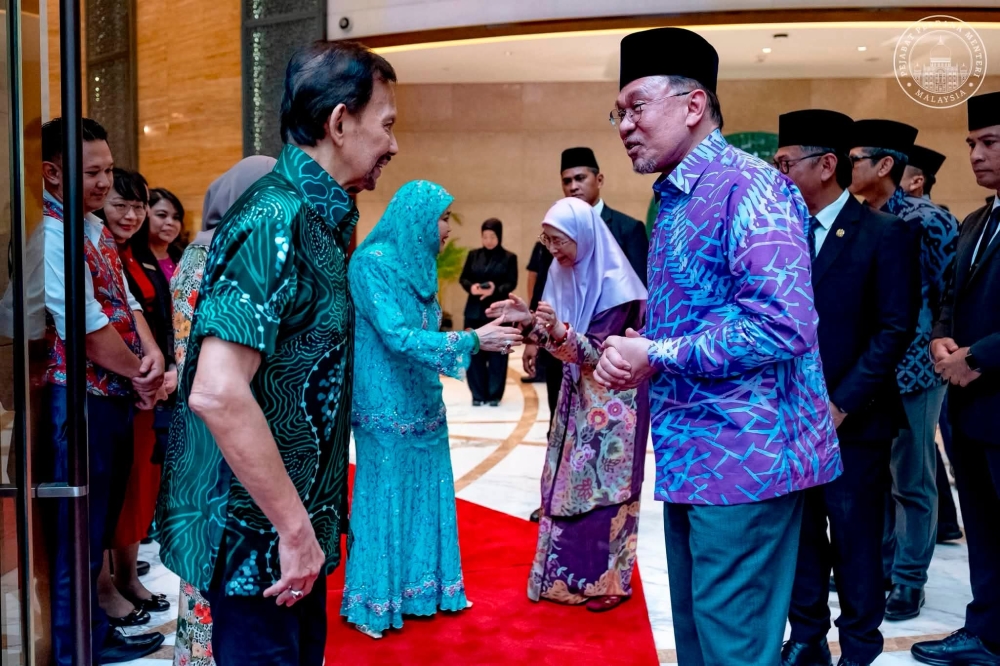
Prime Minister Datuk Seri Anwar Ibrahim has sent formal birthday wishes to Brunei's Sultan Hassanal Bolkiah, marking another chapter in the periodic diplomatic courtesies that characterise relations between Malaysia and its small neighbour on the northern coast of Borneo. The gesture, delivered on July 15, reflects the customary high-level exchanges that punctuate the bilateral calendar and serve to maintain the cordial standing between the two nations.
Through his message, Anwar chose to spotlight the enduring partnership between Malaysia and Brunei, framing the personal tribute within the broader context of state-to-state relations. Such ceremonial expressions from senior officials often carry substantive undertones, signalling commitment to shared interests and mutual respect at a moment when regional geopolitics remain fluid. The timing and tone of these messages can subtly communicate political priorities to audiences in both capitals and the wider Southeast Asian community.
The Malaysia-Brunei relationship rests on a foundation of geographical proximity and shared cultural heritage, yet it has historically remained one of careful diplomacy. Both nations are members of the Association of Southeast Asian Nations and share interests in maritime security, economic cooperation, and maintaining stability in the South China Sea. Brunei's position as a resource-wealthy sultanate and Malaysia's role as a regional economic anchor mean that their interactions carry implications extending beyond their bilateral sphere.
Anwar's reaffirmation of ties arrives amid a period when regional powers are recalibrating their diplomatic positions in response to shifting global dynamics. The message underscores Malaysia's commitment to strengthening bonds across Southeast Asia, particularly with immediate neighbours where shared maritime boundaries and transnational challenges necessitate constant dialogue. For a nation like Brunei, whose international profile is proportionally smaller but whose strategic location remains significant, such high-level acknowledgments from Malaysian leadership carry symbolic weight.
The sultan of Brunei holds considerable cultural and political significance across the Muslim world and within Southeast Asian circles. His long tenure has made him a figure of regional continuity, and Malaysian acknowledgment of his position through formal diplomatic gestures helps solidify the narrative of stability and cooperation that both nations wish to project. For Malaysia's government, maintaining strong relations with all immediate neighbours, including Brunei, forms part of a broader strategy to position itself as a unifying force within ASEAN.
Bilateral cooperation between the two countries spans multiple sectors. Trade exchanges, though modest in comparison to Malaysia's commerce with larger regional partners, reflect commercial interdependence. More importantly, institutional frameworks governing maritime affairs, border management, and defence coordination require constant cultivation. Regular diplomatic engagement at the highest levels ensures these mechanisms function smoothly and prevents minor irritants from escalating into significant tensions.
The extension of birthday wishes also serves a domestic audience within each nation. For Brunei, it demonstrates that the sultanate maintains cordial relations with its powerful neighbour despite size disparities. For Malaysia, it reinforces the government's commitment to prudent diplomacy and respect for regional partners, qualities that resonate with ASEAN's principles of non-interference and mutual respect. Political leaders in both capitals benefit from projecting images of harmonious international relations.
Regional observers note that Malaysia-Brunei relations have remained comparatively stable despite occasional disputes over maritime boundaries and resource management in shared waters. The measured and respectful tone of exchanges between Kuala Lumpur and Bandar Seri Begawan suggests both governments prefer constructive engagement over confrontation. In a region where sovereignty disputes and resource competition can generate friction, the relative tranquillity of the Malaysia-Brunei relationship stands as a modest success story.
Looking forward, the two nations face shared challenges that will require deepened cooperation. Climate change, maritime security threats including piracy and illegal fishing, transnational crime, and economic recovery in the post-pandemic era are priorities that transcend borders. Anwar's emphasis on partnership ties signals recognition that addressing these challenges effectively demands sustained coordination between Malaysian and Bruneian institutions and leadership.
The diplomatic calendar between Malaysia and Brunei likely includes numerous scheduled interactions at ministerial and official levels throughout the year. These regular engagements, supplemented by ceremonial exchanges like birthday greetings from heads of government, create a rhythm that maintains relationships and provides forums for addressing emerging issues. For Malaysian policymakers, such consistent attention to regional partnerships demonstrates the seriousness with which the government approaches its role within ASEAN and as a steward of regional stability in Southeast Asia.

