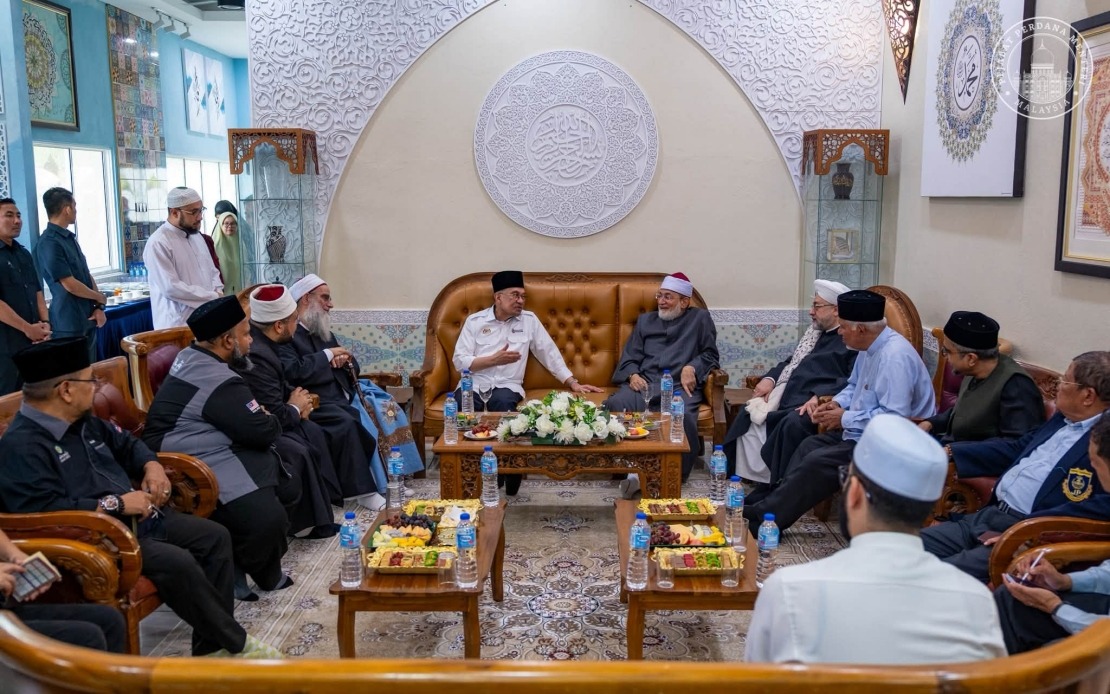
Prime Minister Datuk Seri Anwar Ibrahim has welcomed three internationally distinguished Islamic scholars to Malaysia, personally visiting them to seek their counsel and express the government's appreciation for their presence in the country. The three visitors represent different facets of Islamic scholarship and leadership across the Muslim world, reflecting the diversity of theological expertise and religious authority that Malaysia continues to attract as a centre for Islamic learning in Southeast Asia.
The first scholar is Egyptian hadith specialist Al-Fadhil Al-Allamah Al-Muhaddith Syeikh Dr Mustafa al-Nadwi Al-Hasani, whose work in Islamic jurisprudence and prophetic tradition has earned him recognition throughout the Arab world and beyond. Accompanying him is Al-Fadhil Al-Allamah Al-Muqri' Syeikh Dr Ahmad Isa Al-Ma'sarawy, celebrated globally for his mastery of Quranic recitation and memorisation, a discipline that remains foundational to Islamic education and spiritual practice. The third visitor, Al-Fadhil Al-Syeikh Maulana Al-Sayyid Afeefuddin Al-Jailani, serves as custodian of the sacred waqf endowments, mosques, and burial site associated with the revered Islamic figure Syeikh Abdul Qadir Al-Jailani, a responsibility that carries immense spiritual and administrative significance across the Islamic world.
Through his visit, Anwar sought to strengthen connections with these intellectual and spiritual leaders, viewing their presence as an opportunity to deepen Malaysia's engagement with global Islamic thought. The Prime Minister used the occasion to inquire into their welfare and request their spiritual guidance and supplications, underscoring the government's recognition of the value such scholars bring to Malaysia's Islamic discourse. By personally dedicating time to meet with them despite his demanding schedule, Anwar signalled that engaging with internationally recognised Islamic authorities remains a priority for his administration.
In a Facebook statement following the meeting, Anwar expressed gratitude for the scholars' willingness to travel to Malaysia and contribute their expertise to local communities. He emphasised that their visit at Nasyrul Quran, an established centre for Quranic studies in Malaysia, represents more than academic exchange but rather a mission to elevate Islamic teaching and practice throughout the nation. The Prime Minister framed the visit within his broader vision of constructing a virtuous, educated society characterised by religious devotion and social cohesion.
The visit reflects Malaysia's continuing aspiration to position itself as a bridge between Arab Islamic scholarship and Southeast Asian Muslim communities. As a Muslim-majority nation with a diverse population and complex religious landscape, Malaysia has historically sought to leverage its unique position to host prominent Islamic scholars and facilitate dialogue between different schools of Islamic thought. These scholarly visits serve practical purposes, including public lectures, educational seminars, and consultation on matters of Islamic law and theology that have local relevance.
The presence of such eminent figures also carries implications for Malaysia's soft power in the Islamic world. By hosting these scholars and demonstrating respect for their expertise, the country reinforces its standing as a cosmopolitan Muslim nation committed to intellectual rigour and religious scholarship. This is particularly significant given regional competition among Southeast Asian countries to become recognised hubs for Islamic learning and development.
For Malaysian Muslims seeking to deepen their understanding of Quranic sciences, hadith studies, and Islamic heritage, the availability of internationally renowned teachers provides unprecedented access to authoritative instruction that might otherwise require extensive travel to the Middle East or other Islamic centres. This accessibility has long-term implications for the quality of religious education and the development of Malaysia's own cadre of Islamic scholars and teachers.
The initiative also demonstrates how political leadership can leverage cultural and religious diplomacy to advance national cohesion. By engaging seriously with Islamic scholars and creating platforms for their knowledge dissemination, the government addresses the aspirations of religiously-minded citizens while promoting an inclusive vision of Malaysian Islam. Such interactions help model respectful dialogue between political authority and religious expertise, a relationship that remains consequential in a country where Islam holds constitutional significance.
Looking forward, these kinds of engagements typically lead to expanded educational programming, research collaborations, and longer-term institutional relationships that benefit Malaysian universities, Islamic centres, and communities seeking scholarly resources. The visit thus represents not merely a courtesy but part of a strategic approach to strengthening Malaysia's intellectual and spiritual infrastructure in Islamic studies at a time when such knowledge remains increasingly important to regional stability and cultural identity.

