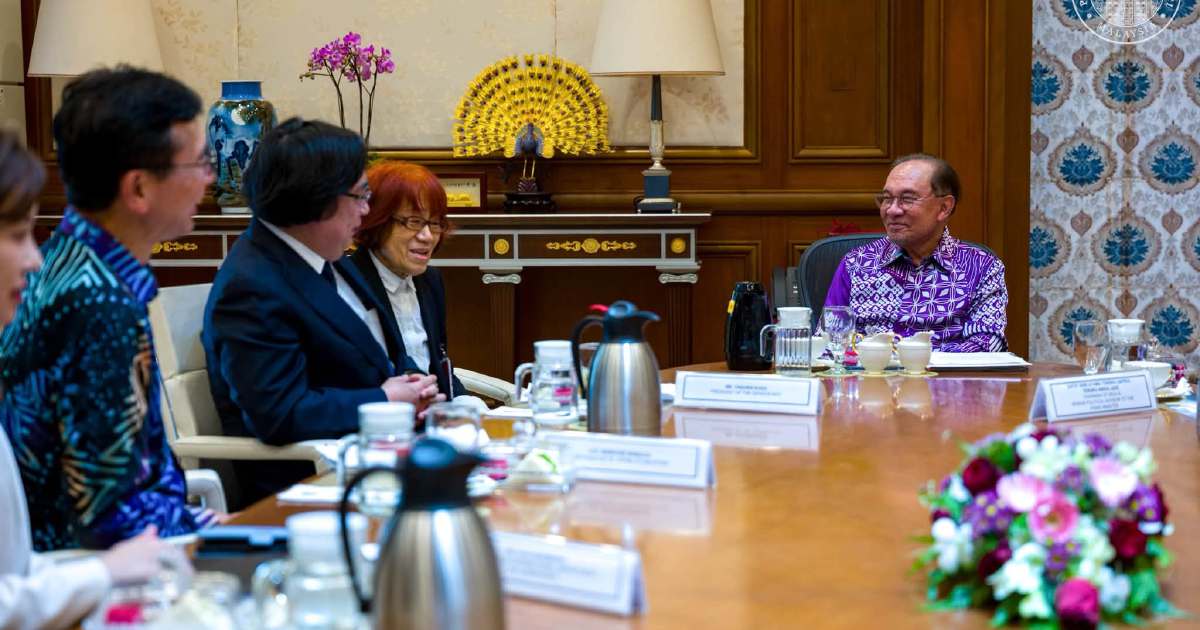
Prime Minister Datuk Seri Anwar Ibrahim received Genron NPO president Yasushi Kudo in Kuala Lumpur today, with the discussion underscoring Malaysia's commitment to deepening its longstanding partnership with Japan through structured strategic engagement. The courtesy call represents continued high-level diplomatic interaction between the two countries, reflecting shared interests in maintaining robust bilateral relations across economic, security, and cultural dimensions.
Genron NPO, formally known as the Japan Initiative for Global Change, serves as an influential non-profit organization headquartered in Tokyo that shapes Japanese foreign policy discourse. The organization conducts research, facilitates dialogue, and convenes policy forums that directly influence Japan's approach to international relations. Kudo's visit to the Malaysian capital signals Japan's sustained focus on Southeast Asian partnerships, particularly with Malaysia, which holds strategic importance in regional architecture and serves as a gateway to broader ASEAN engagement.
The emphasis on strengthening strategic dialogue reflects both nations' recognition that formalized communication channels remain essential for navigating an increasingly complex regional security environment. Malaysia and Japan have cultivated bilateral ties spanning decades, encompassing trade relationships, defence cooperation, cultural exchanges, and educational partnerships. Enhanced dialogue mechanisms allow policymakers to address emerging challenges, coordinate positions on regional issues, and explore fresh avenues for collaboration in areas where national interests converge.
From Malaysia's perspective, engagement with influential Japanese policy organizations like Genron NPO underscores Kuala Lumpur's diplomatic strategy of maintaining balanced relationships with major powers. Japan remains a significant economic partner and technology provider for Malaysia, while cooperation extends into maritime security, cybersecurity, and critical infrastructure development. The visit creates opportunities for Malaysian perspectives to reach influential circles within Japanese government and business communities, facilitating mutual understanding of each nation's priorities and constraints.
The timing of this meeting occurs within a broader context of Japan's "Indo-Pacific" strategy, which emphasizes free and open regional order principles that resonate with Malaysian strategic thinking. Both nations are navigating complex geopolitical shifts, including great-power competition and transnational challenges spanning pandemics, climate change, and supply chain vulnerabilities. Strategic dialogue provides platforms for Japan and Malaysia to coordinate responses to shared concerns while preserving national autonomy in decision-making.
Economic dimensions underpin much of the Malaysia-Japan relationship. Japanese companies maintain substantial manufacturing operations throughout Malaysia, particularly in automotive, electronics, and chemical sectors. Two-way investment flows generate employment for tens of thousands of Malaysian workers while providing Japanese firms with access to Southeast Asian markets. Enhanced strategic dialogue at this level may facilitate discussions regarding technology transfer, green manufacturing initiatives, and addressing supply chain resilience concerns that have preoccupied both economies since global disruptions.
Defence cooperation represents another pillar of bilateral ties that likely featured in discussions. Japan's Self-Defence Force maintains regular training exchanges and port calls in Malaysian waters, contributing to regional maritime stability and freedom of navigation principles both nations uphold. Malaysia's strategic location along major shipping lanes connecting the Indian and Pacific Oceans makes it valuable to Japanese strategic interests. Continued dialogue ensures military-to-military relationships remain professionally grounded and focused on stability rather than strategic competition.
Cultural and educational exchanges constitute a softer dimension of Malaysia-Japan partnership often overlooked in formal diplomatic calculations. Thousands of Malaysian students pursue higher education in Japan annually, fostering generational bonds and cross-cultural understanding. Japanese cultural institutions, from anime to automotive design to culinary traditions, enjoy widespread appreciation among Malaysian youth, creating grassroots affinity that complements official government-to-government engagement. Such people-to-people connections establish foundations for sustained partnership even when political circumstances shift.
For Malaysian policymakers, maintaining productive relationships with all significant powers remains a core diplomatic principle. Japan's position as Asia's second-largest economy and a leader in technological innovation makes consistent engagement strategically prudent. Through organizations like Genron NPO, Malaysia gains channels to influence Japanese discourse on regional issues, from ASEAN unity to maritime security to sustainable development priorities that Malaysia champions. Such influence proves particularly valuable for smaller nations navigating great-power competition.
The meeting also reflects evolving expectations surrounding non-state actors' roles in diplomatic engagement. Organizations like Genron NPO bridge government and private sectors, bringing research capacity, business perspectives, and civil society voices into policy conversations. Their involvement legitimizes dialogue as forward-looking and consultative rather than merely transactional, potentially yielding more creative solutions to shared challenges than purely governmental negotiations.
Looking ahead, this engagement suggests Malaysia and Japan will continue intensifying cooperation across established channels while exploring new areas of mutual benefit. Both nations face demographic challenges, technological disruption, and pressure to enhance regional leadership credentials within ASEAN and broader Asia-Pacific contexts. Strategic dialogue between Malaysian leadership and influential Japanese organizations provides opportunities to align approaches on issues ranging from artificial intelligence governance to green energy transitions to managing strategic competition.
The courtesy call ultimately represents diplomatic functionality at its best: structured conversation between serious policymakers designed to reinforce commitments, identify emerging priorities, and strengthen human networks that prove invaluable during crises. As Malaysia navigates complex regional dynamics, maintaining such relationships with technologically advanced, economically powerful neighbours like Japan supports both near-term national interests and longer-term strategic positioning in an evolving regional order.

