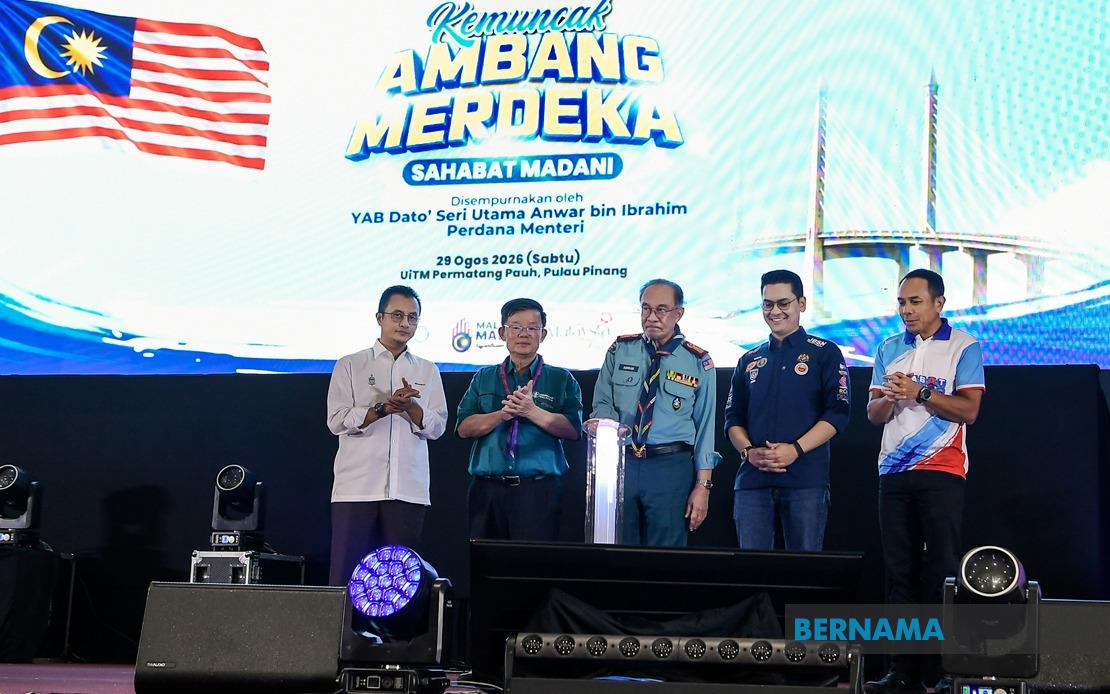
Prime Minister Datuk Seri Anwar Ibrahim has formally launched Sahabat MADANI, a comprehensive national volunteer initiative that harnesses the energy and commitment of over 11,000 registered citizens to address community needs and foster social cohesion. The programme was unveiled at Universiti Teknologi MARA (UiTM) Permatang Pauh in Bukit Mertajam during the Ambang Merdeka Sahabat MADANI 2026 highlight event, underscoring the government's commitment to translating reformist principles into tangible grassroots action as the nation approaches the 70th anniversary of independence.
The volunteer network represents a deliberate institutional architecture designed to bridge the gap between government initiatives and community-level implementation. According to the Implementation Coordination Unit of the Prime Minister's Department (ICU JPM), Sahabat MADANI operates on the foundational premise that sustainable development requires coordinated participation from multiple sectors—government agencies, organised volunteers, and local communities working in synchronisation. This tripartite approach represents an evolution beyond traditional top-down service delivery models, instead creating horizontal linkages that respond to actual community circumstances rather than standardised bureaucratic templates.
The scope of Sahabat MADANI's intervention spans several critical social domains that reflect persistent vulnerabilities within Malaysian society. Priority areas include direct support for marginalised populations, educational interventions targeting school dropouts who risk permanent labour market exclusion, targeted economic programmes creating employment and entrepreneurial pathways for youth, and emergency relief mechanisms mobilised during crises. Each category addresses demonstrable gaps in existing safety nets, acknowledging that formal government services, while essential, sometimes fail to reach those most in need due to information asymmetries, bureaucratic friction, or geographical isolation.
The philosophical underpinning of Sahabat MADANI extends beyond conventional service provision to encompass a vision of national identity rooted in cross-communal participation. By deliberately emphasising volunteer service across ethnic, religious, and socioeconomic boundaries, the initiative attempts to operationalise principles of mutual respect and collective responsibility that transcend identity-based divisions. This framing carries particular significance within Malaysia's pluralistic context, where shared civic participation across communal lines remains contested terrain and where volunteer service is positioned as a mechanism for building solidarity amidst diversity.
The initiative resonates with the government's broader Malaysia MADANI framework, which articulates a vision of shared wellbeing as the overarching development objective. Sahabat MADANI functions as the implementation vehicle for this aspiration, translating the abstract concept of "kesejahteraan dinikmati" (shared prosperity) into concrete community interventions. This alignment between high-level policy vision and grassroots mobilisation reflects an attempt to create narrative and institutional coherence across government structures, enabling volunteers to understand their individual contributions as constitutive elements of a larger national project.
The recruitment of 11,060 volunteers within what appears to be a compressed timeframe indicates substantial mobilisation capacity, though the sustainability of volunteer engagement remains an open question. Maintaining participation rates, preventing volunteer burnout, and ensuring equitable geographic distribution of volunteer resources represent ongoing operational challenges. The programme's success will depend substantially on whether the institutional infrastructure can provide meaningful work, appropriate training, adequate support systems, and recognition mechanisms that sustain volunteer motivation over extended periods.
For Malaysia's youth demographic, Sahabat MADANI presents both opportunity and implicit challenge. By positioning young people as agents of social change rather than passive beneficiaries of government programmes, the initiative channels youthful idealism and capacity into constructive activities. Simultaneously, the explicit messaging cautioning against divisive sentiments and encouraging contribution to national progress contains an implicit counter-narrative to identity-based mobilisation or factional political engagement—a strategic positioning particularly relevant given generational shifts in political consciousness and communication patterns.
The timing of Sahabat MADANI's formal launch during National Day observances carries symbolic weight beyond the immediate programme mechanics. By linking volunteer service to independence commemoration, the government constructs a narrative wherein contemporary national independence is meaningfully expressed through citizens' willingness to serve one another, uphold integrity, and support vulnerable populations. This reframes independence from a historical achievement into an ongoing practice maintained through civic engagement and mutual solidarity.
From a governance perspective, Sahabat MADANI represents an attempt to address the longstanding tension between state capacity and social need through distributed responsibility. Rather than expanding government bureaucracy to reach all identified needs, the model mobilises volunteer effort while maintaining government coordination and resource allocation. This approach potentially increases responsiveness and community ownership of solutions while introducing new coordination challenges and quality assurance considerations that differ from hierarchical civil service accountability mechanisms.
The programme's intersection with antipoverty and anticorruption agendas signals that volunteer mobilisation is conceived not merely as social service delivery but as a component of broader governance reform. By emphasising transparency, responsiveness to actual community requirements, and inclusive participation across social differences, Sahabat MADANI positions volunteerism as a mechanism for rebuilding institutional trust and demonstrating commitment to equitable development outcomes. For Malaysian and regional observers, the initiative merits monitoring as a case study in whether large-scale volunteer mobilisation can sustainably address structural inequalities and strengthen social cohesion in plural societies.
The geographical distribution and demographic composition of Sahabat MADANI's 11,060 volunteers will significantly influence programme effectiveness and public perception. Urban concentration or skewed representation across ethnic or religious lines could undermine the initiative's inclusivity aspirations, whereas genuine diversity in volunteer participation would substantiate claims about cross-communal solidarity. Transparent public reporting on volunteer composition and impact metrics would strengthen programmatic credibility and enable evidence-based adjustments to recruitment, training, and deployment strategies.

