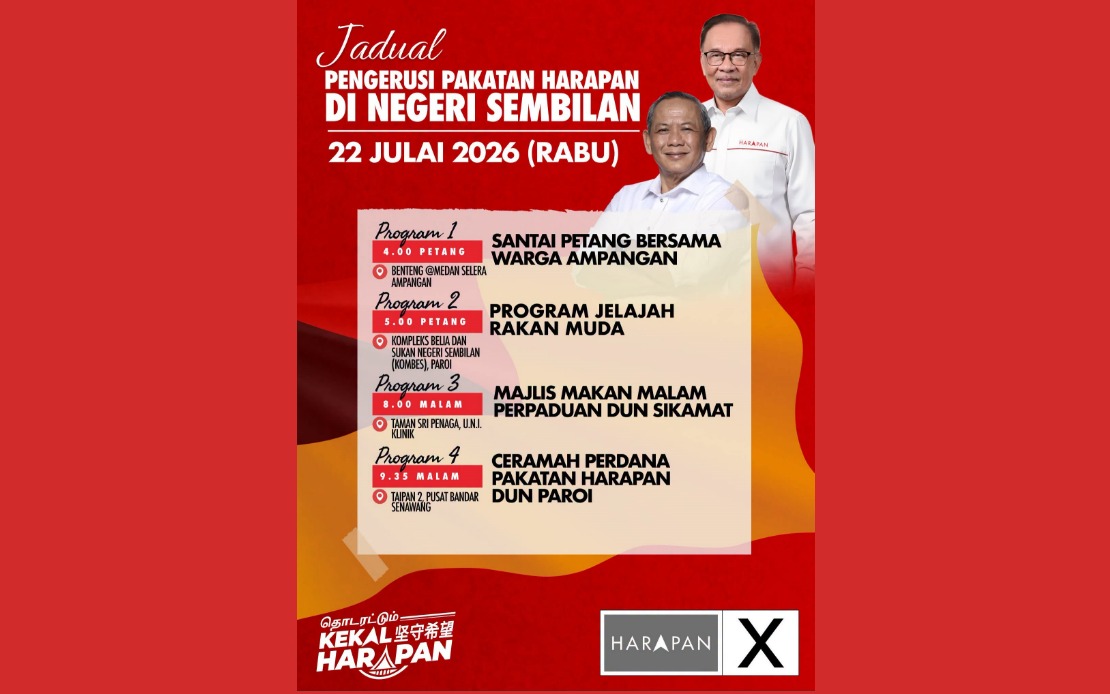
Prime Minister Datuk Seri Anwar Ibrahim is stepping up the Pakatan Harapan (PH) coalition's campaign momentum in Negeri Sembilan, embarking on an afternoon and evening tour that underscores the coalition's determination to maintain control of the state government. His personal involvement on day five of the campaign signals the high stakes attached to the contest, with PH positioning itself to consolidate support among voters and demonstrate the central leadership's commitment to retaining the administration helmed by Menteri Besar Datuk Seri Aminuddin Harun.
As PKR president and PH chairman, Anwar's presence carries symbolic weight beyond the typical campaign appearance. His decision to personally canvas constituencies including Ampangan, Paroi, Sikamat and Senawang reflects a strategic calculation that the coalitional efforts require top-tier endorsement to energise party machinery and persuade undecided voters. The scheduling of multiple engagements—from community dialogues targeting residents to youth-focused programmes and the flagship 'mega ceramah' public rally—demonstrates a deliberate effort to reach across demographic segments rather than relying on a single mass event.
The itinerary beginning at 4 pm with the 'Santai Petang Bersama Warga Ampangan' at Benteng @ Medan Selera Ampangan carries particular significance for constituency-level mobilisation. This informal 'evening gathering with residents' format, juxtaposed against the formal ceramah later, suggests PH is attempting to balance grassroots engagement with broad public communication. The subsequent appearance at the Negeri Sembilan Youth and Sports Complex (KOMBES) in Paroi at 5 pm targets younger voters—a demographic that historically shows volatility in electoral behaviour and requires sustained cultivation rather than taken-for-granted support.
The evening's scheduled progression through a Sikamat constituency unity dinner and culmination at the Paroi PH mega ceramah in Pusat Bandar Senawang reflects careful spatial planning to maximise visibility and generate momentum through the evening hours when voter foot traffic and media attention tend to concentrate. Each venue selection appears calibrated to reach specific voter clusters while building a narrative arc of PH solidarity and forward momentum heading into the final stretch of campaigning.
PH's campaign messaging framework, anchored to the coalition's manifesto unveiled on Monday, emphasises ten key developmental and inclusive governance commitments designed to appeal to aspirations for state advancement. Anwar's presence amplifies this message by suggesting prime ministerial backing for local governance pledges—a mechanism through which federal leadership seeks to validate state-level campaign promises and reinforce voter confidence in PH's capacity to deliver.
The coalition's contestant distribution across the 36 state seats reveals an intricate partnership structure. PKR's 16 candidates constitute the largest bloc, reflecting the party's predominance within PH, while DAP's 11 nominees and Amanah's nine candidates complete a relatively balanced tripartite contest. This allocation pattern suggests negotiations over seat distribution were finalised to minimise intra-coalition friction, enabling a unified campaign posture despite underlying constituency-level pressures that typically characterise multi-party coalitions.
The electoral timeline, with early voting scheduled for July 28 and general polling on August 1, concentrates the campaign period into a narrow window. The five-day window to Anwar's appearance indicates that while initial momentum had been established, coalition strategists evidently determined that a visible demonstration of prime ministerial commitment was necessary to sustain voter engagement and counter any momentum shifts toward opposition candidates. This timing suggests internal assessment that the race remains competitive rather than a assured PH victory.
For Malaysian observers and broader Southeast Asian political analysis, the Negeri Sembilan contest represents a microcosm of contemporary Malaysian electoral dynamics. State elections function as mid-term verdict opportunities on federal governance, permitting voters to express satisfaction or discontent with the PH administration without removing it from federal office. A PH retention would validate Anwar's leadership credentials and suggest his administration maintains sufficient legitimacy to weather governance challenges and opposition criticism. Conversely, losses would provide opposition narratives material for questioning administrative effectiveness and coalition stability.
The contest also reflects the evolving coalition dynamics within Malaysian politics. PH's ability to maintain disciplined seat-sharing arrangements and unified messaging across ideologically diverse partners—from PKR's centrist positioning to DAP's social democratic foundations to Amanah's Islamic modernist framing—demonstrates either genuine consensus-building capacity or enforced unity born from shared electoral interests. Negeri Sembilan's outcome may illuminate which interpretation proves more enduring.
Moreover, the state election occurs amid broader economic pressures affecting household incomes and cost-of-living concerns that consistently dominate voter preoccupations. PH's manifesto commitments to state development and inclusive governance implicitly address these anxieties by proposing state-level interventions in areas within sub-federal jurisdiction. However, voter scepticism about the gap between campaign promises and governing reality—a sentiment amplified by three years of post-2022 federal governance—requires continuous demonstration of credibility. Anwar's personal campaigning serves partly to overcome this scepticism through presidential proximity and visibility.
The Negeri Sembilan election ultimately serves as both a genuine competitive contest and a performance of political legitimacy. For PH, retention reinforces administrative continuity and suggests voter confidence remains adequate. For opposition forces, any gains would constitute evidence of resurgent competitiveness. The August 1 outcome will thus carry implications extending beyond state administration into the broader calculus of federal coalition stability and Anwar's political standing heading toward the next general election cycle.

