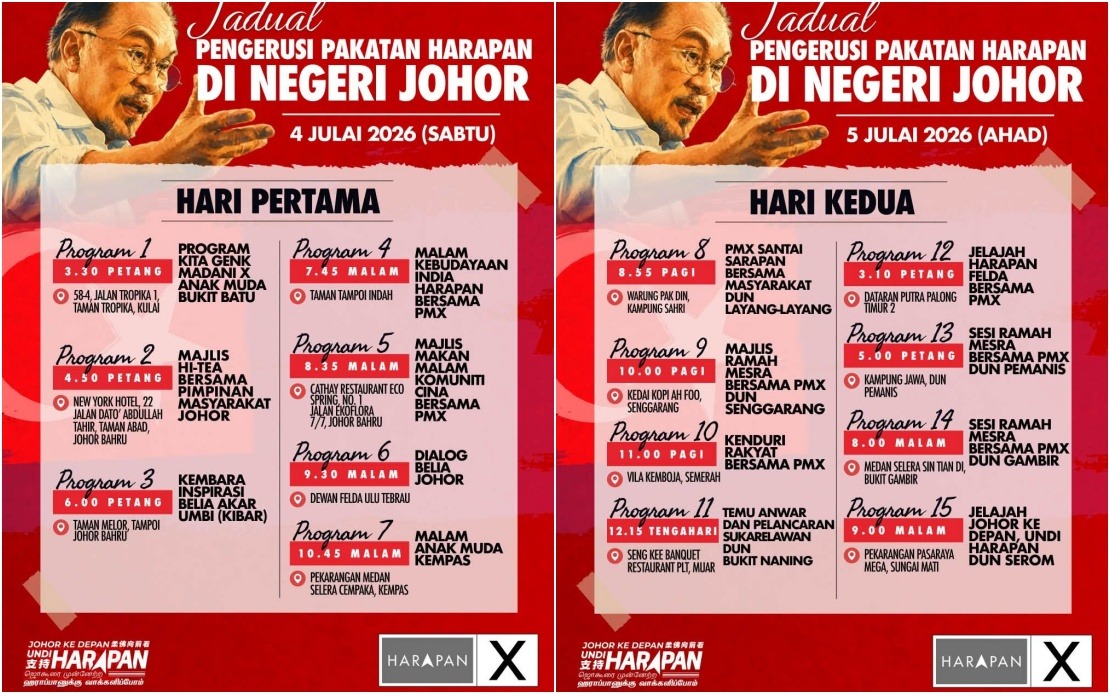
Pakatan Harapan chairman Datuk Seri Anwar Ibrahim is set to execute an ambitious campaign strategy in Johor this weekend, with a packed schedule of 15 public engagements designed to energise grassroots support for the coalition's 56 candidates ahead of the 16th state election. The comprehensive programme underscores the pivotal importance of Johor to PH's electoral fortunes, with Anwar personally stewarding efforts across multiple constituencies and demographic groups in a state that remains strategically crucial to Malaysian politics.
Anwar's weekend itinerary reflects a deliberate strategy to reach diverse constituencies and community segments. Beginning Friday afternoon in Kulai with a youth-focused Kita Genk MADANI event at 3.30 pm, Anwar progresses through a carefully choreographed sequence that blends cultural celebrations, community dialogues, and grassroots mobilisation activities. The programme intentionally spans evening hours, with late-night engagements scheduled as late as 10.45 pm, demonstrating an effort to connect with voters across different schedules and working patterns. This intensity of engagement signals PH's determination to consolidate support in a state where electoral margins have historically proven decisive.
The composition of Anwar's schedule reveals sophisticated targeting across Johor's diverse communities. Events explicitly labeled as Indian Cultural Night, Chinese Community Dinner, and Youth Dialogue segments indicate a deliberate effort to engage different ethnic and age cohorts. Such segmented engagement acknowledges the demographic complexity of Johor's electorate and reflects a recognition that effective campaigning requires tailored messaging and cultural acknowledgment. The inclusion of events at locations like Taman Tampoi Indah and Felda constituencies suggests PH is investing campaign resources in both urban and semi-rural constituencies, recognising that victory requires breadth across geographical divides.
Sunday's schedule extends the campaign into early morning and mid-afternoon slots, beginning with a breakfast engagement at Warung Pak Din in Kampung Sahri at 8.55 am. This approach captures voters during different parts of their day, from early breakfast settings to mid-morning community gatherings and noon kenduri rakyat sessions. The inclusion of volunteer launch events at Bukit Naning demonstrates PH's parallel focus on building grassroots organisational infrastructure, not merely conducting top-down campaign messaging. By featuring volunteer mobilisation alongside direct voter engagement, Anwar's schedule acknowledges that electoral success depends on sustained local activism beyond the candidate's personal appearances.
The geographical spread of Anwar's weekend activities spans multiple Johor districts and constituencies, from Kulai in the north to constituencies including Senggarang, Semerah, Bukit Naning, Pemanis, Gambir, and Serom. This dispersed approach reflects recognition that Johor's political landscape cannot be captured through concentrated efforts in a single region. The coalition appears to be making targeted pushes across constituencies where races remain competitive, with the density of activities suggesting particular focus on areas where voter mobilisation could prove decisive. The scale of personal campaigning by PH's chairman indicates the coalition views Johor as central to its national electoral prospects.
Anwar's public invitation to all Johor voters, conveyed through a Facebook post, extends the campaign beyond formal party structures into broader civic engagement. By publicly declaring his weekend presence and explicitly inviting general participation, Anwar frames the election not merely as a contest between political organisations but as a civic moment requiring broad public participation. This rhetorical framing, combined with the visible intensity of his personal schedule, aims to generate momentum and legitimacy around PH's campaign efforts in a state where voter turnout and enthusiasm will directly influence outcomes.
The timing of this intensive campaign immediately precedes critical voting deadlines. Early voting is scheduled for July 7, with the general election following on July 11. By concentrating his major campaign efforts in the final weekend before these dates, Anwar seeks to maximise impact during the period when voter attention and media coverage typically peak. This temporal positioning allows the coalition to capitalize on heightened election awareness while leaving minimal time for countervailing campaign narratives to gain traction. The compressed timeframe emphasises PH's confidence in its ground organisation's ability to convert momentum into actual votes within days.
For Malaysia's broader political landscape, Johor's 16th state election carries significance extending well beyond the state's borders. Johor remains the nation's second-largest state by population and economy, and electoral outcomes here influence perceptions of national political momentum. A strong PH performance could signal voter confidence in the coalition's governance record and policy direction, while weaker-than-expected results might embolden opposition parties nationally. Anwar's personal investment of time and effort in the state reflects understanding that Johor results will reverberate through Malaysia's national political calculations and influence coalition dynamics heading toward potential federal elections.
The 56 PH candidates supported by Anwar's weekend campaign represent the coalition's bid to secure legislative control in a state where politics has shifted substantially over the past decade. The scale of candidate deployment indicates PH's ambitions extend beyond merely contesting seats to attempting comprehensive victory. Success in Johor would strengthen Anwar's position within the coalition and validate PH's strategic direction, while providing momentum for potential national political moves. Conversely, disappointing results could trigger internal coalition tensions and questions about PH's electoral strategy and messaging effectiveness.
Anwar's engagement strategy also illustrates broader patterns in contemporary Malaysian electoral politics, where senior national figures increasingly conduct intensive ground campaigns rather than relying exclusively on traditional media and organisational structures. The detailed scheduling of 15 separate events demonstrates recognition that direct, personal contact with voters carries particular weight in Malaysian political culture. Each event, from breakfast meetings to cultural celebrations to volunteer launches, creates opportunities for personal interaction, photography, and social media content generation that amplifies campaign reach beyond those physically present. This multi-layered approach combines traditional retail politics with modern digital dissemination strategies.
The specific venue selections merit consideration within Johor's political geography. Locations like Warung Pak Din in Kampung Sahri and Dewan Felda Ulu Tebrau reflect deliberate choices to campaign in community spaces rather than exclusively in formal political venues. Such settings convey accessibility and groundedness, positioning Anwar as a leader willing to engage voters in their everyday environments. The choice of Felda constituencies, which historically held strategic importance in Malaysian politics due to their demographic composition and organisational structure, suggests PH recognises these constituencies remain significant battlegrounds requiring specific attention and cultivation.
For Southeast Asian observers and regional political analysts, Anwar's intensive Johor campaign provides insight into how Malaysian political actors mobilise support during state elections. The coordination required to execute 15 separate events within 48 hours, each targeting different constituencies and demographics, illustrates the organisational sophistication modern Malaysian political parties have developed. The campaign's scale and ambition reflect the resources and personnel deployment that contemporary electoral competition demands, suggesting elections in Malaysia involve increasingly complex logistical coordination and targeted messaging strategies across diverse voter segments.
Looking forward, the outcome of Johor's July 11 election will provide early indication of voter sentiment under PH's continued leadership at the national level. Should PH perform strongly, it could accelerate discussions about Anwar's government pursuing a federal election mandate. Conversely, disappointing results might prompt coalition reassessment and recalibration ahead of eventual national polls. Anwar's personal campaign commitment reflects stakes he perceives in Johor's outcome, positioning the state election not as a routine periodic contest but as a consequential test of coalition viability and voter confidence in PH's direction.

