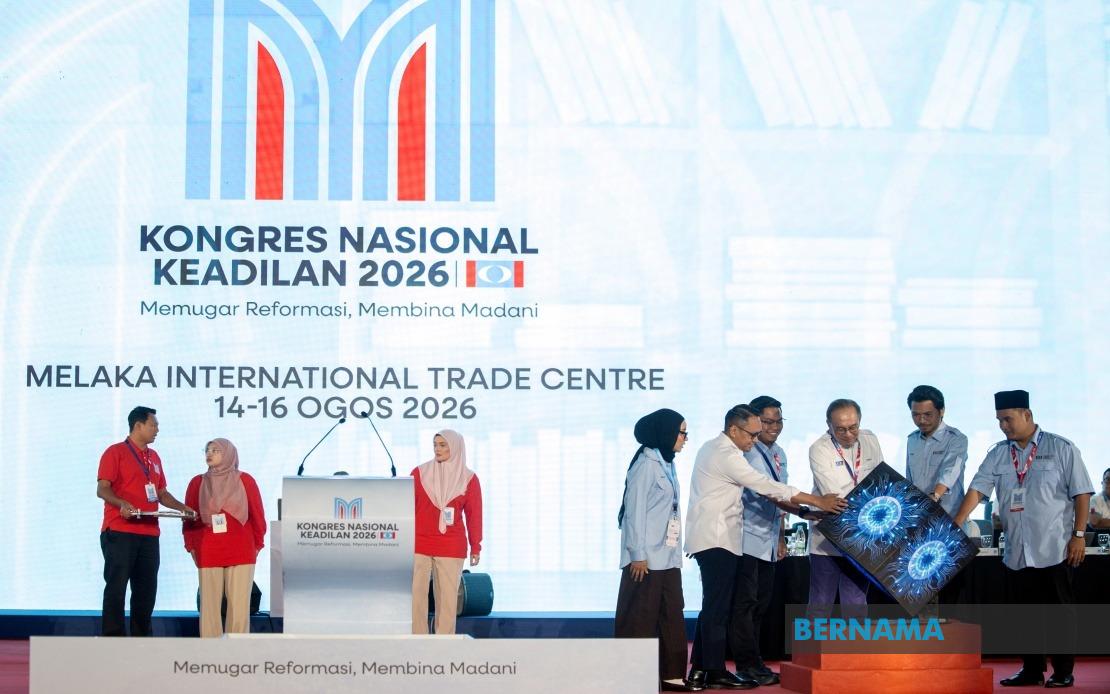
Prime Minister Datuk Seri Anwar Ibrahim marked a significant moment for the Parti Keadilan Rakyat's youth wing on August 16 when he formally introduced a substantial new publication designed to reshape how the party's younger generation understands its historical mission and contemporary role. The launch in Melaka represented more than a ceremonial gesture—it signals PKR's deliberate investment in ideological continuity at a time when Malaysia's political landscape continues evolving after the 2022 transition of power.
The 113-page document, produced by Angkatan Muda Keadilan (AMK) chief Muhammad Kamil Ahmad Munim and executive committee member Ashraf Ahmad Hadi, represents an attempt to codify the party's philosophical approach to addressing modern national challenges. Rather than offering technical policy prescriptions, the publication anchors itself in the party's foundational principles and the concept of "Reformasi"—the reform movement that became synonymous with PKR's emergence during the late 1990s political crisis.
Anwar characterised the initiative as profoundly different from conventional political messaging. His emphasis that this was neither technocratic rhetoric nor seasonal political posturing underscores a distinction between performative politics and substantive ideological commitment. This framing carries weight in Malaysian political discourse, where accusations of inconsistency and expediency frequently dog incumbent administrations. By positioning the publication as an exercise in "civilisational renewal" and the "re-humanisation of national development," Anwar attempts to elevate PKR's engagement with youth beyond transactional party-building.
The timing of the launch coincides with the party's broader adoption of what appears to be a renewed strategic direction. For PKR, which has navigated complex coalition politics since 2018 and faced internal tensions over leadership and policy direction, reasserting core ideological principles to younger members serves multiple purposes. It provides a touchstone amid shifting political alliances while attempting to distinguish PKR's brand from competitors within the broader reformist and opposition ecosystems.
Anwar's address to AMK members contained pointed messaging about responsibility and moral accountability. His invocation of piety and moral integrity as measures of political commitment, rather than mere organisational success or electoral victory, reflects a rhetorical strategy common in Malaysian Islamic-influenced political discourse. However, coming from a Prime Minister leading a coalition government, such language also functions as a call for principled governance—a subtle challenge to his own administration and allies to maintain ethical standards.
The challenging context facing Malaysia's young generation emerged in Anwar's remarks about rebuilding a nation damaged by past injustices and systemic leakages. This language references widespread concerns about corruption, institutional decay, and inequality that motivated much of PKR's original appeal. By explicitly connecting youth mobilisation to addressing these legacies, Anwar positions the younger generation as essential agents in completing Malaysia's incomplete transition toward institutional reform and equitable development.
Creativity, intellectual courage, and spiritual resilience—the three qualities Anwar identified as essential for this younger cohort—represent aspirational rather than purely technical capacities. In a political environment where Malaysia faces complex challenges from economic restructuring to regional geopolitical shifts, the emphasis on intellectual courage suggests PKR is attempting to cultivate members capable of independent analytical thinking rather than mechanical party loyalty. This approach potentially addresses criticisms that Malaysian political parties, across the spectrum, often struggle with internal diversity of thought.
The publication's intended function as a cadre-building resource deserves particular attention for Southeast Asian observers. Malaysia's political parties have historically struggled with systematic member education and ideological transmission across generations. By producing a comprehensive guide that encourages members to appreciate historical context, understand party foundations, and internalise the meaning of "Reformasi," PKR is investing in a form of institutional capacity that extends beyond electoral cycles. Such efforts, when sustained, can contribute to stronger democratic participation and more principled political competition.
For Malaysian readers and regional observers monitoring PKR's evolution, this initiative signals the party's attempt to move beyond the pragmatic coalition politics that have defined its governance period since 2020. The emphasis on "Reformasi"—a concept that transcends partisan boundaries but carries particular significance for PKR's historical identity—suggests the party remains deeply invested in distinguishing itself within Malaysia's crowded political marketplace. Younger voters and party members seeking ideological coherence and moral grounding may find this publication particularly meaningful, though its practical impact will depend on sustained organisational commitment to its principles.
The launch also reflects broader regional patterns in how established political movements attempt to regenerate legitimacy and membership engagement. Across Southeast Asia, parties navigating governance responsibilities while maintaining revolutionary or reform credentials face recurring tensions between pragmatism and principle. PKR's approach—anchoring youth education in philosophical renewal and historical consciousness—represents one response to these pressures, though its long-term effectiveness will depend on whether rhetoric translates into sustained institutional practice and genuine member empowerment within party structures.

