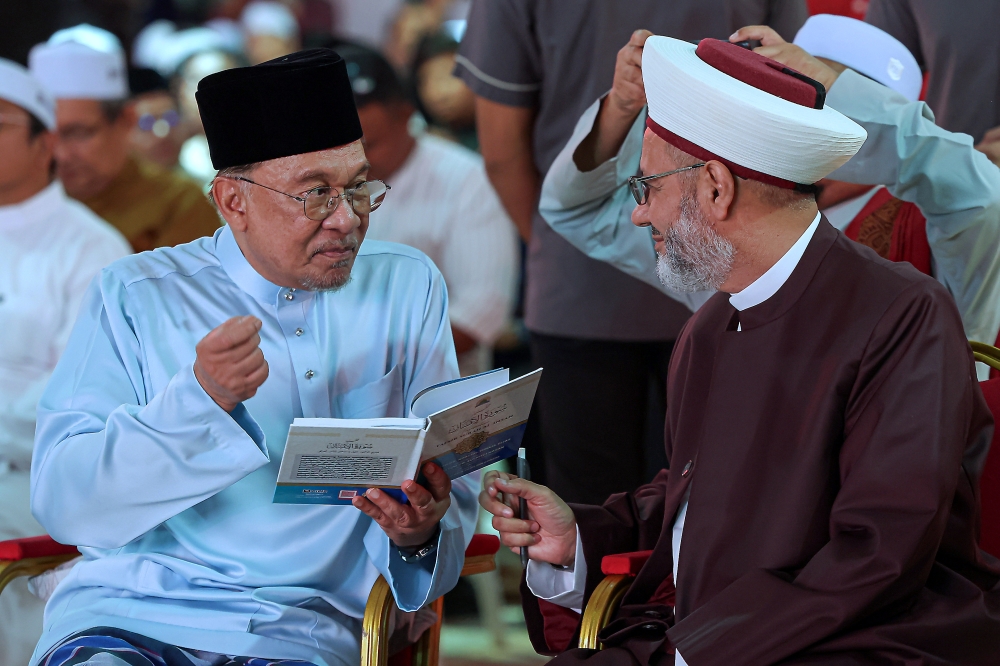
Prime Minister Datuk Seri Anwar Ibrahim has expressed deep admiration for Grand Imam Ahmed Al-Tayyeb of Al-Azhar, positioning the Egyptian religious leader as a pivotal voice for moderation in global Islamic thought. The Malaysian premier's remarks underscore the strategic importance Kuala Lumpur places on engaging influential religious institutions that champion balanced interpretations of Islam, particularly as Malaysia navigates its own multicultural identity in an increasingly polarized world.
Al-Azhar, one of the Islamic world's most venerated institutions with over a millennium of scholarly tradition, wields considerable influence across Muslim-majority societies from Southeast Asia to the Middle East and North Africa. As its Grand Imam, Al-Tayyeb's positions on theological matters, interfaith relations, and Islamic jurisprudence resonate with Muslim communities far beyond Egypt's borders. Anwar's endorsement reflects Malaysia's alignment with Al-Azhar's doctrinal approach, which emphasizes compatibility between Islamic teachings and modern governance, democratic principles, and pluralistic coexistence.
For Malaysian policymakers, Al-Tayyeb's intellectual framework offers valuable legitimacy when advancing domestic narratives around religious moderation and interfaith harmony. Malaysia's constitutional framework guarantees Islam's special position while protecting the rights of other religions, a balance that requires constant reinforcement through credible religious voices. By publicly praising Al-Tayyeb, Anwar signals to Malaysia's Muslim-majority population that engagement with other faiths and acceptance of secular governance mechanisms enjoy support from globally respected Islamic scholars, not merely Western-influenced political elites.
The timing of such statements carries particular significance given rising concerns across Southeast Asia about religious extremism and the spread of literalist interpretations of Islamic law. Countries including Malaysia, Indonesia, and Thailand have grappled with transnational jihadist movements that explicitly reject the gradualist, institutionalist approach represented by Al-Azhar. By elevating Al-Tayyeb's vision, Anwar effectively counters narratives that frame religious authenticity as inherently opposed to pluralism or democratic governance, providing intellectual ammunition for moderate voices within Muslim communities.
Al-Tayyeb's tenure as Grand Imam has been marked by sustained advocacy for interfaith dialogue and condemnations of extremism. He has engaged Christian leaders, participated in international peace initiatives, and issued fatwas opposing violent jihadism—positions that occasionally provoke criticism from ultraconservative factions within Islamic scholarship. His willingness to critique fundamentalist movements while maintaining orthodox Islamic credentials makes him uniquely valuable to regional governments seeking religious allies in countering radicalization without appearing to abandon Islamic authenticity.
Malaysia's appreciation for Al-Azhar's moderate stance reflects broader strategic calculations about soft power and religious influence in the Muslim world. As ASEAN's most developed Muslim-majority nation aspiring to greater regional leadership, Malaysia benefits from association with globally respected Islamic intellectuals. Al-Azhar's historical prestige—it established universities and produced generations of Islamic scholars whose works remain canonical—provides Anwar's government with a powerful reference point when justifying its own interpretations of Islamic governance and religious pluralism.
The relationship between Malaysian leadership and Al-Azhar extends beyond mere diplomatic courtesy. Malaysia has hosted numerous Al-Azhar delegations and facilitated academic exchanges between Malaysian Islamic institutions and the Egyptian university. These connections serve to anchor Malaysia within mainstream Sunni Islamic thought, differentiating the country from nations perceived as either too secular or too radical. For a government balancing demands from conservative constituencies with aspirations toward progressive governance, such alignment proves invaluable.
Within Southeast Asia's broader religious landscape, Al-Tayyeb's emphasis on moderation resonates particularly in Indonesia, where the world's largest Muslim population confronts similar tensions between religious authority and democratic pluralism. His intellectual influence has filtered through Indonesian Islamic networks, university systems, and clerical organizations, creating a constituency receptive to arguments that Malaysia and Indonesia represent a viable alternative model to both Western secularism and Middle Eastern fundamentalism.
However, critics from various perspectives challenge the moderate consensus Al-Tayyeb represents. Conservative Islamic movements argue that his positions compromise essential religious principles in pursuit of contemporary political acceptance. Meanwhile, secular observers question whether institutional religious moderation fundamentally addresses extremism or merely manages its public expression. These tensions remain largely unaddressed in official Malaysian-Egyptian dialogues, where consensus-building takes precedence over contentious theological disputes.
The broader implication of Anwar's commendation lies in Malaysia's continued investment in religious institutionalism as a counterweight to grassroots extremism. Rather than relying solely on security measures or theological argument by individual scholars, the strategy involves leveraging prestigious Islamic institutions with historical legitimacy and transnational reach. Al-Azhar's position at the apex of Sunni Islamic scholarship makes it invaluable for this purpose, particularly as Malaysia seeks to export its model of moderate Islamic governance to other developing nations.
Looking forward, Malaysia's relationship with Al-Azhar may deepen as both institutions confront evolving challenges: digital radicalization, youth alienation from traditional Islamic institutions, and competition from alternative Islamic authorities operating through social media platforms. Al-Azhar's efforts to establish online presence and engage younger generations align with Malaysia's own institutional modernization efforts, suggesting potential for expanded collaboration in religious education and counter-messaging strategies.

