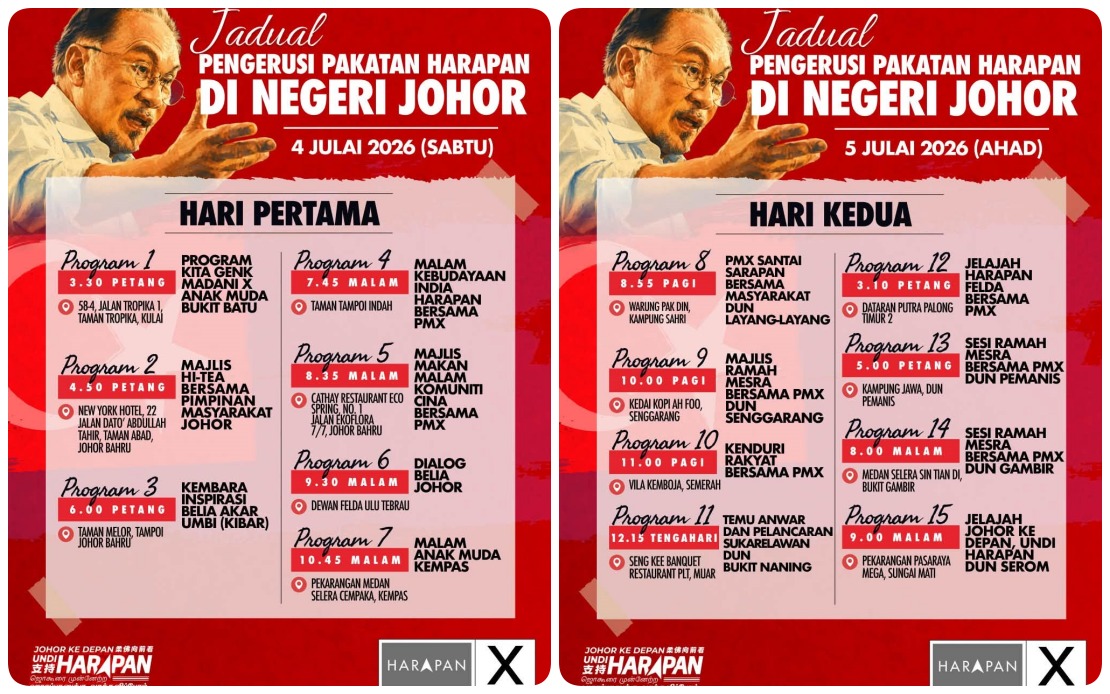
Prime Minister Datuk Seri Anwar Ibrahim is marshalling Pakatan Harapan's electoral machinery in Johor, personally leading a demanding seven-programme campaign day designed to energise party supporters and swing undecided voters ahead of the 16th state election on July 11. The multi-location blitz underscores the coalition's determination to retain control of Malaysia's second-most populous state, where it faces determined challenges from rival coalitions competing for dominance in a strategically important electoral battleground.
Anwar's campaign schedule reflects the coalition's grassroots strategy, beginning with voter engagement sessions in the morning and continuing through evening youth outreach programmes. The itinerary includes a high tea gathering with Johor community leaders at a local hotel at 4.50 pm, designed to facilitate dialogue between party leadership and constituents spanning diverse professional and social backgrounds. This emphasis on small-group interactions and direct voter contact represents PH's attempt to build personal connections rather than relying solely on mass rallies or broadcast messaging.
A centrepiece of today's campaign push is a Youth Dialogue session scheduled for 9.30 pm at the Felda Ulu Tebrau Hall. This targeted engagement with younger voters addresses demographic concerns within PH's electoral coalition, as younger Malaysians have demonstrated increasingly volatile voting patterns in recent elections. The timing—late evening—suggests organisers anticipate strong attendance from working professionals and students, indicating the coalition views young urban and semi-urban voters as critical to victory in hotly contested constituencies.
The Prime Minister's packed schedule continues tomorrow with eight additional programmes, demonstrating sustained organisational intensity in the final days before early voting commences on July 7. This two-day campaign marathon positions Anwar as the visible face of PH's Johor effort, a strategic choice that leverages his position as Prime Minister while attempting to translate national leadership status into state-level electoral advantage. The approach contrasts with previous Malaysian elections where state campaigns operated somewhat independently of federal party leadership.
Pakatan Harapan is contesting all 56 state assembly seats in this election—a maximalist strategy reflecting confidence that the coalition can compete across Johor's diverse constituencies. The candidature breakdown reveals careful coalition management: PKR fields 20 candidates, Amanah 19, and DAP 17, with the distribution attempting to balance party ambitions while respecting coalition equilibrium. This seat allocation reflects ongoing negotiations within PH regarding power-sharing arrangements and the pecking order among coalition members.
The broader electoral context shapes Anwar's campaign intensity. A total of 172 candidates are competing for the 56 seats, indicating competitive three- or four-cornered contests in numerous constituencies. Early voting on July 7 preceding the main polling day on July 11 suggests elevated civic participation expectations, with multiple voting opportunities potentially mobilising different voter cohorts. This expanded voting window complicates campaign strategies, as parties must maintain momentum across an extended electoral period rather than concentrating efforts on a single polling day.
Johor's electoral significance extends beyond its 56 state assembly seats. The state remains a crucial revenue-generating region for Malaysia's federal government and a bellwether for broader political trends. Control of Johor state government influences land use policies, infrastructure development, and business-friendly regulations affecting foreign investment and domestic enterprise. For PH, retaining Johor governance validates its 2023 federal election mandate and demonstrates sustained voter confidence. For opposition coalitions, capturing Johor would provide a major political victory and territorial stronghold for future federal competition.
Anwar's personal campaign involvement addresses specific vulnerabilities within PH's Johor positioning. Despite controlling the state government, PH faces criticism over economic management, development prioritisation, and equitable resource distribution across constituencies. By engaging directly with voters across diverse communities, Anwar seeks to counter narratives of disconnected federal leadership and demonstrate PH's responsiveness to local concerns. The community leader engagement and youth dialogue elements specifically target constituencies where PH support may have softened since 2023.
The campaign's emphasis on multi-location programming reflects electoral realities in a state spanning over 19,000 square kilometres with populations concentrated in urban centres and scattered across rural constituencies. Voter fatigue and logistical challenges necessitate efficient campaign scheduling. The PM's willingness to conduct seven programmes in a single day signals to party machinery that senior leadership takes the election seriously, potentially energising lower-tier party workers and encouraging local campaign intensity.
Pakatan Harapan's broader Johor strategy appears centred on expanding support among urban voters and Chinese-majority constituencies where DAP traditionally performs strongly, while consolidating Malay-Muslim support in constituencies where PKR and Amanah compete. The coalition's all-seats contestation means PH must campaign defensively in constituencies it currently holds while mounting offensive campaigns in opposition-held districts. This bifurcated campaign dynamic typically favours incumbent governments with administrative resources and incumbent officeholders.
The timing of Anwar's campaign push—just days before early voting—suggests PH seeks to capture momentum in the final stretch before voters cast ballots. Campaign psychology research indicates late campaign activities disproportionately influence undecided voters and remobilise supporters at risk of low turnout. By concentrating high-profile campaign activity in the final campaign days, PH maximises visibility and creates impression of strong organisational capacity and momentum.
For Southeast Asian observers, Johor's election demonstrates how Malaysia's federal and state political systems interact, with national leadership directly involved in state campaigns. The election also illustrates coalition dynamics within PH, testing whether PKR, Amanah, and DAP can maintain unified messaging and coordinated campaigning despite occasional policy differences. The outcome will signal whether Malaysia's complex multi-party coalitional politics prove sustainable for governance or whether bipolar competition reasserts itself in future elections.

