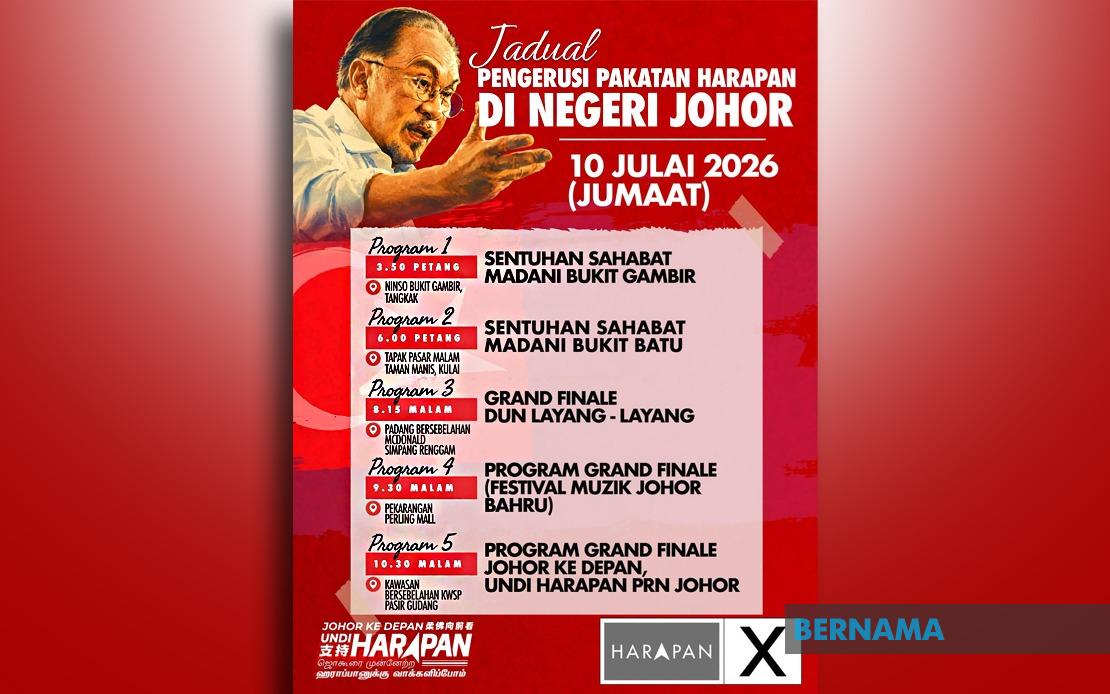
Prime Minister Anwar Ibrahim is set to execute a high-intensity campaign swing through five key locations across Johor on Thursday, marking the climactic stage of Pakatan Harapan's bid to secure dominance in the state election. The coordinated blitz represents a strategic concentration of leadership presence in constituencies deemed crucial to the coalition's electoral fortunes, with the tour stretching from mid-afternoon through late evening to maximise voter engagement across diverse demographic groups and geographical areas within the state.
The campaign itinerary begins at the 'Sentuhan Sahabat MADANI' programme in Bukit Gambir, Tangkak at 3:50 pm, a location chosen to tap into rural and semi-urban voter sentiment in the central Johor region. The Bukit Gambir seat, contested within the Tangkak parliamentary area, represents a traditional stronghold where grassroots mobilisation remains critical to securing and retaining support. From there, Anwar will proceed to Bukit Batu in Kulai at approximately 6:00 pm, shifting the campaign narrative towards the Klang Valley-adjacent constituencies where suburban and urbanised voters hold considerable sway in determining overall state composition.
As evening settles, the campaign's intensity escalates with the DUN Layang-Layang 'Grand Finale' programme scheduled for 8:15 pm in Simpang Renggam. This timing capitalises on the natural human inclination towards evening political engagement, particularly amongst working-class voters returning from daily labour. The selection of Simpang Renggam as a Grand Finale venue underscores its significance within Pakatan Harapan's broader electoral calculus, likely reflecting tight margins or contested territory requiring maximum leadership endorsement and visibility to consolidate wavering support.
The Johor Bahru Music Festival component at Perling Mall beginning at 9:30 pm represents a deliberate pivot towards entertainment-integrated political messaging, designed to attract younger demographics and families who might engage less with traditional rally formats. By embedding political campaigns within entertainment frameworks, Pakatan Harapan seeks to broaden appeal beyond conventional party supporters and reach persuadable voters through informal, culturally-integrated channels. This approach reflects contemporary political strategy across Southeast Asia, where the line between civic engagement and entertainment increasingly blurs, particularly in urbanised settings.
The campaign concludes with the 'Johor Ke Depan, Undi Harapan PRN Johor' Grand Finale programme at Pasir Gudang at 10:30 pm, strategically positioning the campaign's final message within a constituency representing Johor's industrial and working-class heartland. Pasir Gudang's significance extends beyond mere symbolism; as a major petrochemical and manufacturing hub, the constituency epitomises the economic dimensions central to Pakatan Harapan's governance narrative, providing an apt geographical and thematic conclusion to the campaign narrative.
Thursday's campaign activities occur precisely as the official campaigning period concludes at 11:59 pm, meaning the coalition frontloads its final messaging into a single intensive day rather than spreading efforts across the remaining window. This compressed timeline suggests confidence in organisation or urgency regarding voter persuasion in identified marginal seats. The decision to concentrate leadership resources in five specific locations simultaneously represents a calculated trade-off: maximum symbolic impact and media attention concentrated in select areas against reduced direct outreach capacity in non-targeted constituencies.
Saturday's election will determine representation for all 56 State Legislative Assembly seats across Johor, with approximately 2.7 million registered voters eligible to participate. This figure underscores the state's substantial electoral weight within Malaysia's broader political architecture; Johor commands roughly one-tenth of the national electorate, making its results consequential for national political calculations beyond state-level implications. The turnout patterns and margin distributions in Johor typically correlate with national sentiment, rendering the state effectively a bellwether for broader Malaysian political trends.
Anwar's personal presence across these five locations carries symbolic weight extending beyond routine campaigning. As Prime Minister, his direct engagement signals Pakatan Harapan's institutional stake in retaining and potentially expanding dominance within Malaysia's second-largest state. His concentrated presence in traditionally contested or marginal constituencies implicitly acknowledges that the election remains competitive, contradicting any perception of predetermined outcomes that might depress turnout amongst coalition supporters or embolden opposition supporters.
The geographic distribution across Bukit Gambir, Bukit Batu, Layang-Layang, central Johor Bahru urban zones, and Pasir Gudang spans the state's social and economic diversity: rural agricultural regions, suburban commuter zones, urban centres, and industrial heartlands. This geographic breadth ensures messaging resonance across varied voter constituencies with distinct policy priorities. Rural voters prioritise agricultural support and rural development; suburban voters emphasise infrastructure and education; urban voters focus on cost of living and economic opportunity; industrial workers centre on employment security and wages.
The 'MADANI' branding present in the Bukit Gambir programme title references Pakatan Harapan's broader governance framework emphasising inclusive development and strengthened social safety nets. Repeated invocation of such thematic messaging across multiple campaign stops reinforces policy narrative consistency, attempting to construct a coherent governance identity distinct from opposition alternatives. For Malaysian voters evaluating candidates across diverse constituencies, repetition of central messaging themes enhances cognitive retention and facilitates voting decisions aligned with state-level coalition performance rather than individual candidate variations.
The campaign's conclusion at 10:30 pm Thursday evening leaves approximately thirteen hours before polls open, sufficient time for final organisational adjustments, volunteer deployment, and last-minute voter contact efforts. The intensity of Thursday's schedule aims to generate momentum extending through polling day, with media coverage, social media activity, and volunteer enthusiasm amplifying in the campaign's final hours. Political momentum in final campaign phases frequently influences turnout patterns amongst less-committed supporters, making the psychological impact of high-visibility final activities disproportionately important relative to actual persuasion effects.
Anwar's personal appeal through social media alongside the physical campaign tour demonstrates integrated communication strategies combining traditional mass gatherings with digital platforms enabling broader reach beyond physical presence limitations. Facebook posts inviting residents to support the "wave of change" and realise "new hope for the people" embed aspirational messaging within formal announcements, appealing to both ideological supporters and pragmatic voters evaluating governance alternatives. Such communications strategy acknowledges that contemporary Malaysian political engagement encompasses both physical and digital spheres simultaneously, requiring coordinated messaging across multiple platforms to achieve comprehensive voter penetration.
The Johor state election represents a significant inflection point in Malaysia's post-2022 political trajectory. Results Saturday will clarify whether Pakatan Harapan's national governing coalition maintains substantive state-level control or whether opposition forces have consolidated sufficient support to pose competitive alternatives. For Malaysian and regional observers, the outcome illuminates not merely state-level dynamics but broader patterns in voter behaviour, coalition stability, and political competition's structural evolution within Southeast Asia's largest democracy.

