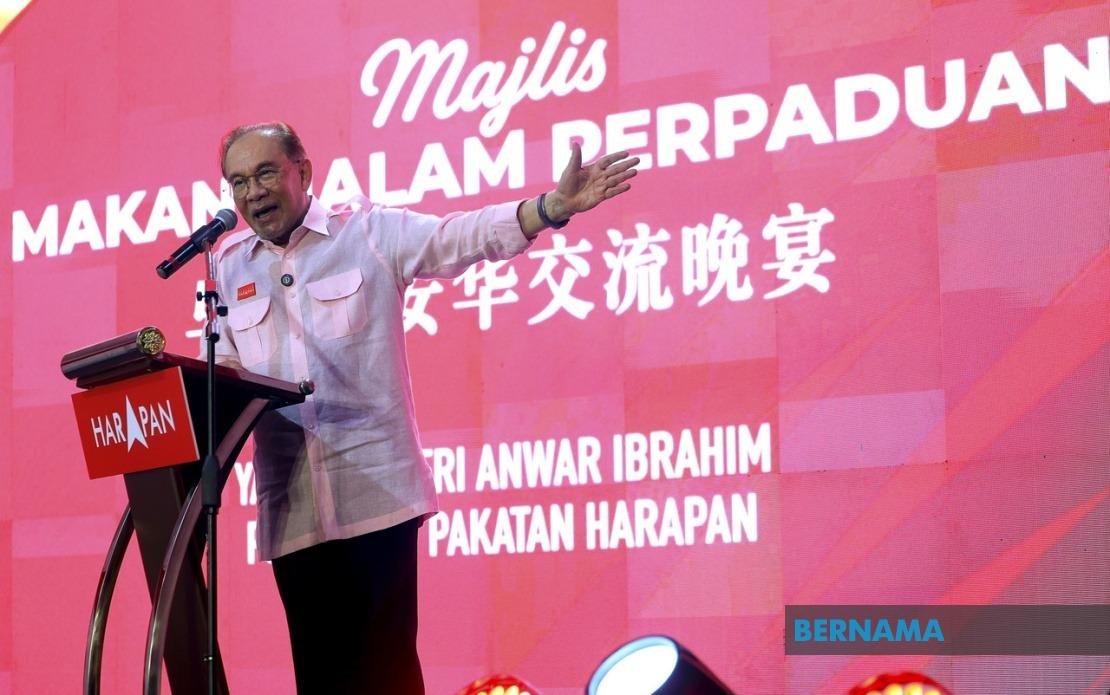
Prime Minister Datuk Seri Anwar Ibrahim has launched a pointed critique at opposition parties contesting the Negeri Sembilan state election, accusing them of prioritising internal power struggles over their ability to serve the people. Speaking at a Pakatan Harapan event in Seremban on July 22, the PKR president highlighted what he characterised as unseemly competition among rival coalitions for the coveted menteri besar post, suggesting this revealed misplaced priorities ahead of the August 1 polls.
Anwar's comments underscored a central theme of PH's campaign strategy: positioning the coalition as united and focused on governance, while portraying opponents as fragmented and primarily motivated by personal political advancement. The prime minister stressed that elections should fundamentally revolve around identifying capable administrators rather than facilitating internal rivalries. By framing the opposition's apparent jostling as evidence of poor leadership instincts, Anwar sought to persuade Negeri Sembilan voters that backing PH would protect the state from the chaos of a leadership tussle that could undermine effective administration.
Central to PH's narrative is the record of the incumbent menteri besar, Datuk Seri Aminuddin Harun, who is defending the Linggi state seat under the Pakatan Harapan banner. Anwar explicitly recommended retaining Aminuddin, citing his stewardship of Negeri Sembilan as characterised by administrative integrity and freedom from corruption and power abuse. This emphasis on clean governance reflects broader concerns within Malaysian politics about institutional accountability, and positions the Unity Government as fundamentally distinct from predecessors marked by governance scandals. For voters in Negeri Sembilan, the appeal to continuity under proven leadership carries particular weight given the state's experience of stable PH administration.
Anwar also used the campaign occasion to rebuke what he described as divisive racial narratives deployed by certain political quarters to mobilise electoral support. This criticism signals PH's rejection of identity-based campaign messaging that pits ethnic or religious communities against one another. The prime minister contrasted this approach with what he characterised as the Unity Government's commitment to inclusive, race-neutral administration that delivers socio-economic benefits to all segments of society. In the context of contemporary Malaysian politics, where racial and religious appeals have periodically dominated electoral discourse, Anwar's intervention represents a deliberate effort to set PH apart as a coalition committed to substantive policy delivery rather than divisive identity politics.
The specific policy initiatives Anwar highlighted—expanded socio-economic allocations, housing programmes, and civil service salary increases—represent tangible commitments intended to resonate with ordinary voters regardless of background. Housing accessibility remains a pressing concern for many Malaysian families, particularly younger professionals and workers seeking to establish themselves in towns and cities. Similarly, civil service remuneration adjustments directly benefit a significant constituency of government employees, whose electoral preferences can swing outcomes in state contests. By embedding these concrete initiatives within a broader narrative about inclusive governance, Anwar attempted to ground PH's ideological positioning in recognisable material improvements.
Packatan Harapan's electoral machinery in Negeri Sembilan reflects careful seat allocation among its component parties. The coalition is fielding candidates across all 36 state constituencies, with PKR contesting 16 seats, the Democratic Action Party eleven, and Amanah nine. This distribution reflects both the parties' relative organisational presence in the state and internal coalition agreements about proportional representation. The arrangement ensures that each major PH component maintains significant electoral presence while avoiding excessive intra-coalition competition that could dissipate the coalition's aggregate vote share. For Malaysian political observers, such seat allocation patterns reveal the complex negotiations required to maintain multi-party coalitions in a highly competitive electoral environment.
The timing of the contest—with polling scheduled for August 1 and early voting on July 28—provides the electorate with a relatively compressed campaign period. This condensed timeline means that campaign messages must penetrate quickly and effectively, amplifying the impact of high-profile interventions like Anwar's remarks. The inclusion of early voting represents an effort to expand electoral accessibility, though such provisions generate ongoing debate about their effects on voting patterns and overall turnout. From a Southeast Asian perspective, Negeri Sembilan's electoral procedures reflect Malaysia's relatively mature democratic infrastructure, though questions about the optimal calibration of voting convenience and security remain subject to legitimate discussion.
Anwar's specific choice to attack the opposition's apparent menteri besar competition suggests deep knowledge of internal dynamics within rival coalitions. The accusation that opposition parties are prematurely quarrelling over leadership posts carries implicit weight only if such competition is visibly evident to voters. This rhetorical strategy works most effectively in contexts where opposition factionalism has previously become public or where structural factors (such as coalition composition or past disputes) make such conflict plausible. By highlighting this dimension, Anwar attempted to undermine opposition credibility even before the campaign reached peak intensity, a typical approach in Malaysian state electoral contests where early dominance of the discourse landscape can substantially influence voter perceptions.
For Negeri Sembilan specifically, the election carries implications extending beyond state-level governance. As a component state of Malaysia's federal system, outcomes in Negeri Sembilan influence the broader balance of power between ruling and opposition coalitions at the national level. A decisive PH victory would reinforce Anwar's political position and his Unity Government's legitimacy, whereas an opposition breakthrough would signal erosion of PH support and potentially embolden challengers to his authority. Consequently, PH's mobilisation in Negeri Sembilan represents not merely state-level electoral competition but a proxy contest for national political momentum.
The substantive stakes of this election for Negeri Sembilan residents centre on which coalition can credibly claim capacity to manage state resources, pursue development priorities, and maintain administrative integrity. The state's relatively modest size compared to major population centres like Selangor or Johor means that state-level administration directly shapes public service quality, infrastructure investment, and economic opportunities for local residents. Voters confronting campaign messaging from competing coalitions ultimately must assess which leaders and parties have demonstrated genuine competence in translating electoral mandates into tangible governance improvements, a calculation that Anwar's remarks attempted to influence through appeals to demonstrated administrative capability and internal coalition cohesion.

