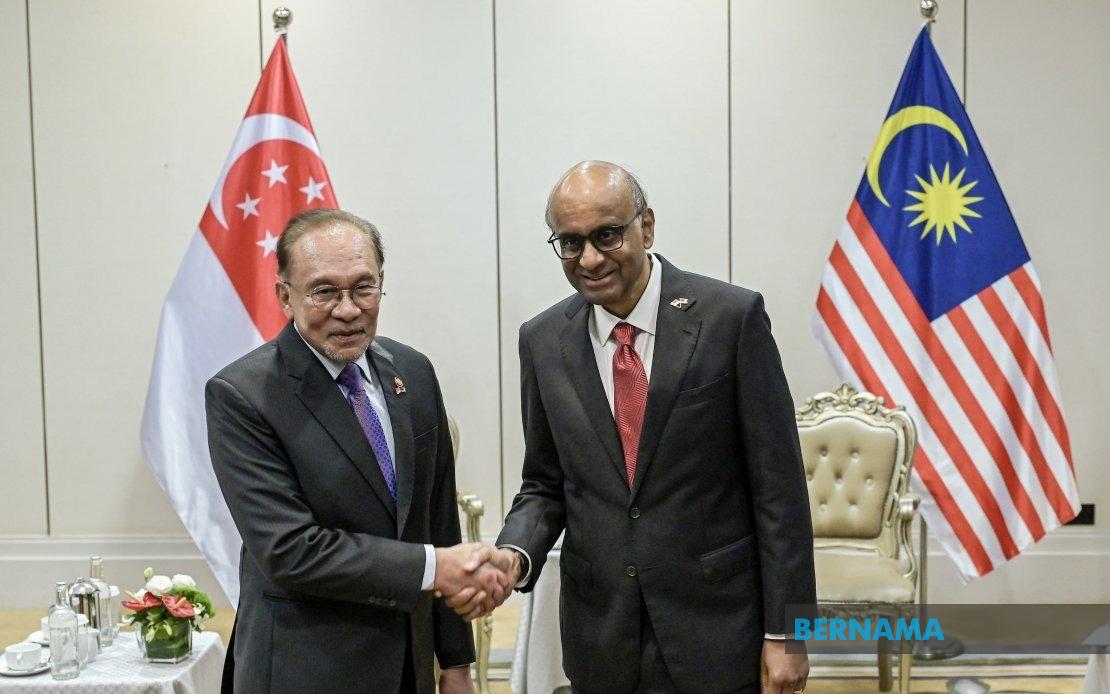
Prime Minister Datuk Seri Anwar Ibrahim received Singapore President Tharman Shanmugaratnam for a formal courtesy call on Monday, July 13, marking a significant moment in the bilateral relationship between Malaysia and Singapore. The 40-minute meeting, held in Kuala Lumpur as part of Tharman's three-day state visit, reflected the high-level diplomatic engagement that characterises ties between the two Southeast Asian neighbours. The gathering brought together key figures from Malaysia's government, including Foreign Minister Datuk Seri Mohamad Hasan, Investment, Trade and Industry Minister Datuk Seri Johari Abdul Ghani, and Entrepreneur and Cooperatives Development Minister Steven Sim Chee Keong, alongside senior officials representing both nations.
Tharman's visit came after he was accorded full state honours at Istana Negara, where Yang di-Pertuan Agong Sultan Ibrahim extended a formal welcoming ceremony befitting a head of state. This ceremonial dimension underscores the ceremonial importance Malaysia attaches to the Singapore leadership's visit. The invitation from the King himself signals the significance both nations place on maintaining robust bilateral relations at the highest levels of government.
The three-day engagement from July 13 to 15 represents a direct reciprocation of Sultan Ibrahim's own state visit to Singapore in May 2024, demonstrating the commitment of both countries to sustaining a pattern of high-level diplomatic exchange. Such reciprocal visits serve as anchors for bilateral relations, offering opportunities for leaders to discuss regional and global matters whilst reinforcing personal relationships that often prove valuable in navigating complex policy issues.
The economic dimension of Malaysia-Singapore ties cannot be overstated. Singapore stands as Malaysia's second-largest trading partner globally, yet within the ASEAN framework, it occupies an even more prominent position as Malaysia's most significant trading partner among fellow association members. This economic interdependence reflects decades of integration across multiple sectors, from manufacturing and finance to services and digital infrastructure.
Bilateral commerce between the two nations reached RM402.35 billion, equivalent to approximately US$93.97 billion, in 2025, representing a modest growth of 1.5 per cent compared to the previous year. Whilst this rate of increase may appear modest on the surface, it indicates sustained economic engagement despite global market uncertainties and varying economic cycles across the region.
More significantly, trade data from the first five months of 2025 paints a more dynamic picture of the bilateral relationship. During January to May, bilateral trade surged 14.5 per cent to RM189.90 billion, equivalent to US$47.87 billion, marking a substantial acceleration compared to RM165.93 billion recorded during the corresponding period in 2024. This year-on-year expansion suggests that the relationship is gathering momentum, potentially driven by recovering regional demand, supply chain adjustments, and renewed investment confidence in both economies.
For Malaysian readers and policymakers, these figures underscore why Singapore remains strategically important to Malaysia's economic strategy. The island republic serves as a crucial entrepot for Malaysian goods destined for global markets, whilst also being a significant investor in Malaysia across sectors including finance, real estate, and technology. The bilateral trade relationship extends beyond simple goods exchange to encompass complex value chains, intellectual property flows, and financial services that bind the two economies together.
The timing of Tharman's visit also reflects broader ASEAN dynamics and the ongoing evolution of Southeast Asian regional architecture. With Malaysia holding various regional responsibilities and Singapore maintaining its position as one of Asia's most developed economies, the dialogue between their leaders carries implications beyond bilateral matters. Discussions likely covered regional security concerns, the evolving relationship with major powers, and ASEAN cohesion at a time when the association faces various pressures and opportunities.
From Malaysia's perspective, maintaining strong ties with Singapore is essential for several reasons. Geographically proximate and economically intertwined, the two nations share responsibilities for regional shipping lanes, cross-border labour movements, and water agreements that require constant diplomatic attention. The state visit provides a platform for addressing both routine administrative matters and strategic issues that might benefit from high-level political engagement.
The inclusion of multiple Malaysian ministers in the courtesy call—spanning foreign affairs, trade and industry, and entrepreneurship—suggests a comprehensive agenda potentially encompassing trade expansion, investment facilitation, and business cooperation. These ministerial presences indicate that the diplomatic engagement extends beyond ceremonial courtesy into substantive policy discussions affecting multiple economic sectors.
For the broader Southeast Asian region, the Malaysia-Singapore relationship serves as something of a barometer for bilateral relations within ASEAN. The two nations have historically managed to maintain robust diplomatic and economic ties whilst occasionally disagreeing on specific issues, demonstrating that substantive partnership can coexist with differing national interests. The smooth execution of such high-level visits reinforces confidence in bilateral dispute resolution mechanisms and the commitment both nations have to dialogue.
Looking ahead, the momentum evident in early-2025 trade figures suggests opportunities for deepening economic cooperation. Both nations stand to benefit from further integration in emerging sectors such as renewable energy, digital transformation, and sustainable manufacturing. The diplomatic space created by state visits provides valuable opportunity to negotiate frameworks that could unlock additional bilateral benefits in these growth areas.

