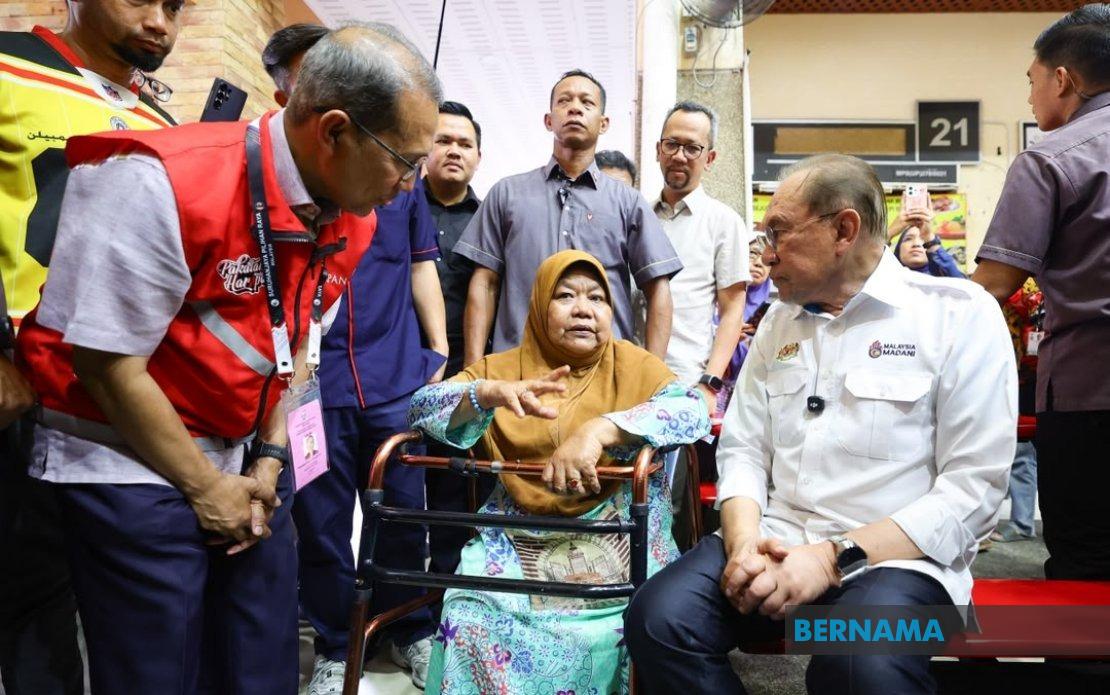
Prime Minister Datuk Seri Anwar Ibrahim has mounted a vigorous defence of the Pakatan Harapan (PH)-led administration in Negeri Sembilan, presenting reciprocal river development initiatives as proof that the coalition government is capable of implementing meaningful infrastructure while maintaining fiscal transparency and returning value to ordinary citizens. Speaking at a community gathering in the Ampangan area of Seremban on July 22, Anwar drew direct parallels between specific river widening and deepening projects and a broader narrative of people-centred governance that prioritises public benefit over political expediency.
The Prime Minister's remarks were carefully calibrated to address voter scepticism about whether PH genuinely delivers on development commitments. He singled out the Ampangan river project as exemplifying an approach where sand extracted during maintenance operations is recycled to finance ongoing infrastructure improvements within the same communities. This circular economic model, Anwar argued, demonstrates how government agencies can extract public resources while simultaneously reinvesting those same resources back into local areas, thereby reducing wasteful expenditure and creating tangible community benefits. The emphasis on this reciprocal mechanism speaks to a broader concern among Southeast Asian voters that elected officials often promise development that materialises elsewhere or never materialises at all.
Beyond the technical merits of the river projects themselves, Anwar framed the Negeri Sembilan government's approach as rooted in what he termed integrity-based governance—a philosophy he contends must underpin all development initiatives. This rhetoric is strategically important given PH's origins as a reform coalition that came to power in 2018 partly on an anti-corruption platform. For Malaysian voters, particularly in smaller states like Negeri Sembilan where electoral competition increasingly focuses on material delivery rather than grand ideological promises, evidence of honest project management and transparent resource allocation carries considerable weight. The Prime Minister's insistence that every development initiative must prioritise public interest suggests an attempt to rehabilitate PH's governance credentials as the coalition faces an uphill struggle in several state contests.
Anwar supplemented his remarks about Negeri Sembilan by invoking a separate example from Port Dickson, where he claimed involvement in hotel development negotiations that factored in the welfare of local fishing communities. This anecdote served multiple rhetorical purposes: demonstrating that PH leadership has long advocated for marginalised groups, establishing a pattern of development projects that serve broader social cohesion, and implicitly contrasting such approaches with the allegedly extractive model of previous administrations. For Malaysian readers familiar with tensions between commercial development and traditional livelihood protection, particularly in coastal districts, this narrative resonates as evidence of a more sophisticated approach to balancing economic growth with social protection.
The political context for Anwar's campaign visit is crucial to understanding the stakes involved. The 16th Negeri Sembilan State Election, scheduled for August 1 with early voting on July 28, represents a significant test of PH's appeal in a state where the coalition faces formidable competition. By appearing in Seremban and delivering a substantive message about governance quality rather than simply exhorting voters to support PH candidates, the Prime Minister signalled that the coalition's campaign strategy hinges on demonstrating competent administration rather than relying on emotional appeals or partisan rhetoric. This approach reflects lessons learned from earlier state elections where voters punished PH candidates perceived as taking victory for granted or disconnected from grassroots concerns.
PH's electoral machinery is operating at full strength in Negeri Sembilan, contesting all 36 state seats with a carefully balanced slate of 16 candidates from the Peoples Justice Party (PKR), 11 from the Democratic Action Party (DAP), and nine from the National Mandate Party (Amanah). This distribution reflects coalition arithmetic at the national level while attempting to field candidates with credible local roots and community support. The fact that party leaders at Anwar's level are personally campaigning in relatively small state elections underscores how significant these contests have become for PH's political trajectory. A strong performance in Negeri Sembilan would provide momentum ahead of potential federal challenges, while a disappointment could embolden opposition narratives about the coalition's declining appeal.
Anwar's explicit appeal to voters to support candidates of integrity regardless of ethnicity—his statement that "there are many good Malays, many good Indians and many good Chinese who have dignity"—reflects the multicultural character of Malaysian electoral competition and PH's historical brand as a cross-communal coalition. In a country where ethnic polarisation has intensified in recent years, and where opposition parties have sometimes sought to consolidate support along narrower demographic lines, PH's messaging emphasising merit and trustworthiness across communal boundaries represents a deliberate counter-narrative. Whether such messaging translates into voting behaviour, particularly in rural or semi-rural constituencies where communal identities and patronage networks remain influential, remains an open question that will be resolved on August 1.
The river management projects highlighted by Anwar also deserve scrutiny within the broader context of climate adaptation and environmental governance in Malaysia. Negeri Sembilan, like much of the country, faces increasing flood risk as climate patterns shift and urbanisation accelerates. Infrastructure investments in river maintenance and deepening address these practical challenges while potentially yielding local economic benefits through sand extraction and material recycling. For voters concerned about whether elected governments take environmental risks seriously, Anwar's emphasis on systematic river management projects offers some reassurance that the state administration approaches such issues proactively rather than reactively.
The timing of Anwar's campaign appearance and his specific focus on transparent governance deserves note given the persistent concerns about political financing and resource allocation that have haunted Malaysian politics generally and PH's record in particular. By consistently returning to themes of integrity and public benefit, the Prime Minister appears to be attempting to foreclose opposition criticism by preemptively establishing that the PH government operates according to different standards than its predecessors. Whether this messaging will prove sufficient to consolidate PH voter support or attract persuadable swing voters in constituencies where the outcome remains uncertain will become apparent once voting concludes and results are tabulated.
As Malaysia's political landscape continues to evolve following the 2022 federal election and subsequent state contests, performances in relatively smaller state elections like Negeri Sembilan carry disproportionate significance. Every seat gained or lost reshapes calculations about coalition durability, intra-coalition dynamics, and the broader trajectory of Malaysian democracy. For voters in Negeri Sembilan facing the choice on August 1, the election ultimately hinges on whether they believe the PH-led government has delivered tangible benefits and demonstrated governance competence, or whether they prefer to give the opposition opportunity to govern. Anwar's campaign message attempted to frame the election as fundamentally about choosing trustworthy leadership capable of implementing projects that benefit ordinary communities, a framing that will either resonate convincingly with voters or ring hollow depending on their lived experience with the incumbent state government.

