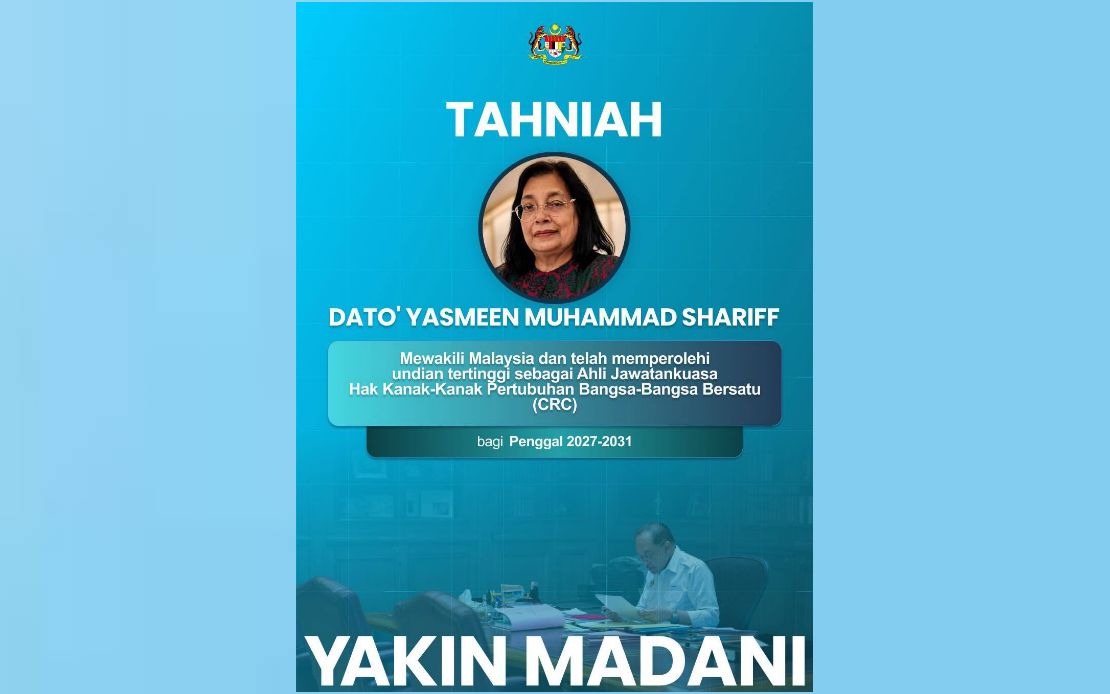
Prime Minister Datuk Seri Anwar Ibrahim has lauded Datuk Yasmeen Muhamad Shariff's election to the United Nations Committee on the Rights of the Child, viewing the development as a significant validation of Malaysia's engagement and influence within the global governance framework. The leadership's warm acknowledgement of the achievement underscores the administration's emphasis on Malaysia's participation in international multilateral institutions and the weight it places on securing positions that allow the country to contribute to global policy discussions.
Yasmeen secured a commanding 136 votes from the 189 States Parties that cast ballots during the 21st Meeting of States Parties to the Convention on the Rights of the Child, held at the UN headquarters in New York this week. This decisive electoral mandate reflects substantial support from the international community and positions her strongly within the committee framework for her term spanning 2027 through 2031. The breadth of her support suggests that Malaysia's candidacy resonated across diverse regional and political blocs within the UN system.
In his public remarks, Anwar characterised the election outcome as a reflection of the international community's confidence in Malaysia's commitment to global issues, particularly those touching on children's welfare and protection. He described the accomplishment as highly commendable and extended his congratulations not only to Yasmeen but also to the Ministry of Women, Family and Community Development, recognising the institutional effort that facilitated her candidacy and campaign. The Prime Minister's framing positions this success within a broader narrative of Malaysia strengthening its diplomatic footprint and advancing national interests through expert participation in UN mechanisms.
This represents Yasmeen's second appointment to the committee, building on her prior service during the 2013-2017 term. Her re-election demonstrates her acceptance and credibility within the committee ecosystem, as well as continuity in Malaysia's engagement with child rights advocacy at the highest international level. The return of a familiar Malaysian expert to this position may facilitate smoother collaboration and institutional memory within the committee's operations.
As a committee member, Yasmeen will function in a personal capacity as an independent expert rather than as a government representative, though her election clearly carries diplomatic significance for Malaysia. This distinction is important in the UN system, where committee members are expected to act impartially according to their professional expertise and conscience, separate from national directives. Nevertheless, her presence on such a body inevitably reflects and influences Malaysia's standing within human rights and child protection discourse at the global level.
Anwar's public statement reflected his administration's strategic approach to international engagement, emphasising that such electoral successes should catalyse further Malaysian efforts to strengthen bilateral and multilateral relationships. He expressed confidence that the achievement would serve as momentum for elevating Malaysia's broader international standing and achieving additional accomplishments on the world stage. This framing suggests the government views UN committee positions not merely as ceremonial honours but as practical platforms for advancing Malaysian interests and values within global governance structures.
The Committee on the Rights of the Child holds significant responsibilities within the UN human rights framework, tasked with monitoring state compliance with the Convention on the Rights of the Child and its optional protocols. Committee members review country reports, issue concluding observations, and provide guidance on implementing child protection standards. Malaysia's representation ensures that Southeast Asian perspectives and experiences inform these deliberations, particularly regarding challenges specific to the region's developing economies and diverse social contexts.
Yasmeen's background and prior committee experience position her to make substantive contributions to discussions on implementation mechanisms and capacity-building initiatives that align with Malaysia's development stage and regional priorities. Her familiarity with international child protection standards from her previous tenure may enable her to champion approaches that balance universal child rights principles with the practical realities facing middle-income Southeast Asian nations.
The election outcome comes at a time when Malaysia is actively pursuing enhanced participation across various UN mechanisms and specialised agencies. This competitive success contrasts with broader concerns about developing nations' representation within international institutions and demonstrates Malaysia's continuing diplomatic capacity to secure election to important global bodies. For Malaysian policymakers and the international community, Yasmeen's appointment signals the country's sustained commitment to child welfare issues and its willingness to engage constructively within human rights frameworks, even as regional debates about sovereignty and universal standards continue.

