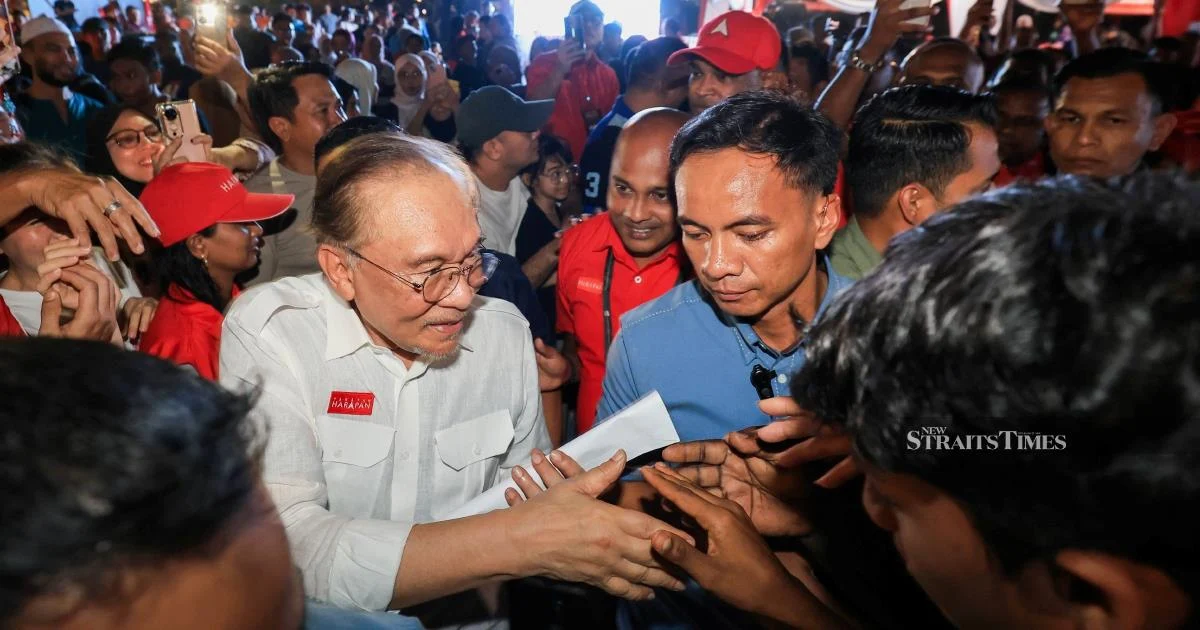
Prime Minister Datuk Seri Anwar Ibrahim has firmly rejected mounting pressure to dissolve Parliament and trigger an early general election, reaffirming that the current unity government maintains sufficient political legitimacy and parliamentary support to fulfil its governance mandate. His remarks represent a deliberate effort to quell speculation about potential snap polls that have circulated within Malaysian political circles in recent months.
The pressure for early elections reflects broader uncertainties within Malaysia's multi-party political landscape. The unity government, formed after the 2022 elections, brought together historically rival coalitions—Pakatan Harapan and Barisan Nasional—alongside smaller partners to create a stable parliamentary majority. However, shifting political dynamics and occasional tensions between coalition members have prompted some observers to question whether the arrangement could endure until the constitutionally mandated election period in 2027 or 2028.
Anwar's dismissal of dissolution calls underscores the government's confidence in its legislative position. Since assuming office, the administration has pursued significant policy initiatives ranging from economic reforms to infrastructure development, all dependent on maintaining parliamentary stability. An early election would interrupt these ongoing programmes and inject considerable political uncertainty into Malaysia's economic environment during a period of global instability and regional competitive pressures.
The political landscape underpinning Malaysia's unity government differs markedly from single-coalition administrations of previous decades. The arrangement requires constant negotiation and consensus-building among coalition partners who retain distinct organisational interests and voter bases. This complexity means that governing becomes an exercise in continuous diplomatic management, making sudden elections potentially destabilising not just politically but economically.
Investor sentiment around Malaysian governance has shown sensitivity to political uncertainty. Previous electoral cycles demonstrated how extended campaigns and uncertain outcomes can weigh on the ringgit, equity markets, and foreign direct investment flows. By affirming continuity, Anwar signals to both domestic and international stakeholders that the administration intends to provide a stable operating environment for businesses and maintains confidence in its parliamentary arithmetic.
Opposition voices calling for fresh elections typically emerge when they perceive advantageous political conditions for themselves. Conversely, ruling coalitions resist dissolution when surveys or internal assessments suggest electoral headwinds. Anwar's robust rejection suggests the government believes its current parliamentary composition serves its interests better than gambling on new electoral outcomes. This calculation reflects pragmatic realism about Malaysia's competitive electoral environment.
The unity government's formation itself represented a historic political recalibration. After decades of competition and mutual recrimination, Pakatan Harapan and Barisan Nasional collaborating at the federal level surprised many observers. The arrangement survived the 2023 state elections, though with mixed results across different states, reinforcing that the coalition possesses genuine staying power rather than representing a temporary expedient.
For Malaysian businesses and investors, Anwar's message carries practical significance. A government committed to its full constitutional term can implement longer-term economic strategies, regulatory frameworks, and infrastructure commitments with greater assurance of completion. This contrasts sharply with the uncertainty generated by potential snap elections, which would freeze policy-making and redirect political energy toward campaigning.
Regional considerations also factor into Malaysia's political calculations. Southeast Asian economies face intensifying competition from regional peers and extra-regional powers. Political instability or governmental distraction through early elections could disadvantage Malaysia's positioning on trade agreements, investment attraction, and technological advancement relative to neighbours like Thailand, Vietnam, and Singapore. Anwar's emphasis on governance continuity implicitly acknowledges these regional competitive realities.
The unity government's internal dynamics, however, require ongoing careful management. Coalition partners occasionally signal discontent through statements or symbolic gestures. These tensions, while manageable within current arrangements, could theoretically accelerate if any major partner perceives insufficient benefits or growing electoral disadvantage. Anwar's firm stance against early elections may partly serve to reassure coalition members that the administration remains committed to the original bargain that brought them together.
Public opinion regarding early elections remains fluid and has typically shifted based on economic conditions, policy satisfaction, and perceptions of government performance. The unity government's mixed performance across different policy domains means public sentiment offers no unambiguous mandate for fresh elections. In such circumstances, incumbent governments typically prefer maintaining status quo arrangements.
Looking forward, the stability Anwar claims to command will face periodic testing. Coalition coherence depends on successful delivery of governance outcomes that satisfy partners' constituencies while maintaining national economic momentum. Each state election cycle, parliamentary vote on contentious legislation, and economic indicator reading becomes a referendum of sorts on whether the unity arrangement serves its partners' interests sufficiently. Anwar's confident rejection of dissolution calls represents a bet that the government can navigate these challenges through its projected term.

