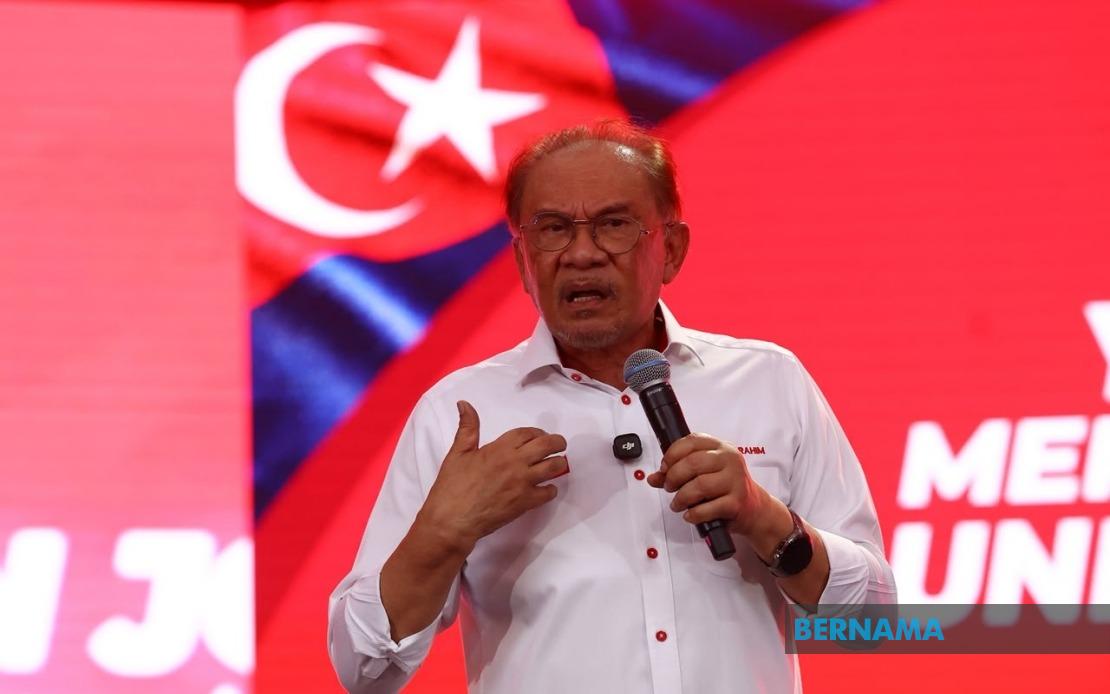
Prime Minister Datuk Seri Anwar Ibrahim moved swiftly to counter viral social media allegations on Wednesday, dismissing suggestions that he had acquired a luxury BMW vehicle for his own purposes during a campaign event in Batu Pahat ahead of Johor's state election this Saturday. Speaking at the 'Yok! Meriahkan Johor! Undi Harapan' programme in Senggarang, he characterized the circulating claims as deliberate falsehoods designed to undermine his political messaging around poverty alleviation and fiscal responsibility.
The denial represents an attempt to contain what has become a recurring line of attack against the administration—accusations that senior officials enjoy lavish perks while advocating for reduced inequality. Anwar's response sought to reframe the narrative by emphasizing the distinction between personal wealth accumulation and the legitimate use of government-owned assets for official purposes. He stressed that the vehicle in question was not a recent acquisition but rather an older government asset being repurposed, casting aspersions on those spreading what he characterized as misinformation.
Addressing the broader question of his vehicle usage, Anwar clarified the provenance and ownership structure of the Mercedes-Benz sedan he currently employs. He explained that the automobile was bestowed upon him as a gift from His Majesty Sultan Ibrahim, King of Malaysia, a detail he presented as evidence of his propriety in handling state resources. Critically, he noted that rather than registering the vehicle under his personal name, he had ensured it was recorded as an asset of the Prime Minister's Department, thereby maintaining clear institutional ownership rather than converting it to personal property.
The Prime Minister's statement contained an implicit contrast with other officeholders, suggesting that his approach differed markedly from those who had historically misappropriated public resources for private enrichment. His invocation of the royal gift carried symbolic weight—accepting a present from the monarch while maintaining its institutional status could be read as a demonstration of both honor and restraint. The emphasis on departmental rather than personal registration appears designed to show compliance with governance protocols and transparency standards.
Official clarification had already been issued earlier in the week through formal government channels. The Prime Minister's Department (JPM) and the Ceremonial and International Conference Secretariat Division (BIUPA) released a joint statement on Monday providing technical details about the BMW vehicle. Their account characterized it as an existing government asset rather than a newly purchased official vehicle, confirming its status within BIUPA's administrative purview and its designation for government logistics operations. This bureaucratic confirmation preceded Anwar's public remarks but did not entirely quell the social media speculation.
The incident reflects broader tensions surrounding elite consumption and public perception in Malaysian politics. Even as living standards face pressure across much of the population, scrutiny of high officials' material circumstances remains a potent political issue. The BMW controversy, whether substantive or manufactured, taps into longstanding public concern about whether political leaders genuinely practice the austerity and restraint they preach. Anwar's framing of the issue—emphasizing inherited vehicles and institutional ownership—suggests an awareness that optics matter as much as technical compliance.
The timing of these allegations during the final days before Johor's state election carries particular significance. The 16th Johor state election, scheduled for Saturday, represents a critical test of Pakatan Harapan's electoral viability. With the coalition contesting all 56 state seats, the campaign period has intensified focus on government credibility and administrative conduct. Allegations about leaders' personal acquisitions, particularly those suggesting hypocrisy between stated values and actual behavior, carry amplified weight in such politically charged moments.
Several Pakatan Harapan figures shared the stage with Anwar during his Senggarang appearance, including Datuk Fahmi Fadzil, who serves as both Communications Minister and the coalition's communications director. The presence of official campaign candidates for three separate constituencies—Onn Abu Bakar, Mohd Khuzzan Abu Bakar, and Felicia Poh Rui Ling—underscored that this was not merely a personal defense but a coordinated messaging effort aimed at protecting the broader coalition's reputation during a consequential electoral window.
For Malaysian voters and regional observers, the incident illustrates the persistent vulnerability of political narratives to challenge through social media channels. The speed at which allegations spread, combined with the official response machinery required to contain them, reflects contemporary electoral dynamics where perception management has become as strategically important as policy substance. Whether audiences accept Anwar's explanations regarding vehicle ownership or view them with skepticism will likely depend on preexisting partisan attitudes and broader assessments of government transparency.
The emphasis on the Mercedes-Benz as a royal gift rather than an official vehicle purchase also warrants closer examination. The distinction between receiving gifts from state institutions and those from private sources remains a potential area for future clarification, particularly as Malaysia's governance standards continue evolving. The way officials navigate these gray areas between personal benefit and public trust will continue shaping electoral calculations and public confidence in institutional leadership throughout the region.

