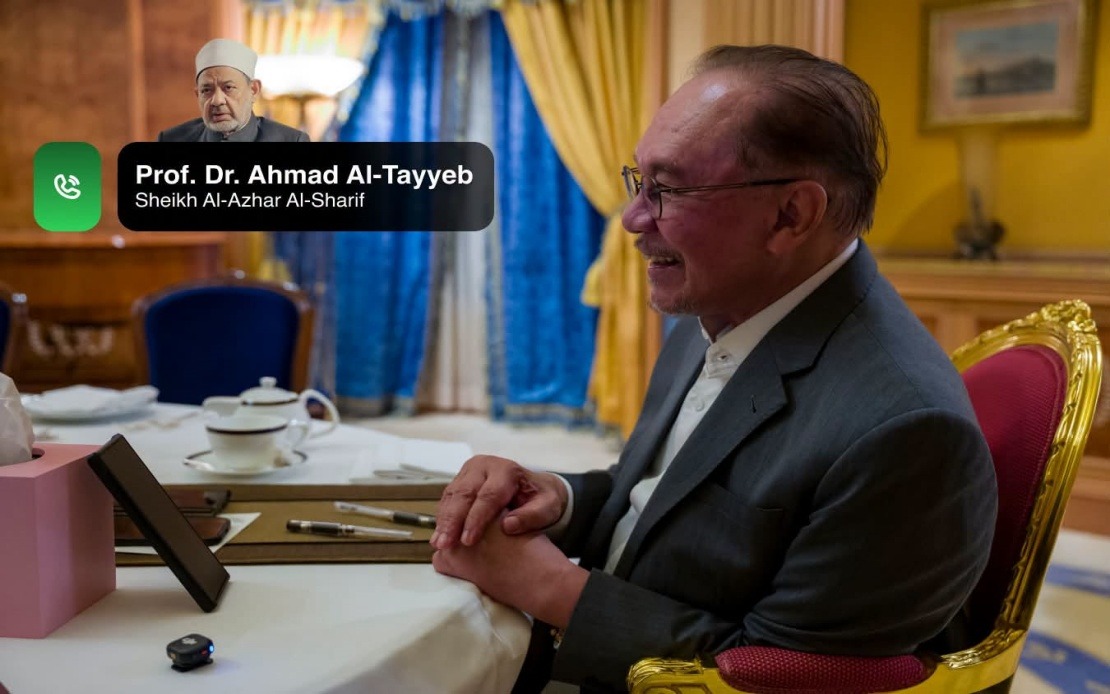
Prime Minister Datuk Seri Anwar Ibrahim held a telephone discussion with one of Islam's most influential religious authorities, Sheikh al-Azhar al-Sharif Prof Dr Ahmad al-Tayyeb, to explore collaborative efforts in promoting Islamic scholarship and religious education. The conversation, which Anwar shared through a social media post, came at the initiative of the Al-Azhar Grand Imam, who called to check on the Prime Minister's wellbeing following his recent surgical procedure and to extend his prayers for a swift recovery.
Anwar expressed gratitude for the spiritual support and well-wishes, conveying that his surgery had proceeded without complications and that his recuperation was progressing favourably. The discussion then broadened into substantive matters concerning the advancement of Islamic knowledge, with both leaders emphasizing the importance of continuing dakwah efforts—the Islamic concept of inviting people to understand and embrace Islamic teachings—alongside formal religious studies. This thematic focus reflects a shared commitment between Malaysia's political leadership and Egypt's premier Islamic institution to deepen religious understanding across Muslim communities globally.
The Prime Minister recalled Sheikh al-Azhar al-Sharif's previous visit to Malaysia, noting that the engagement had made a lasting impression on Malaysia's Muslim population and contributed meaningfully to interfaith dialogue in the country. He specifically mentioned the potential for future meetings, proposing that he and the Grand Imam could reconvene either in Cairo or Kuala Lumpur to advance their joint vision for expanding Islamic knowledge and bringing spiritual benefit to broader society. This emphasis on bilateral engagement highlights Malaysia's growing diplomatic focus on strengthening ties with established Islamic centres of learning, particularly Al-Azhar, which has served as a beacon of Islamic scholarship for over a millennium.
Beyond the principal conversation, Anwar also spoke separately with Mohamed Abdelsalam, Secretary-General of the Council of Muslim Elders (Majlis Hukama Muslimin), who had similarly inquired about the Prime Minister's health. During this exchange, Anwar reciprocated by asking about the wellbeing of Abdelsalam's wife, who is currently hospitalized and undergoing treatment. The Prime Minister extended his prayers for her swift recovery, demonstrating the personal dimension of Malaysia's engagement with prominent Muslim leaders across the Islamic world.
Abdelsalam raised the desire of Sheikh al-Azhar al-Sharif to return to Malaysia for a subsequent visit, signalling ongoing momentum in the relationship between Al-Azhar and Malaysia. The discussion also touched upon several emerging initiatives designed to fortify Malaysia's institutional relationship with Al-Azhar and to promote what Anwar characterized as a form of Islam that is straightforward, accessible, and grounded in authentic scholarship. This framing carries particular significance in the Malaysian context, where the government has frequently positioned itself as an advocate for moderate, inclusive Islam that counters extremist interpretations and fosters social cohesion.
The emphasis on strengthening Malaysia's connection with Al-Azhar underscores a deliberate diplomatic strategy to anchor Malaysian Islamic thought within the intellectual traditions of one of the Sunni world's most respected institutions. Al-Azhar's historical role as a custodian of classical Islamic jurisprudence and theology gives its endorsement considerable weight across Muslim-majority societies. By cultivating a closer relationship with the institution and its leadership, Malaysia seeks to enhance its soft power credentials within the Islamic world while simultaneously importing scholarly frameworks that support its domestic narrative of progressive, knowledge-based Islam.
Anwar also took the opportunity to acknowledge the steadfast support of his wife, Datuk Seri Dr Wan Azizah Wan Ismail, recognizing her role as a model of female leadership characterized by loyalty, sacrifice, and dedication throughout his political career. This personal dimension reflects the importance Anwar places on family support networks, particularly given the demanding nature of Malaysia's prime ministerial office and the challenges he has faced throughout his political journey. His public recognition of Wan Azizah serves both to honour her contributions and to reinforce family-centred values within Malaysia's political discourse.
The conversations represent part of a broader pattern of engagement through which Malaysia's leadership maintains connections with influential Islamic scholars and organizational networks. Such interactions serve multiple purposes: they enable the sharing of perspectives on contemporary Islamic thought, facilitate coordination on issues of mutual concern to Muslim-majority nations, and strengthen Malaysia's positioning as a bridge between the Arab Islamic heartland and Southeast Asia. For Sheikh al-Azhar al-Sharif and the Council of Muslim Elders, engagement with Malaysian leadership provides an opportunity to understand the specific religious and social contexts within Southeast Asia's Muslim communities.
The framing of Islam as simple, free, and authoritative—as described in Anwar's account—reflects Malaysia's philosophical approach to countering radical interpretations while avoiding perceived Western impositions on Islamic practice. This positioning has become central to Malaysia's regional and international diplomacy, particularly as concerns about religious extremism have grown across Southeast Asia. By anchoring this vision within the scholarly authority of Al-Azhar, Anwar seeks to demonstrate that moderate Islam has deep roots in classical Islamic tradition rather than representing a modern, externally-imposed compromise.
Looking forward, the prospect of Sheikh al-Azhar al-Sharif returning to Malaysia signals likely expansion of institutional cooperation between Al-Azhar and Malaysian religious organizations. Such visits typically generate significant media coverage and public engagement within Malaysia's Muslim community, amplifying the messages both leaders wish to convey about Islam's contemporary relevance and the importance of education-based approaches to religious understanding. The emphasis on continued cooperation and strengthened ties suggests that Malaysia views its relationship with Al-Azhar as strategically important for both theological development and diplomatic standing within the Islamic world.
The recovery from Anwar's surgery and his resumption of substantive engagement with international Islamic leaders demonstrates the continuity of Malaysia's foreign policy priorities despite temporary disruptions to the Prime Minister's schedule. The specific focus on Islamic scholarship and dakwah, rather than narrowly political or economic concerns, reflects Anwar's longstanding intellectual interests in Islamic thought and his belief that religious understanding forms a foundational element of effective governance and social cohesion. These conversations will likely inform Malaysia's continued approach to religious education policy, interfaith initiatives, and engagement strategies with Islamic institutions globally.

