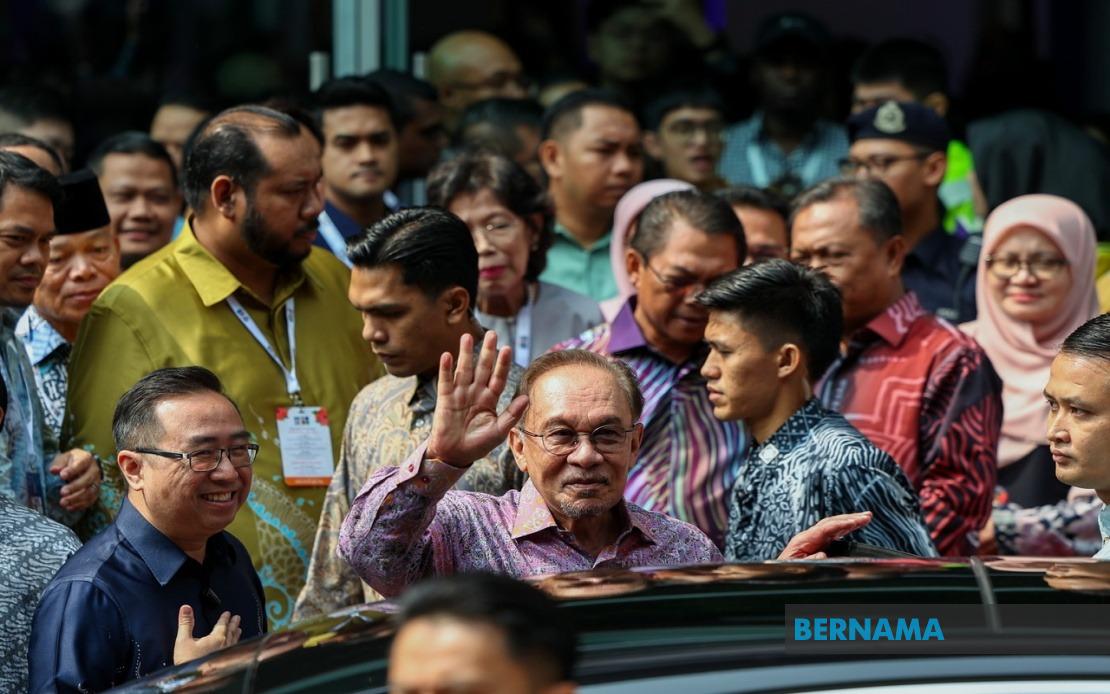
PKR President Datuk Seri Anwar Ibrahim distanced himself from reports that the party had extended an invitation to Datuk Seri Mohamed Azmin Ali to rejoin its ranks, stating on Tuesday that he had received no briefing on such an approach. Speaking at the National Innovation and Commercialisation Expo (NICE) 2026 at the Kuala Lumpur Convention Centre (KLCC), the Prime Minister gave a terse response when questioned about Azmin's potential return, emphasising his lack of involvement or awareness in any such matter.
The clarification comes amid a broader effort by PKR to consolidate support and attract back former members who have drifted to rival parties in recent years. The dynamics within Malaysia's fractious political landscape have created openings for parties to recalibrate their strategies, and PKR appears to be leveraging this moment to strengthen its organisational base ahead of the next electoral cycle. Anwar's public disavowal, however, suggests either internal communication gaps within the party machinery or a deliberate attempt to signal restraint in its recruitment drive.
Azmin, who served as PKR's deputy president before his departure, currently holds the position of secretary-general at Parti Pribumi Bersatu Malaysia (Bersatu), a considerably different standing within the coalition landscape. On the previous day, Azmin had publicly rebuffed any notion of returning to PKR, stating categorically that he would not rejoin the party regardless of formal invitations. His defection represented one of the more significant ruptures within PKR's leadership during a turbulent period when the party grappled with internal fractures and competing visions for its direction.
The apparent campaign to draw former PKR figures back into the fold has nonetheless gained some traction. Multiple reports have surfaced suggesting that former Bandar Tun Razak Member of Parliament Datuk Kamarudin Jaffar and former Nibong Tebal Member of Parliament Datuk Mansor Othman are being positioned as potential returnees to the party. These developments signal that PKR's recruitment efforts extend beyond single personalities and represent a more systematic approach to party rebuilding.
Significantly, former PKR vice-president Datuk Dr Xavier Jayakumar has already confirmed his decision to return to the party, marking at least one concrete success in what appears to be a wider reconciliation initiative. Jayakumar's decision carries symbolic weight given his previous standing within party structures, suggesting that the door remains open for dialogue between PKR leadership and estranged members who may have departed during periods of internal strife.
The distinction between Anwar's personal knowledge and organisational activities raises important questions about internal party governance and communication protocols. If invitations have indeed been extended without the party president's direct involvement, this indicates either a decentralised decision-making structure or dysfunction in how leadership directives are being transmitted through party machinery. Alternatively, Anwar's disclaimer could represent a strategic positioning to avoid appearing desperate for members or to distance the party's leadership from any perceived divisive outreach efforts.
For Malaysian observers of political dynamics, the incident underscores the permeable nature of party boundaries in the current era. The ease with which senior figures move between parties, and the corresponding openness of established parties to reabsorbing wayward members, reflects both the fragmented state of coalition politics and the pragmatic calculations driving individual and collective political choices. PKR's position as a key component of the ruling coalition makes its internal stability a matter of concern beyond party circles.
The timing of these developments also merits scrutiny. With electoral competition intensifying and coalition dynamics remaining volatile, parties are actively positioning themselves to maximise their parliamentary strength and ground-level organisational capacity. PKR's recruitment drive appears calibrated to address perceived weaknesses in representation and party infrastructure, though the mixed signals emanating from its leadership suggest some uncertainty about the strategic direction.
Azmin's steadfast refusal to contemplate a return to PKR despite such overtures indicates that the rupture between him and his former party runs deeper than mere procedural disagreements. His embrace of Bersatu and its associated political culture appears to represent a more fundamental realignment of political allegiances and ideological positioning. The fact that he felt compelled to publicly dismiss the possibility of return suggests that pressure or expectations regarding such a move were sufficiently pronounced to warrant a formal statement.
For the broader political ecosystem in Malaysia and the region, these internal party movements carry implications for coalition stability and electoral strategy. The ability of ruling coalition partners to retain and consolidate membership directly affects their capacity to govern effectively and respond to opposition challenges. PKR's apparent vulnerability in member retention, despite its pivotal role in national governance, suggests that internal party satisfaction and member engagement remain challenges for the party to address systematically.
Anwar's public disavowal of direct involvement in outreach to Azmin may also serve a diplomatic function, allowing PKR to continue recruitment efforts without the Prime Minister appearing personally invested in potentially controversial reconciliations. This separation of political space enables the party to maintain flexibility in its approach while preserving the leadership's public positioning on questions of party loyalty and internal discipline.
Looking forward, the success of PKR's rebuilding efforts will depend on whether broader party reorganisation can address the underlying grievances and structural issues that prompted departures in the first place. Inviting former members back without addressing the conditions that prompted their exit risks repeating previous patterns of instability. The political calculations extending across Malaysia's coalition system will continue to shape these internal party dynamics, particularly as the nation approaches future electoral contests.

