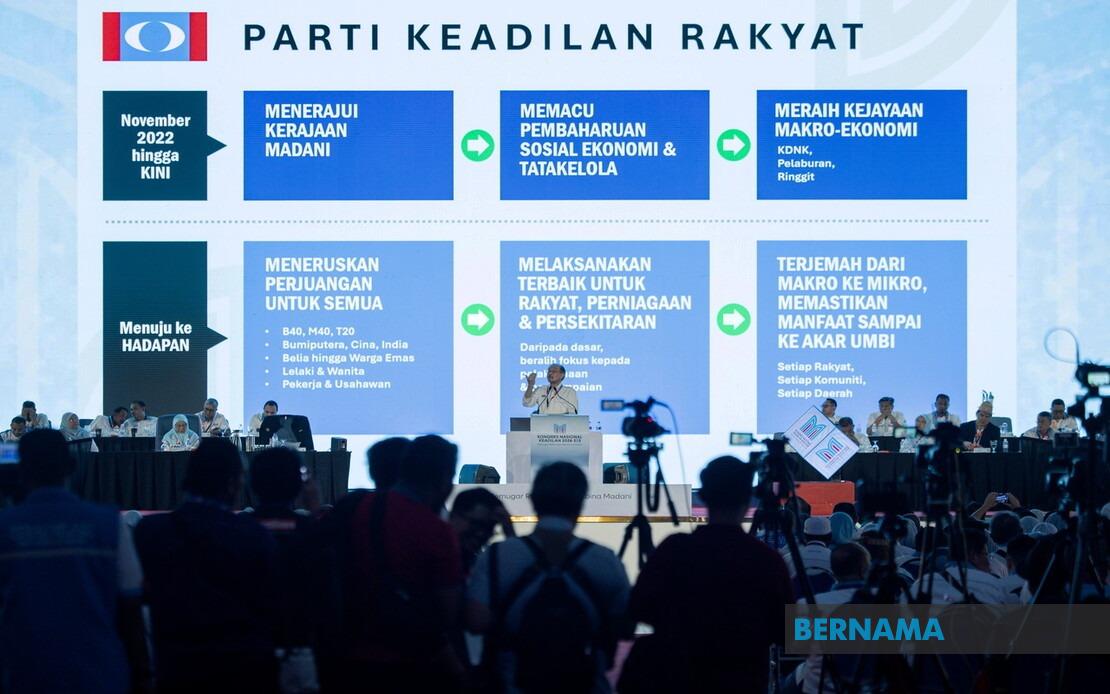
Prime Minister Datuk Seri Anwar Ibrahim has formally vested full authority in Home Minister Datuk Seri Saifuddin Nasution Ismail to discharge the responsibilities of PKR's deputy president while party vice-president Nurul Izzah Anwar takes temporary leave from her position. The announcement, made during the PKR National Congress 2026 held at the Melaka International Trade Centre in Ayer Keroh on August 16, underscores the leadership reshuffle within the coalition's largest component party as it confronts recent electoral disappointments and plots its strategic direction for the coming years.
The decision to place these duties with Saifuddin Nasution—a seasoned politician who currently oversees the Home Ministry portfolio—reflects Anwar's confidence in his long-standing associate. In his address to party delegates, the Prime Minister characterised Saifuddin Nasution as a loyal lieutenant of considerable tenure and institutional understanding, someone whose familiarity with his working methods positions him well to maintain continuity within the party apparatus. While Anwar acknowledged that this additional responsibility might constitute a burden alongside Saifuddin Nasution's ministerial obligations, he framed the assignment as both necessary and critical to PKR's organisational functioning during the interim period.
This interim arrangement had been previously endorsed by PKR's Central Leadership Council on August 6, following a decision to grant Nurul Izzah her requested temporary absence. At that time, party Information Chief Datuk Seri Fahmi Fadzil outlined the structural adjustment, which now formalises the reporting relationship and empowers Saifuddin Nasution to act with the full authority of the deputy president's office. The manoeuvre represents the latest in a series of organisational adjustments within PKR as the party navigates both internal dynamics and external pressures within Malaysia's competitive political landscape.
Beyond the deputy president transition, Anwar unveiled a broader cabinet of leadership appointments designed to strengthen specific functional areas within the party structure. Datuk Seri Amirudin Shari, another vice-president, assumes the position of election director—a role of considerable significance given upcoming electoral cycles at both state and federal levels. Simultaneously, Tengku Datuk Seri Zafrul Tengku Abdul Aziz has been designated as coordinator within the Prime Minister's Office, a position that bridges party machinery with governmental decision-making processes and reflects the intertwining of PKR's organisational and executive functions.
The leadership restructuring also targeted issues within PKR's Negeri Sembilan chapter, where the party suffered a notable defeat in the state election held on August 1. Anwar sought to redirect focus toward Datuk Seri Aminuddin Harun, the former Negeri Sembilan Menteri Besar, emphasising that his extensive political and administrative experience should be channelled toward capacity-building within the party. Specifically, Anwar tasked Aminuddin with concentrating on his role as vice-president and overseeing training initiatives designed to develop emerging PKR cadres across multiple organisational tiers. This pivot represents an attempt to harness Aminuddin's institutional knowledge for succession planning and internal development rather than allow his focus to fragment across multiple portfolios.
The Negeri Sembilan situation had emerged as a point of internal tension, with six PKR division chiefs petitioning for a review of Aminuddin's position as chairman of the Negeri Sembilan PKR State Leadership Council. Rather than immediately acceding to these demands, Anwar signalled his intention to personally examine the matter, suggesting that precipitous personnel decisions might not serve the party's longer-term interests. In his closing remarks at the national congress, the Prime Minister calibrated a delicate balance between acknowledging grievances and defending colleagues against what he framed as disproportionate personalisation of electoral setbacks.
Anwar's treatment of the Negeri Sembilan defeat illustrates his broader philosophy toward managing party accountability. Rather than attributing the loss solely to Aminuddin's leadership of the state-level structure, he insisted that electoral outcomes reflect collective institutional challenges and shared responsibility across the entire party machinery. This approach serves multiple purposes: it deflects demands for scapegoating, preserves the standing of senior lieutenants, and maintains focus on systemic improvements rather than factional recriminations. However, it also carries the implicit recognition that PKR faces genuine electoral vulnerabilities that transcend any single individual's performance.
For Malaysian observers tracking PKR's internal dynamics, these appointments reveal Anwar's confidence in a relatively tight circle of senior figures who have demonstrated loyalty and competence across extended political careers. The elevation of these responsibilities for Saifuddin Nasution, Amirudin, and others occurs against a backdrop of PKR consolidating its position within the broader Pakatan Harapan coalition while maintaining its crucial anchor role in Selangor and other strategic states. These leadership changes signal continuity in strategic direction rather than fundamental reorientation, even as the party confronts questions about electoral appeal and organisational effectiveness in contested territories.
The appointments also carry implications for Malaysia's broader executive structure. Tengku Zafrul's placement as Prime Minister's Office coordinator suggests mechanisms for tightening coordination between party machinery and governmental apparatus—a longstanding concern in Malaysian politics where party and state structures frequently operate in parallel rather than integrated fashion. Similarly, Amirudin's focus on cadre development reflects PKR's apparent concern about replenishing its talent pipeline and ensuring institutional sustainability beyond the current generation of senior leaders.
Moving forward, success in these restructured roles will likely be measured against electoral performance in upcoming contests, particularly in states where PKR holds sway or aspires to greater influence. The assignment of Amirudin as election director places him at the epicentre of campaign strategy and resource allocation, positions that will intensify scrutiny of PKR's competitive positioning. Simultaneously, the broader emphasis on cadre training and development suggests recognition that Malaysia's political landscape is shifting toward more competitive contestation, requiring deeper institutional bench strength and more sophisticated grassroots organisation than previous decades demanded.
The reshuffle ultimately reflects Anwar's consolidation of control within PKR while projecting an image of meritocratic advancement and rational organisational design. By framing these moves as responses to functional necessity rather than factional maneuvering, he seeks to project stability and strategic thinking to both party members and the broader electorate. Whether these arrangements prove sufficient to arrest PKR's electoral momentum or represent merely tactical adjustments to deeper structural challenges will become apparent in contests ahead.

