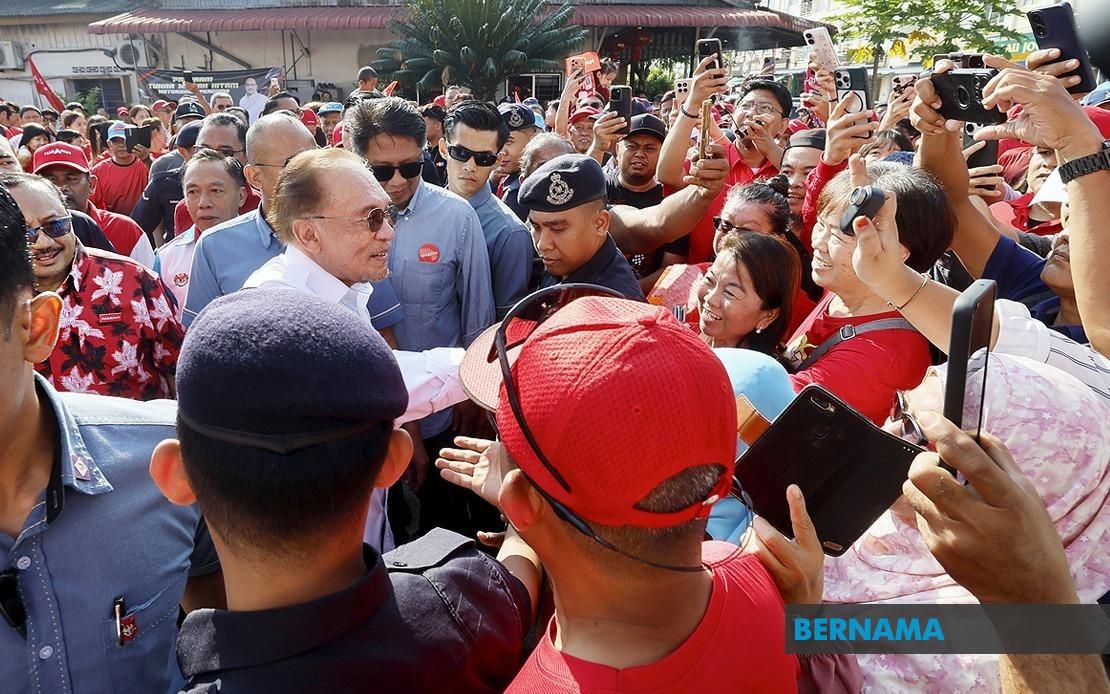
Prime Minister Datuk Seri Anwar Ibrahim has moved to counter perceptions of political bias in federal resource distribution, asserting that his government operates on principles of equitable treatment across all states irrespective of their ruling coalitions. Speaking at a Pakatan Harapan campaign event in Senggarang, Batu Pahat, during the lead-up to the 16th Johor state election, Anwar emphasised that his administration's track record demonstrates genuine commitment to nationwide development rather than selective patronage based on electoral calculations.
The Prime Minister's remarks come amid longstanding concerns in Malaysian politics about resource allocation favouring states controlled by the ruling federal coalition. Anwar, who chairs Pakatan Harapan, sought to distinguish his government's approach from what he characterised as transactional campaign promises. He stressed that substantive project implementation since assuming federal office in late 2022 reflects a genuine dedication to improving living standards across all communities, extending beyond rhetorical gestures during election cycles.
Johor featured prominently in Anwar's enumeration of federal support, underscoring the significance of maintaining momentum in a state that historically alternates political control. The Johor-Singapore Special Economic Zone represents a flagship bilateral initiative with substantial long-term economic implications for the southern region. This cross-border project symbolises federal willingness to invest in infrastructure that transcends local political configurations, serving broader national and regional interests in developing economic corridors.
Flood mitigation emerged as a second major illustration of federal commitment to Johor's welfare infrastructure. The government's approval of multi-billion ringgit allocations for projects in Segamat and Muar addresses a recurring vulnerability in the state's low-lying districts, where monsoon flooding regularly disrupts economic activity and displaces communities. Such infrastructure investments typically transcend electoral cycles and represent essential public goods regardless of administrative affiliation.
Anwar's invocation of support for Kelantan and Kedah—both states with different political complexions at various points—attempts to establish a pattern of non-partisan resource distribution. Kelantan has traditionally been governed by opposition parties, while Kedah's political representation has shifted multiple times. By naming these states alongside Johor, the Prime Minister sought to construct a narrative suggesting federal developmental initiatives respond to regional needs rather than partisan calculations.
The timing of these assertions during active state election campaigning requires analytical attention. While Anwar's framing emphasises principle, observers across Malaysia's political spectrum typically acknowledge that perception often diverges sharply from stated intent regarding federal-state resource flows. Opposition-controlled states frequently complain of marginalization in development spending and infrastructure prioritization, though quantifying such disparities remains methodologically complex given the multiple bureaucratic layers and funding mechanisms involved.
Communications Minister Datuk Fahmi Fadzil's presence at the event underscores the federal government's intention to communicate a coordinated message about inclusive governance. The participation of PH's local candidates—Onn Abu Bakar in Senggarang, Mohd Khuzzan Abu Bakar in Semerah, and Felicia Poh Rui Ling in Penggaram—localises this narrative, connecting federal-level policy assertions to ground-level representation and governance.
For Malaysian readers, particularly those in states where federal-opposition dynamics create tangible anxieties about resource scarcity, Anwar's statements invite critical assessment against observable outcomes. The metrics that matter most—infrastructure completion timelines, funding disbursement rates, maintenance expenditure levels—require sustained monitoring across state lines to evaluate whether rhetoric aligns with implementation reality.
The broader Southeast Asian context renders such federal-state equity particularly consequential for Malaysia. Regional economic competitiveness increasingly depends upon coordinated development across subnational units rather than fragmented approaches. The Johor-Singapore zone exemplifies how cross-border infrastructure demands political consensus transcending local electoral cycles. Federal governments that successfully depoliticise development spending gain capacity for strategic regional engagement that enhances national positioning within ASEAN frameworks.
Looking ahead, Anwar's public commitment to equitable treatment establishes benchmarks against which his government's performance will be evaluated. States experiencing delayed projects or reduced allocations relative to their population or development metrics may invoke these statements as accountability mechanisms. Conversely, states receiving substantial investments can reference federal commitment to justify federal authority in infrastructure planning decisions that occasionally bypass local preferences.

