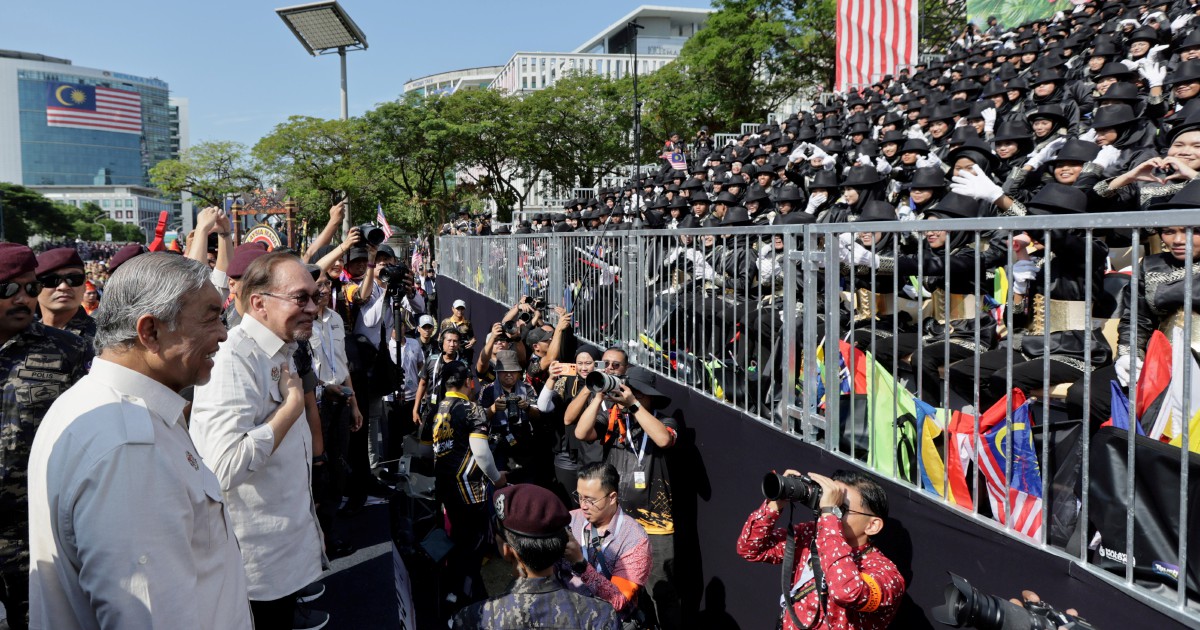
Prime Minister Datuk Seri Anwar Ibrahim seized the opportunity following the National Day parade at Dataran Putrajaya to conduct an unscheduled engagement with crowds gathered at the celebration venue, demonstrating a notably approachable demeanor throughout the afternoon. The impromptu walkabout saw Malaysia's leader pause repeatedly to acknowledge members of the public, with particular attention devoted to younger attendees who had gathered to witness the festive proceedings.
The interaction reflected a broader pattern of high-profile Malaysian leaders making themselves visible and accessible during major national events. Such occasions serve as critical touchpoints between government officials and the electorate, allowing citizens to observe their representatives in an informal setting removed from the formality of parliamentary proceedings or official ceremonies. For many attending the National Day festivities, the encounter provided a rare opportunity to experience a personal moment with the country's chief executive, an interaction that carries symbolic weight in shaping public perception of leadership accessibility.
Anwar's engagement with children during the walkabout appeared particularly significant, as the prime minister devoted considerable time to embracing and conversing with the younger generation. This focus aligned with broader governmental messaging around national unity and inclusivity, themes that invariably dominate discourse surrounding the National Day observances. The visual documentation of such moments through video and photography ensures that these exchanges extend beyond those physically present, amplifying their reach through media distribution and social media circulation to a substantially wider audience.
The National Day parade itself represents one of Malaysia's most significant annual ceremonial events, drawing thousands of participants and spectators to Dataran Putrajaya. The occasion provides an established platform for national leadership to reaffirm commitments to national integration and celebrate the country's diverse cultural heritage. By engaging personally with attendees following the formal parade proceedings, Anwar reinforced the principle that governance extends beyond legislative chambers into direct community interaction.
Such grassroots engagement carries particular relevance in Malaysia's political landscape, where public sentiment and electoral considerations remain paramount. Prime ministers who cultivate visible connections with ordinary citizens often generate positive media coverage that reinforces favorable political narratives. The informality of a post-parade walkabout, as opposed to a scripted public address, creates opportunities for spontaneous interactions that can appear more genuine and resonant with audiences than prepared statements.
For Malaysian children specifically, direct interaction with the nation's prime minister represents a formative experience that shapes their developing understanding of national leadership and civic participation. Such personal encounters can influence long-term attitudes toward government institutions and foster a sense of connection between the individual citizen and the broader machinery of state. Educational institutions frequently highlight such moments when discussing civics and national identity with students.
The timing of the engagement, immediately following the parade's formal conclusion, allowed Anwar to capitalize on the heightened emotional and patriotic atmosphere that characterizes National Day celebrations. Citizens in this state of mind are typically more receptive to positive interactions with authority figures and more inclined to interpret such exchanges favorably. The warm reception Anwar received during his walkabout appeared consistent with public responses documented at similar national occasions.
From a communications perspective, the spontaneous nature of the walkabout and its capture on video creates compelling content that resonates with digital audiences across multiple platforms. In contemporary Malaysian media consumption, such visual documentation of political leaders engaging authentically with ordinary citizens carries substantial value in shaping public discourse and media narratives around political figures. The embrace with children, in particular, generates the type of emotionally engaging content that tends to circulate widely across social networks.
The occasion also underscores the ceremonial importance of Dataran Putrajaya itself, which has become the primary venue for hosting Malaysia's most significant national celebrations. The symbolic weight attached to this location, as the administrative heart of the federal government, reinforces the connection between the physical spaces where Malaysians gather for national occasions and the institutions of state authority that govern the country.
Anwar's approach to public engagement reflects evolving expectations surrounding political leadership in Malaysia, where citizens increasingly anticipate leaders who demonstrate accessibility and willingness to interact beyond formal governmental settings. The success of such initiatives often correlates directly with perceptions of leadership effectiveness and popular approval ratings. The positive reception to his National Day interactions suggests that this mode of engagement continues to resonate with Malaysian voters across various demographic segments.
Looking forward, such moments of public engagement set precedents for how future national occasions might be managed, potentially encouraging greater emphasis on informal leadership-public interaction as a component of official celebrations. The precedent established through visible, affectionate engagement with citizens and children may influence expectations for similar behavior during subsequent national events throughout the Malaysian political calendar.

