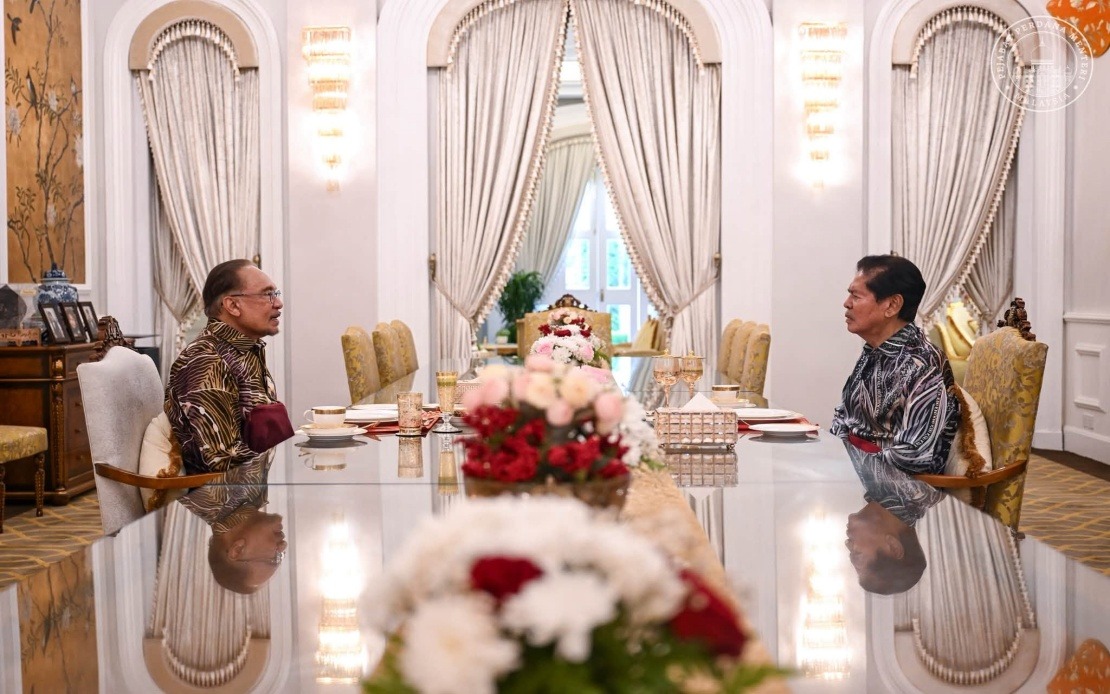
Prime Minister Datuk Seri Anwar Ibrahim brought his two-day working visit to Penang to a close today with a formal tea reception at the Governor's residence, Seri Mutiara, where he was received by Governor Tun Ramli Ngah Talib. The ceremonial gathering in George Town marked the final engagement of a densely scheduled itinerary that had seen the Prime Minister engage with business entrepreneurs, youth organisations, and civic bodies across the state.
The reception served as a diplomatic moment to underscore the strengthening relationship between Malaysia's federal administration and Penang's state government. Through a social media post, Anwar characterised the occasion as a reaffirmation of their joint dedication to advancing the island state's economic prospects and enhancing living standards for its residents. The emphasis on cooperative governance reflects broader efforts to ensure that federal initiatives and state-level priorities remain aligned, particularly as Penang continues its role as a major economic and industrial hub within the northern corridor.
Governor Ramli expressed genuine appreciation for the Prime Minister's willingness to participate in the informal setting before departing for Kuala Lumpur. He framed the visit as a valuable opportunity to deliberate on emerging issues affecting both Penang specifically and Malaysia at large, suggesting that such high-level exchanges facilitate candid discussion beyond the confines of formal ministerial meetings. His remarks highlighted the importance of maintaining open channels of communication between state and federal leadership, a principle essential for coordinated policy implementation across diverse regions.
A particularly human element emerged when Ramli noted that his grandson, Aldrey Alfi, attended the reception and engaged the Prime Minister with questions, receiving warm responses. This informal detail underscores how such visits often transcend their ceremonial purpose, creating personal connections that can strengthen political relationships at a human level. For Malaysian readers, such gestures often carry symbolic weight, demonstrating accessibility and approachability expected of national leaders.
Anwar's two-day presence in Penang involved substantially more than ceremonial functions. His schedule encompassed the Permatang Pauh Entrepreneur Revival Programme, reflecting the government's emphasis on supporting small and medium-sized enterprises at the grassroots level. This initiative speaks directly to economic recovery and job creation concerns that resonate across Southeast Asian markets, where entrepreneurship remains a key lever for inclusive growth.
The Prime Minister also made an appearance at the 15th Malaysia Scout Jamboree, engaging with youth organisations that have traditionally served as platforms for character development and nation-building. Such participation demonstrates the government's investment in youth engagement and suggests continuity in supporting civic institutions that have anchored Malaysian society for generations. For regional observers, Malaysia's approach to youth development through structured organisations like the Scout movement distinguishes it from peers grappling with youth alienation and disengagement.
Additionally, Anwar participated in the MADANI Sahabat 2026 National Day Countdown Programme, an event that ties governance initiatives directly to national identity and patriotic mobilisation. The MADANI framework, introduced by the current administration, emphasises people-centric policies centred on prosperity, integrity, and unity. By anchoring National Day observances within this broader governance philosophy, the government attempts to connect civic celebrations with tangible policy commitments.
The concentration of these engagements within a single visit reflects contemporary Malaysian political strategy: using state visits not merely as courtesy calls but as multifaceted platforms for showcasing government programmes, reinforcing federalism dynamics, and building public support for administration policies. For Penang specifically, the attention from the Prime Minister carries particular significance given the state's historical position as a distinct political entity that has periodically tested federal authority.
Penang's role within Malaysia's economic architecture has evolved considerably, particularly as manufacturing and digital services have increasingly concentrated in this northern corridor. Federal-state cooperation on infrastructure, workforce development, and investment facilitation directly influences the state's competitiveness against emerging regional rivals. Anwar's visit, therefore, signals commitment to maintaining this partnership despite occasional policy divergences that emerge between different levels of government.
The diplomatic tone of the Governor's remarks and the Prime Minister's framing of mutual commitment suggest a period of relative harmony in federal-state relations. Such stability proves essential for attracting sustained foreign direct investment and maintaining business confidence in Penang's governance environment. Any significant rupture in this relationship could complicate economic planning and create uncertainty in commercial circles that thrive on political predictability.
Looking beyond the immediate ceremonial aspects, the visit reflects broader patterns within Malaysian governance: the persistence of hierarchical relationships between federal and state authorities, the importance of personal connections in sustaining political partnerships, and the strategic use of public events for political messaging. For Malaysian and Southeast Asian observers monitoring governance dynamics, such visits provide useful indicators of political stability and institutional functioning.
The conclusion of Anwar's Penang visit with this formal reception encapsulates the ceremonial requirements of Malaysian federalism while simultaneously serving pragmatic purposes of programme rollout and relationship management. As Malaysia navigates complex economic and social challenges, such demonstrations of coordinated federal-state action, regardless of potential underlying tensions, contribute to the veneer of institutional coherence that international observers and domestic stakeholders alike scrutinise when assessing governance quality and investment safety.

