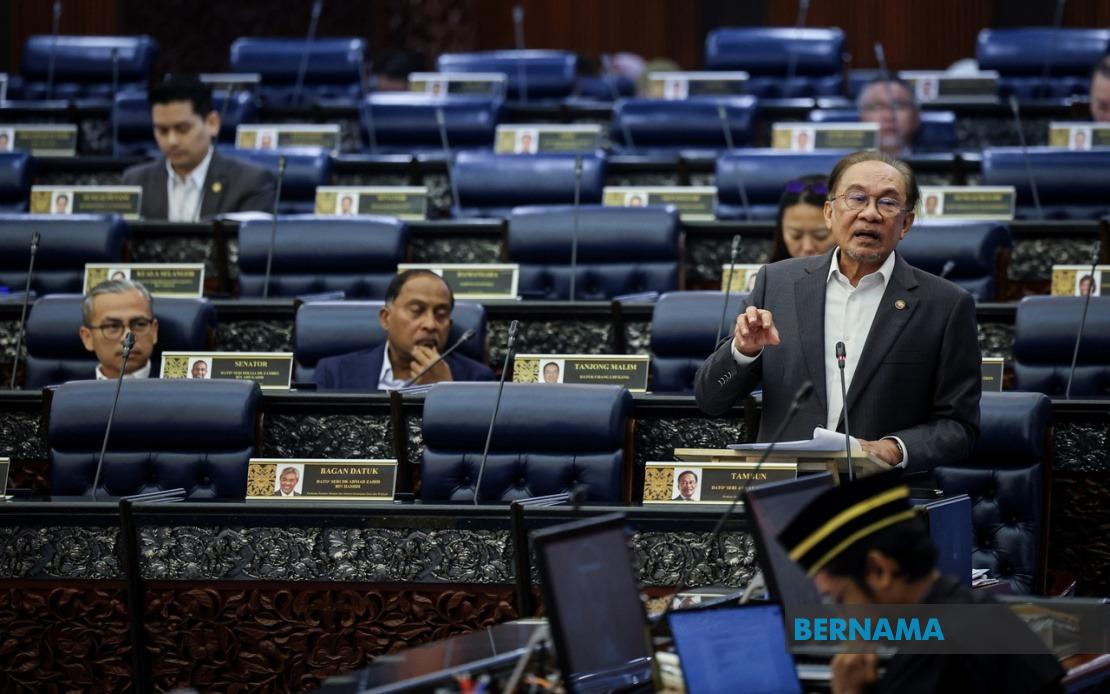
Prime Minister Datuk Seri Anwar Ibrahim moved to defuse controversy over his commentary on the Johor state election polling schedule, telling Parliament on July 7 that his statements reflected a personal perspective designed to encourage civic participation rather than any attempt to direct the Election Commission's decision-making. Speaking during Minister's Question Time in the Dewan Rakyat, Anwar underscored the constitutional independence of the EC and acknowledged its sole mandate to determine when elections take place, while simultaneously explaining the reasoning behind his earlier public observations on the matter.
The genesis of the clarification lay in Anwar's campaign-trail comments favouring a Sunday polling date over Saturday for the Johor election. In articulating this preference, the Prime Minister had highlighted the practical circumstances of Malaysian workers employed in Singapore, many of whom maintain half-day schedules on Saturdays and would find greater convenience in returning across the Causeway on a Sunday. Rather than positioning this as a directive, Anwar characterised it as contextual commentary reflecting the lived realities of cross-border commuters—a demographic consideration relevant to maximising electoral participation without encroaching on institutional prerogatives.
When pressed by Ahmad Fadhli Shaari, the PN MP for Pasir Mas, Anwar reiterated that his observations carried no institutional weight and must not be misconstrued as executive pressure on an independent body. The distinction Anwar drew centred on tone and intent: his remarks entered the public discourse as suggestive commentary rather than as binding direction. He illustrated this boundary by noting that if he were genuinely interfering with the EC's operations, the nature and consequence of his intervention would be materially different. This formulation attempts to preserve both the independence principle central to electoral administration and the legitimate space for political leadership to engage with public policy questions touching on voter accessibility.
The Prime Minister's position acquired additional importance given Malaysia's federal structure and the delicate balance between executive initiative and institutional autonomy. Electoral commissions across democracies face persistent pressure to align their scheduling with political convenience, making Anwar's emphatic acknowledgement of the EC's independence a significant statement of principle. Yet the clarification also reveals the genuine tension between respecting institutional independence and addressing substantive concerns about voter participation among particular constituencies, particularly those whose economic circumstances create geographic complications for exercising the franchise.
Anwar also moved to preempt any diplomatic dimensions to the dispute by firmly shutting down suggestions that Malaysia should seek Singapore's cooperation to facilitate voting arrangements for cross-border workers. When Mohd Sany Hamzan, the PH representative for Hulu Langat, proposed formal engagement with Singapore's Prime Minister Lawrence Wong to ease the logistical challenges faced by Malaysian voters in Singapore, Anwar declined to pursue such an avenue. He stressed Malaysia's adherence to non-interference principles in other nations' domestic affairs and asserted that electoral processes remained exclusively within Malaysia's sovereign domain, regardless of how they affected expatriate Malaysians.
The relationship between Malaysia and Singapore, while characterised by exceptional diplomatic warmth and Anwar's own cordial personal rapport with Wong, could not justify formal bilateral negotiation on electoral matters, the Prime Minister insisted. This positioning reflects a deeper commitment within Malaysian statecraft to avoiding any appearance of external influence over internal democratic processes. International norms around electoral sovereignty weigh heavily in this context, as permitting formal coordination with another country on voting arrangements—even an allied neighbour—could theoretically create precedent for questioning the autonomy of Malaysia's own electoral decisions.
However, Anwar disclosed that informal coordination had already occurred at the corporate level, with Singapore-based companies being apprised of Malaysia's electoral calendar and encouraged to facilitate their Malaysian employees' return home during polling periods. This distinction between unofficial corporate accommodation and formal government-to-government engagement represents a pragmatic middle ground. Corporations operating in Singapore's competitive business environment have natural incentives to support employee participation in home-country elections without requiring diplomatic instruction, and Anwar's acknowledgement of this practice suggests the government had encouraged such goodwill without formalising arrangements through official channels.
The episode illuminates broader challenges facing Malaysia's electoral system in an era of significant cross-border mobility. Tens of thousands of Malaysians reside and work in Singapore, constituting a growing demographic constituency whose voting participation requires creative logistical solutions. The practical difficulty of enabling their participation—particularly given constraints on leave, scheduling, and transportation costs—has not been substantially addressed through policy innovation. While Anwar's informal comments and corporate-level facilitation represent modest efforts, they fall short of systemic measures such as extended polling periods, advance voting provisions, or overseas polling stations that some democracies employ to accommodate diaspora and temporary resident populations.
The timing of this clarification, arriving during the actual campaign period for the Johor election, reflects political sensitivities around the EC's independence at a moment when the institution's credibility carries particular weight. Public trust in electoral administration in Malaysia, while generally robust, depends substantially on demonstrated independence from political pressure. Any perception that the EC responds to executive preferences in determining polling dates risks eroding confidence in the integrity of the entire electoral process. Anwar's explicit acknowledgement of this principle, even as he explained his earlier remarks, therefore served important institutional interests beyond the narrow question of Saturday versus Sunday voting.
Moreover, the exchange in Parliament highlighted how questions about electoral accessibility inevitably implicate political judgment. A government genuinely committed to maximising voter participation across all demographic segments must consider practical barriers to voting, yet must do so in ways that preserve the appearance and reality of institutional independence. Anwar's balancing act—acknowledging the EC's autonomy while explaining the substantive logic behind his scheduling preference—attempted this difficult navigation, though success ultimately depends on how observers interpret his distinction between personal observation and institutional direction.

