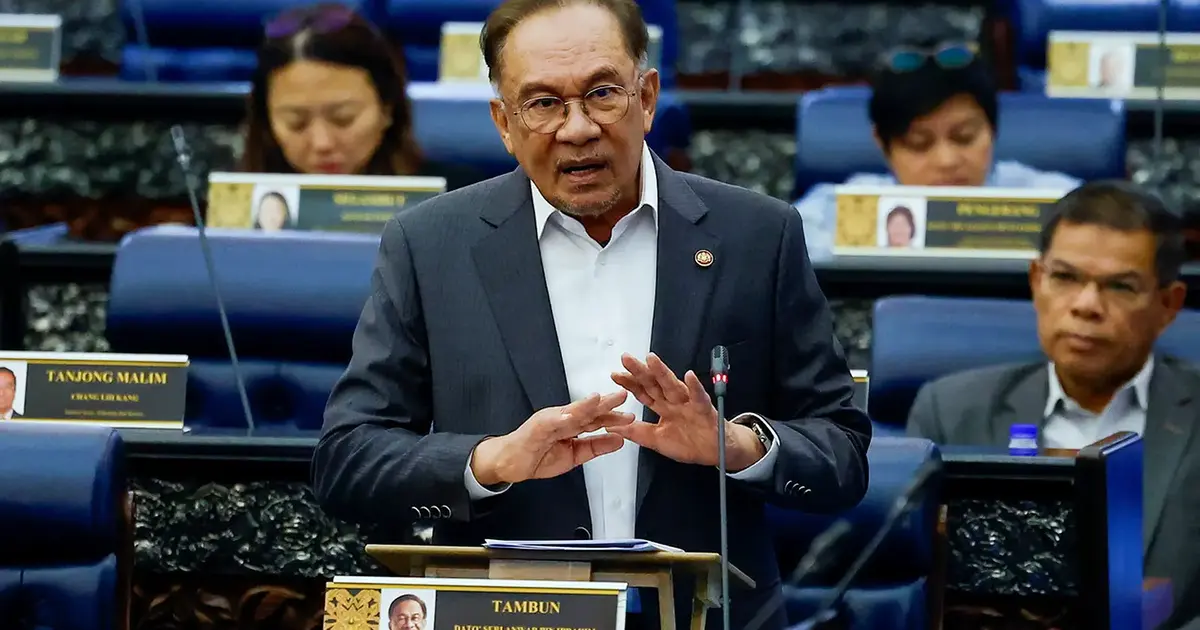
Prime Minister Anwar Ibrahim has pointed to prior approval from Sabah's former administration under Warisan as justification for the state's current special grant framework, citing figures that demonstrate substantial growth in federal allocations over the past four years.
According to Anwar, the grant structure originated from agreements established during the previous state leadership's tenure, with the federal government providing RM53.4 million annually in 2020 and 2021. These figures subsequently escalated, reaching RM106.8 million by 2024, representing a doubling of the initial commitment within a relatively short timeframe. The prime minister's assertion appears designed to demonstrate the federal government's commitment to Sabah while simultaneously highlighting the expansion of support during consecutive budget cycles.
Sabah has long occupied a distinctive position within Malaysia's federal arrangement, owing to its entry into the federation under unique constitutional terms outlined in the Malaysia Agreement 1963. The state has persistently advocated for enhanced financial autonomy and greater federal resource allocation, citing its geographic remoteness, substantial land area, and lower population density compared to peninsular states. These geographical and demographic characteristics have historically formed the basis for special consideration in federal funding mechanisms, distinguishing Sabah from other Malaysian states in terms of infrastructure development and administrative capacity.
The special grant mechanism represents one of several funding instruments through which the federal government addresses regional disparities and supports state-level development priorities. By invoking the previous government's consent, Anwar seeks to establish continuity and consensus across different administrations regarding Sabah's funding arrangements. This rhetorical strategy underscores that federal support transcends partisan boundaries and reflects a longstanding commitment rather than a newly introduced political favour.
The trajectory from RM53.4 million to RM106.8 million warrants examination within the context of Malaysia's broader fiscal environment. The intervening period encompassed the COVID-19 pandemic, which fundamentally disrupted government revenue streams and compelled substantial reallocation of budgetary resources toward emergency response measures. Within this constrained fiscal landscape, the doubling of Sabah's special grants signals deliberate prioritisation of the state's developmental needs and reflects acknowledgment of its vulnerabilities during periods of national economic stress.
The political implications of Anwar's statement extend beyond mere financial transactions. Sabah's electoral significance within Malaysia's parliamentary framework makes the state a focal point for competing political coalitions. The Warisan party, which previously governed the state until the 2022 state elections, remains a substantial political force, and its cooperation or tacit acceptance of funding arrangements carries weight in contemporary political negotiations. By emphasising continuity between administrations, Anwar attempts to depoliticise the funding question and position federal support as a structural feature of the Malaysian federation rather than a transactional component of political negotiation.
The present Sabah government, led by Chief Minister Hajiji Noor of the United Malays National Organisation, operates within this inherited framework while navigating its own fiscal priorities and developmental ambitions. The state administration must balance the deployment of federal grants against local revenue generation and the addressing of pressing infrastructure and social service deficits. For constituents in Sabah, the practical significance of these allocations lies in their translation into educational facilities, healthcare infrastructure, transportation networks, and administrative capacity enhancement.
Regional observers in Southeast Asia have noted Malaysia's model of asymmetric federalism, wherein states possess varying degrees of autonomy and resource entitlements. Sabah's special grant arrangement exemplifies this model's flexibility, permitting customised solutions to address the distinct challenges presented by the state's geographical and demographic profile. The Malaysian federation's capacity to accommodate such variations has contributed to the nation's stability, though periodic tensions emerge regarding the equity of resource distribution and the adequacy of central government support for state-level aspirations.
The financial progression documented by Anwar reflects not merely nominal increases but represents a substantial enhancement of Sabah's annual federal allocation. When contextualised against population size and per capita distribution metrics, the grants assume particular importance for addressing fundamental service delivery gaps. Infrastructure development in peripheral regions typically demands proportionally higher per-unit investment costs owing to geographical challenges, and the escalating grants provide necessary resources for tackling these barriers to development.
Moving forward, the sustainability and trajectory of these grant allocations remain subjects requiring clarity. Economic forecasts, petroleum revenue fluctuations affecting federal revenues, and evolving national development priorities will influence future budgetary allocations to Sabah. The prime minister's invocation of consensual agreement with the previous administration establishes a baseline expectation against which future governments will be measured, potentially constraining future administrations' flexibility in grant determination while simultaneously establishing a floor beneath Sabah's federal support.
For Malaysian policymakers and political actors, Anwar's statement represents an attempt to normalise special financial arrangements for Sabah within the prevailing political narrative. By anchoring contemporary allocations to decisions made by a different political administration, the prime minister endeavours to demonstrate that such support enjoys cross-partisan endorsement and reflects enduring national commitments rather than ephemeral political calculations. This framing proves particularly relevant during periods of heightened political competition for Sabah's electoral support.

