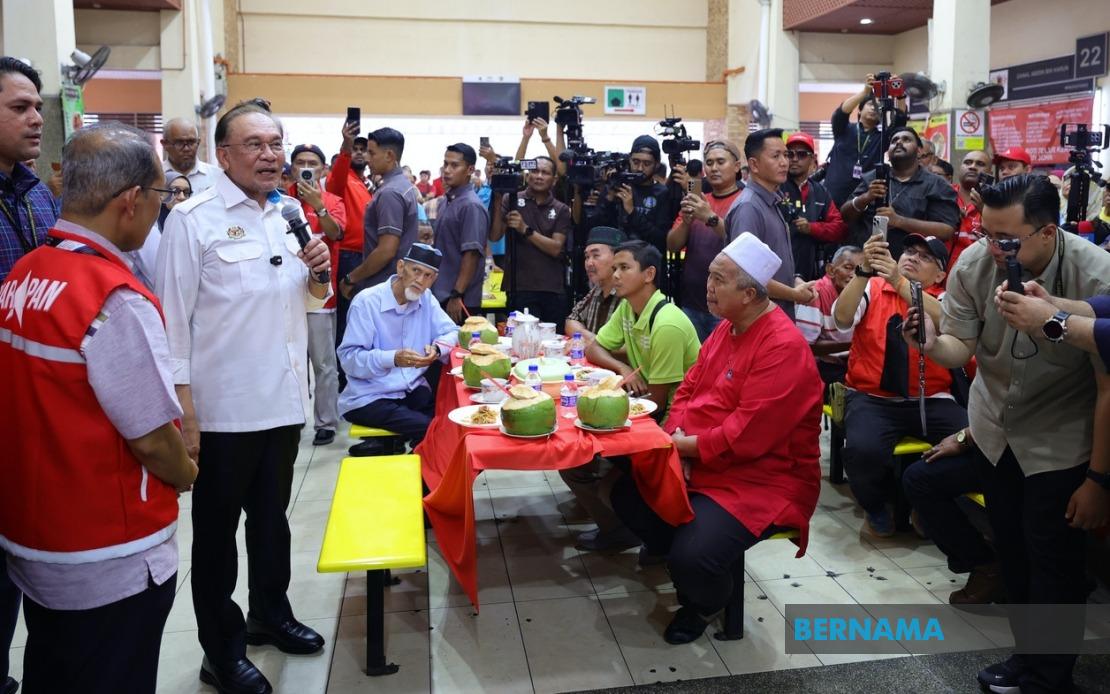
Prime Minister Datuk Seri Anwar Ibrahim has made a direct appeal to the voters of Negeri Sembilan to return Pakatan Harapan to power in the upcoming state election, framing the ballot as a choice between continuity and uncertainty. Speaking in Seremban on July 22, Anwar stressed that a reinforced electoral mandate would provide the platform needed to sustain the political equilibrium that has characterised the state over the past three years, allowing both state and federal administrations to operate in synchronisation toward shared development goals.
The Pakatan Harapan chairman articulated a vision in which renewed voter confidence would translate into tangible improvements across Negeri Sembilan. A cohesive political environment, he suggested, would remove friction between state and federal levels and enable the streamlined delivery of infrastructure projects and welfare initiatives that directly affect household living standards. This framing attempts to position the election not as a simple choice between competing parties, but rather as a referendum on whether voters wish to maintain the current trajectory or risk disruption through political fragmentation.
Anwar acknowledged the leadership of Menteri Besar Datuk Seri Aminuddin Harun, crediting both the state chief minister and inter-party cooperation within the PH coalition for what he characterised as three years of relative administrative calm. This recognition reflects the coalition's strategy of presenting itself as a stabilising force, particularly important in a state where political volatility has historically posed challenges. The emphasis on stability resonates with moderate voters who prioritise predictable governance over ideological change, a crucial demographic in a state where margins can be razor-thin.
Yet Anwar's messaging also contained an implicit acknowledgement that the PH administration's record is not flawless. Rather than presenting an unblemished track record, he invited voters to view the upcoming election as an opportunity to provide constructive feedback and demand further refinements. This softer approach—admitting imperfection while requesting a chance to improve—diverges from the triumphalism often deployed during campaign season and may resonate with pragmatic voters fatigued by hyperbolic political rhetoric.
The tactical composition of PH's candidate slate reflects the careful balancing act required to maintain coalition unity. With 16 seats allocated to PKR, 11 to DAP, and nine to Amanah across all 36 contested seats, the distribution attempts to acknowledge each component party's role while maintaining the dominant partner's preeminence. These internal negotiations, typically conducted behind closed doors, often generate friction, and the public coherence displayed by Anwar's campaign messaging suggests the coalition has at least temporarily resolved outstanding tensions.
From a Malaysian political economy perspective, this election holds significance beyond Negeri Sembilan's borders. The state serves as a bellwether for federal political sentiment, and a strong showing for PH would provide Anwar with renewed political capital ahead of the 2025 federal elections. Conversely, substantial losses would embolden opposition figures and create internal pressure within PH's component parties, potentially destabilising the federal coalition. The stakes therefore extend well beyond the state capital of Seremban.
The Election Commission's scheduling of the contest for August 1, with early voting on July 28, provides a compressed campaign window that typically favours incumbent administrations with greater access to state resources and media coverage. This timetable gives voters limited time to absorb opposition messaging, which may advantage the ruling coalition, though it also risks voter fatigue and lower turnout if the campaign fails to generate sufficient engagement.
Negeri Sembilan's political economy has traditionally centred on its palm oil and rubber processing sectors, though urbanisation and service sector growth have diversified the state's economic base. State-level policies on land development, smallholder support, and agricultural labour standards directly affect households in these communities, making governance competence a material issue for many voters. Anwar's emphasis on development delivery thus carries concrete implications for employment and household income in ways that resonate beyond abstract political principles.
The strategic deployment of the stability narrative by the ruling coalition also reflects broader regional trends. Across Southeast Asia, voters increasingly evaluate incumbent governments on their capacity to deliver efficient services and maintain predictable institutional frameworks, rather than on ideological positioning alone. This shift has elevated administrative performance as a primary electoral criterion, and PH's decision to foreground stability and delivery rather than revolutionary change aligns with this evolving voter calculus.
Anwar's invitation for voter feedback and willingness to acknowledge imperfection creates a softer landing zone should PH experience electoral setbacks in specific constituencies. Rather than framing any losses as categorical rejection, the coalition can position them as areas requiring renewed attention and refinement. This rhetorical flexibility, whether consciously deployed or not, provides the coalition with interpretive latitude in claiming victory or managing defeat depending on results.
The countdown to August 1 will test whether PH's coalition unity holds under campaign pressure and whether the stability argument resonates sufficiently to overcome any anti-incumbency sentiment. For Malaysian political observers and regional analysts tracking the trajectory of Southeast Asian governance, the Negeri Sembilan outcome will provide crucial signals about the durability of PH's federal coalition and the electoral appetite for continued Anwar Ibrahim-led stewardship at the national level.

