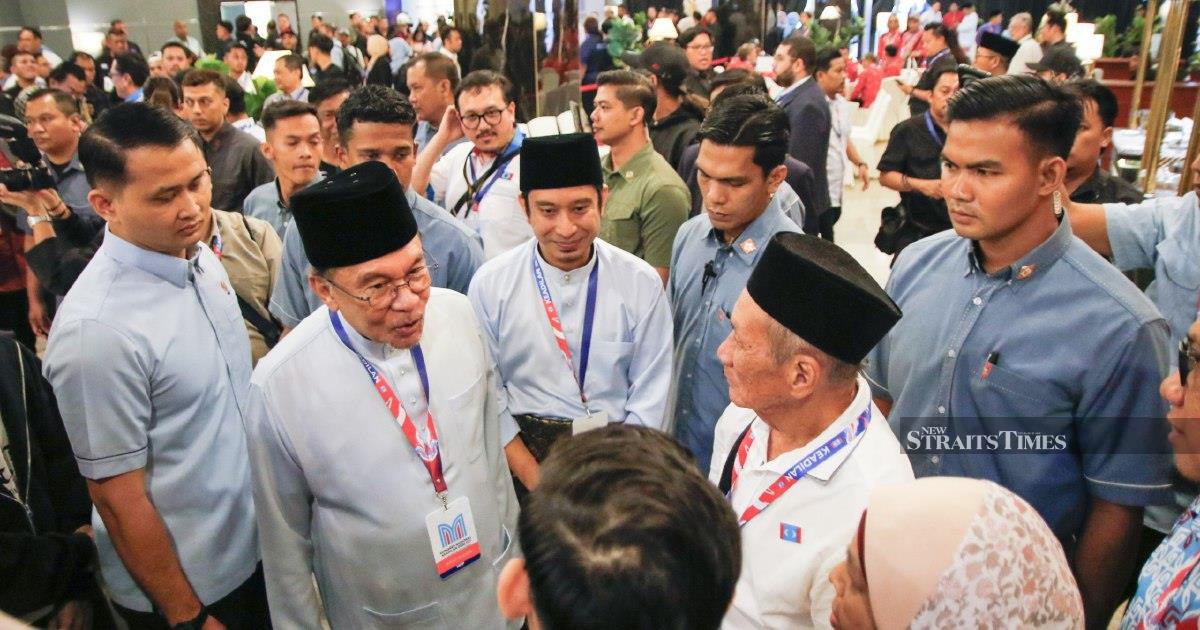
Prime Minister Datuk Seri Anwar Ibrahim moved to extinguish mounting speculation about the state of his relationship with Deputy Prime Minister Datuk Seri Dr Ahmad Zahid Hamidi on a visit to Ayer Keroh, firmly stating that suggestions of deteriorating ties between them do not reflect reality. The denial comes against a backdrop of persistent political chatter within Malaysia's leadership circles about possible friction between the two figures, who lead the coalition government's two largest components.
Anwar's explicit reassurance signals an attempt to project unity at the apex of federal government, a critical concern for a coalition that has navigated considerable complexity since its formation. The Prime Minister's characterization of relations as "good at the national level" appears carefully calibrated to address localised tensions or factional disputes that may exist without conceding any fundamental breakdown in governance arrangements between him and his deputy.
The timing of Anwar's intervention underscores the political sensitivity surrounding leadership dynamics in Malaysian politics. Coalition administrations depend heavily on the stability of relationships between component parties and their leading figures, particularly when managing diverse constituencies and policy priorities. Any perceived distance between the Prime Minister and his deputy risks emboldening opposition forces and creating uncertainty among coalition supporters regarding the government's continuity.
Zahid, as head of the United Malays National Organisation (UMNO), commands substantial parliamentary representation and grassroots organisational capacity. The stability of his relationship with Anwar, who leads PKr, directly affects the coalition's capacity to manage legislative business and maintain party discipline. Speculation about their ties invariably triggers concerns about whether underlying disagreements might eventually destabilize the government or force significant policy compromises.
Political observers have long noted that coalition governments inherently involve tension between different power bases, ideological emphases, and constituent interests. Malaysia's experience with multi-party administrations demonstrates that managing these tensions requires constant attention from senior leaders. Zahid's position as Deputy Prime Minister places him in a uniquely sensitive position—close enough to Anwar to be integral to decision-making, yet leading a party with its own agenda and membership that may not always align perfectly with broader coalition directions.
The Ayer Keroh setting for Anwar's statement carries its own significance within Malaysian political geography and history. Such venue choices for high-profile statements often reflect deliberate efforts to address regional concerns or strengthen messaging in particular constituencies. The specific location may indicate an intent to reach particular audiences beyond national media, suggesting the statement targets broader internal coalition constituencies as much as public consumption.
Anwar's approach mirrors patterns established by other coalition leaders navigating similar circumstances. Rather than dismissing concerns outright, he provides a measured affirmation of functional relationships while implicitly acknowledging that questions exist requiring response. This rhetorical strategy acknowledges public and internal awareness of potential tensions whilst asserting that they remain manageable and do not threaten operational coherence.
For Malaysian political stability, the persistence of such rift speculation itself matters as much as the underlying reality. Each cycle of rumour and denial requires leadership intervention, diverting attention and political capital that might otherwise address policy priorities. The frequency with which Malaysian administrations must publicly reaffirm their internal cohesion suggests that coalition management remains among the most delicate and resource-intensive aspects of contemporary Malaysian governance.
The relationship between Prime Minister and Deputy carries particular weight in Malaysian constitutional arrangements and political practice. Unlike purely ceremonial arrangements in some systems, Malaysia's Deputy Prime Minister role carries substantive authority and represents clear expectations of succession planning. Zahid's position thus involves not merely executing delegated responsibilities but embodying potential alternative leadership. This structural reality inevitably creates complex dynamics regardless of personal relationships.
Anwar's statement also reflects awareness that in the Malaysian political environment, perceptions shape outcomes as powerfully as reality does. Whether genuine friction exists becomes almost secondary to the reality that speculation about it affects confidence, undermines coalition messaging, and provides ammunition to opposition figures seeking to portray the government as unstable. Denying rifts therefore becomes a necessary maintenance activity for any coalition administration seeking to project competence and unity.
Looking forward, such public reassurances likely will not eliminate ongoing speculation about coalition dynamics. The structural incentives embedded in Malaysia's multi-party coalition system mean that tensions will periodically arise, requiring periodic reaffirmation of commitment from senior figures. The ability of Anwar and Zahid to manage these cycles effectively will significantly influence whether the coalition can deliver on its legislative agenda and consolidate support ahead of future electoral contests.
For regional observers monitoring Malaysian politics, Anwar's statement reinforces the fundamental reality that despite periodic tensions, the major coalition partners remain invested in maintaining the administration. Such continuity provides predictability for Southeast Asian neighbours and international partners tracking developments in the region's largest economy, even as coalition management remains perpetually demanding work.

