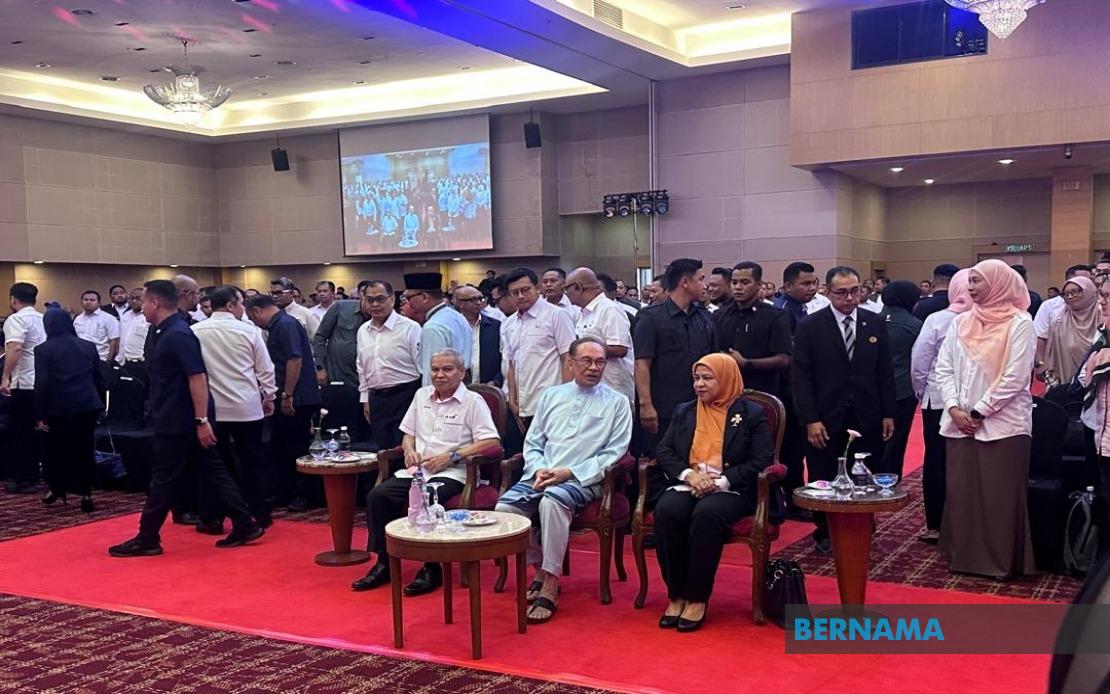
Prime Minister Datuk Seri Anwar Ibrahim has signalled that any official statement regarding the Federal Land Development Authority will only come after he receives the final report from the Special Task Force currently investigating the agency's operational and administrative practices. Speaking at Tenera Hotel in Bangi following a session with FELDA leadership, Anwar emphasised the importance of allowing the investigative process to reach its natural conclusion rather than rushing to public disclosure.
The government established the Special Task Force to conduct a comprehensive examination of how FELDA has been managed, with particular attention to longstanding concerns about governance and operational efficiency. While the exact timeline remains fluid, officials previously indicated that the investigation would likely take several months to complete, suggesting that a formal announcement could materialize before year-end. Anwar's cautious approach reflects recognition that FELDA's importance as a major land settlement and agricultural development institution demands thorough scrutiny before any corrective measures are unveiled.
The Prime Minister outlined the investigation's scope during his remarks, explaining that the task force would identify historical management shortcomings while simultaneously focusing on current administrative standards and future strategic direction. This dual focus—examining past dysfunction while evaluating present-day operations—suggests that the inquiry is not merely a post-mortem exercise but rather a foundation for institutional reform. FELDA oversees vast tracts of land settled with farming families across Malaysia and represents a critical pillar of rural development, making any findings potentially consequential for hundreds of thousands of landholders and their dependents.
FELDA's governance has long attracted scrutiny from civil society groups, opposition parliamentarians, and media watchdogs concerned about transparency, land utilization, and whether settler communities have received fair returns on their holdings. The establishment of this task force represents tacit acknowledgment from the ruling coalition that questions about FELDA's stewardship merit official investigation. The presence of FELDA chairman Tan Sri Ahmad Badri Mohd Zahir and director-general Datuk Dr Suzana Idayu Wati Osman at the session underscores the government's desire to maintain organizational stability while the investigation proceeds.
Anwar's comments also carry broader political significance given ongoing public discourse about institutional accountability across Malaysia's government apparatus. His explicit comparison to the Royal Commission of Inquiry into Tabung Haji suggests that the FELDA findings, like the TH report, will eventually become public documentation available for citizen scrutiny. This commitment to transparency contrasts with earlier administrative practices and reflects the current government's stated commitment to institutional reform, though the delayed release schedule also allows the authorities time to consider how to manage potentially sensitive findings.
The Special Task Force's investigation encompasses management structures, operational efficiency, resource allocation, and governance mechanisms that have accumulated over FELDA's decades of existence as a state-backed enterprise. Such investigations typically examine financial accountability, procurement practices, personnel decisions, and land management protocols. The scope suggests that investigators are not restricting their attention to recent years but rather undertaking a broader historical assessment to identify systemic weaknesses and trace how particular problems became entrenched.
For Malaysian stakeholders—particularly the settler communities that form FELDA's foundation—the investigation's findings could have material implications regarding land valuations, dividend distributions, management reforms, and organizational restructuring. Agricultural communities relying on FELDA-administered schemes have periodically expressed frustration regarding commodity price volatility, input costs, and what they perceive as inadequate institutional support. An investigative report addressing these grievances might catalyze policy shifts affecting how the authority interacts with settled farming families and allocates resources toward agricultural productivity and settler welfare.
Regionally, Malaysia's approach to investigating FELDA parallels efforts across Southeast Asia to enhance governance standards in state-owned enterprises and agricultural development institutions. Neighbouring countries have similarly undertaken examinations of land authority performance, settlement programs, and rural development effectiveness. The Malaysian investigation therefore contributes to broader regional conversations about balancing institutional stability with accountability mechanisms and public disclosure requirements for entities managing significant natural resources and affecting rural populations.
The task force's eventual report will likely generate intense political interest given FELDA's electoral significance in rural constituencies where settler communities constitute important voting blocs. Political parties frequently contend for influence in FELDA-administered areas, and any report findings could factor into campaign messaging and policy positioning ahead of future electoral contests. Anwar's emphasis on releasing the report publicly, rather than confining it to internal government review, suggests awareness that credibility demands open disclosure rather than selective or limited circulation.
As the investigation progresses, observers will watch whether the task force produces findings that merely critique historical management or whether it recommends structural reforms, leadership changes, or policy reorientations. The distinction matters considerably because cosmetic adjustments carry different implications than fundamental reorganization. Anwar's preliminary framing emphasizes forward-looking solutions alongside historical accountability, suggesting the government intends the investigation to serve dual purposes: documenting past problems while establishing a blueprint for institutional renewal.
The timeline for completing this investigation remains uncertain, though Anwar's language suggests the report should materialize within a reasonable horizon rather than languishing indefinitely. Political observers anticipate that announcement timing could align with parliamentary sessions or policy presentation windows when the government typically introduces significant initiatives. Until the report's release, speculation about its contents will likely persist, with various constituencies projecting their preferred findings and reform recommendations onto an investigation whose actual conclusions remain undisclosed.

