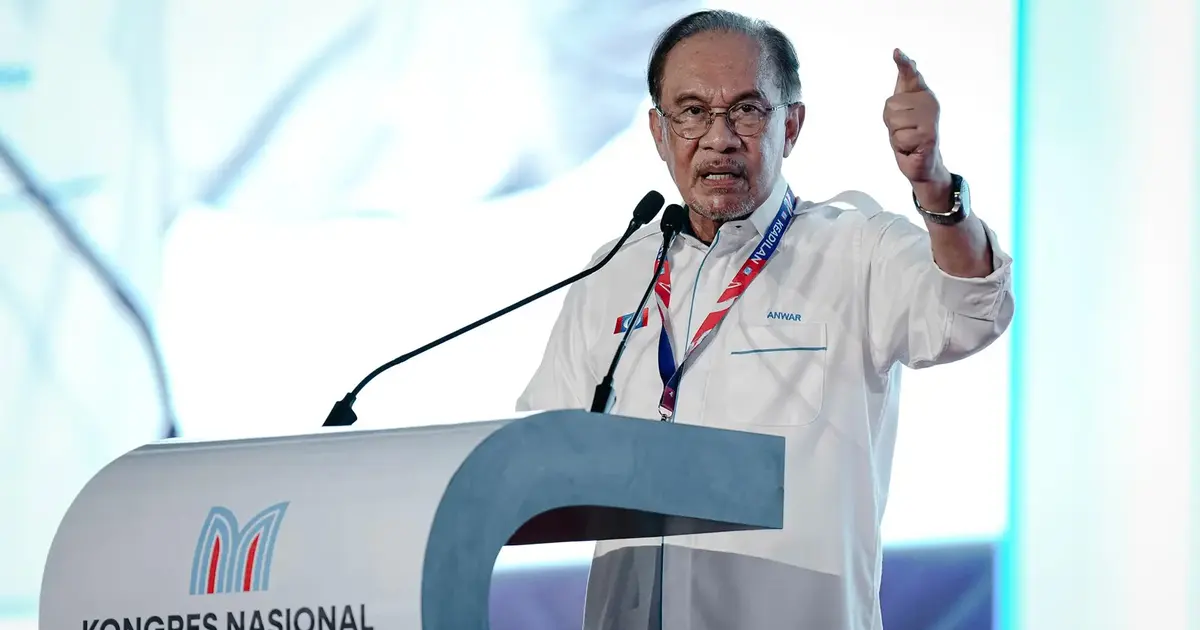
Prime Minister Anwar Ibrahim has announced a fresh injection of RM1 million for each parliamentary constituency across the country, a move that directly addresses persistent accusations of political bias in federal development spending. The allocation, which will distribute funds to all 222 constituencies regardless of their political affiliation, represents a significant attempt by Anwar to counter narratives suggesting his administration has penalised opposition-held areas.
The announcement comes at a time when federal-state relations remain fraught with tension over resource distribution. Opposition coalitions, particularly Perikatan Nasional and the remaining independent voices, have repeatedly claimed that constituencies under their control receive diminished allocations compared to government-aligned areas. These grievances have gained traction in public discourse, fuelling perceptions of unfairness in how national development budgets are apportioned across Malaysia's diverse political landscape.
Anwar's categorical rejection of withholding allegations reflects the delicate political equilibrium that characterises contemporary Malaysian governance. With a relatively slim parliamentary majority and coalition partners who must be managed carefully, the prime minister faces constant scrutiny over whether federal resources are distributed equitably. The RM1 million per-constituency announcement serves as a visible, quantifiable response that allows Anwar to demonstrate commitment to all Malaysians, irrespective of how they voted.
For opposition-controlled states and constituencies, this initiative carries particular significance. States such as Kelantan, Terengganu, and Pahul—where opposition parties hold sway—have historically complained about reduced federal allocation relative to their population and development needs. While the quantum of RM1 million per constituency may seem modest when calculated against total federal budgets, the symbolic importance of universal inclusion cannot be underestimated in Malaysia's zero-sum political environment.
The timing of this announcement warrants closer examination within the context of Malaysia's political calendar and economic pressures. With global uncertainty affecting government revenues and domestic concerns mounting over cost-of-living challenges, Anwar faces pressure to demonstrate that his administration maintains faith in equitable resource distribution. By committing fresh funds across all constituencies, he signals that despite fiscal constraints, the government prioritises fairness in development spending.
Understanding the underlying tensions reveals why such announcements resonate beyond mere financial transactions. Malaysia's federal system has long grappled with centre-periphery dynamics, where states perceive the federal government as either a partner in development or an instrument of political punishment. This fundamental distrust between federal and opposition-led state governments has repeatedly constrained coordination on infrastructure projects, healthcare initiatives, and educational programmes that would benefit from seamless cooperation.
The RM1 million allocation also raises practical questions about utilisation and oversight. Without clear guidelines on how constituencies must spend these funds, there remains potential for implementation challenges or local disputes about prioritisation. Whether these resources will fund infrastructure projects, community programmes, or administrative capacities will determine their actual impact on constituents' lives. Transparency in deployment will therefore become crucial to substantiating Anwar's claims of equitable governance.
From a Southeast Asian perspective, Malaysia's approach to managing political diversity through development funding offers instructive lessons. Unlike some regional neighbours where opposition areas face more severe fiscal punishment, Malaysia's federal system—despite its imperfections—has generally maintained baseline service provision across constituencies. This announcement reinforces that principle, though critics might argue it comes only after sustained pressure from opposition parties and civil society observers.
The broader implication for Anwar's tenure involves demonstrating that his government can rise above narrow partisan calculations. Accusations of developmental discrimination undermine social cohesion and exacerbate existing regional disparities. By universalising the RM1 million allocation, Anwar attempts to reset perceptions and establish a precedent where no constituency feels abandoned by the federal government regardless of electoral outcomes. Whether this single initiative fundamentally alters opposition parties' grievances remains uncertain, but it represents a tangible acknowledgment that equitable governance requires visible, consistent action.
Looking forward, this announcement's sustainability will depend on whether future budget cycles maintain similar commitment to universal allocation. If this proves to be a one-off gesture rather than entrenched policy, its political impact will fade quickly. Conversely, if Anwar embeds equitable resource distribution as a governing principle across multiple budget cycles, it could substantively reshape how opposition-led areas view federal-state relations and contribute to more constructive dialogue on development priorities. The measure, therefore, represents both an immediate political manoeuvre and a potential inflection point in Malaysia's approach to development federalism.

