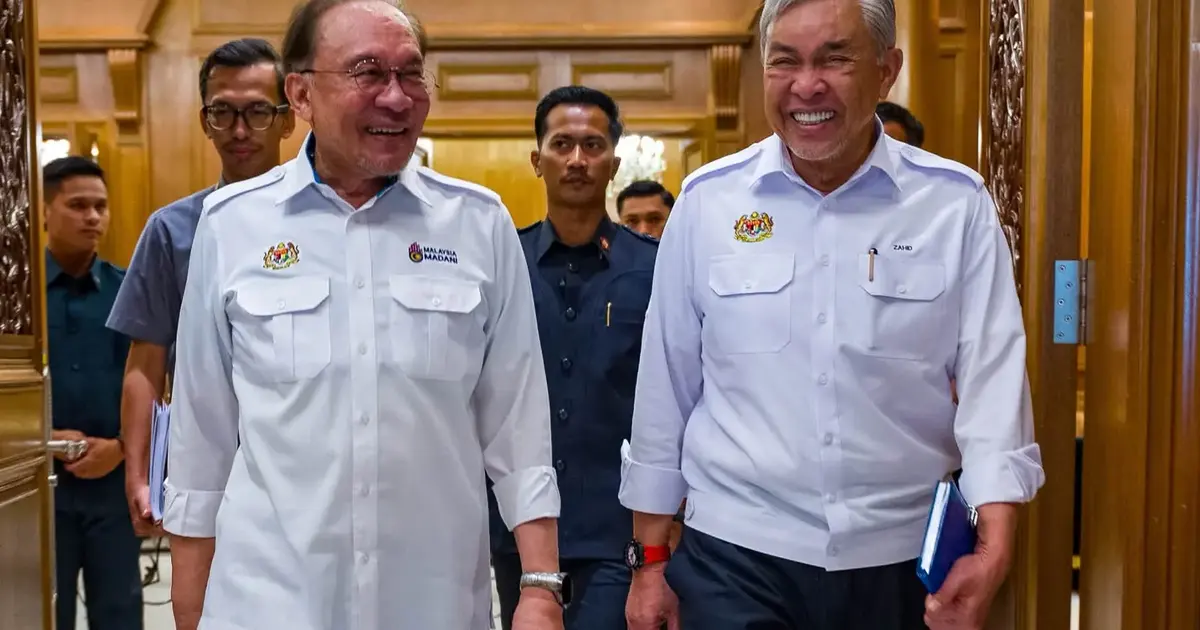
Prime Minister Anwar Ibrahim and Barisan Nasional chairman Ahmad Zahid Hamidi presented a picture of coalition harmony on Wednesday, their shared smiles and cordial exchanges aimed at reassuring observers that recent friction remains superficial rather than structural. The public show of warmth came precisely one day after Zahid made headlines by suggesting that Anwar possessed the authority to dismiss the eight BN ministers serving in the cabinet should he find their performance unsatisfactory—a statement widely interpreted as both a challenge and a veiled assertion of ministerial competence.
The timing of their collaborative appearance held particular significance within Malaysia's complex political landscape, where coalition governments depend heavily on optics and perception management. By presenting themselves as aligned and cooperative, Anwar and Zahid were sending unmistakable signals to their respective party bases and to the broader electorate that the federal government's founding partnership remained robust. Such moments become especially important in Malaysian politics, where rumours of ministerial discord or coalition strain can quickly erode confidence in governance and embolden opposition movements seeking to exploit perceived weakness.
Zahid's prior comments had carried multiple layers of meaning that analysts were quick to parse. By explicitly stating that Anwar retained the constitutional right to remove BN representatives from ministerial posts, Zahid was simultaneously defending his ministers' overall competence while establishing clear boundaries around the Prime Minister's authority. The remarks reflected the delicate negotiation that occurs within any coalition government between the premier and coalition partners—a balance between executive prerogative and the need to maintain the trust of supporting parties whose parliamentary votes remain essential for government survival.
For the Perikatan Nasional-led government, which depends on external support from BN's 41 MPs alongside its own 79-strong faction and support from other sources, ministerial appointments have become a critical leverage point. BN's eight cabinet positions represent tangible recognition of the coalition's weight in parliament and serve as symbols of political relevance to the broader UMNO party machinery. Any threat to these positions, whether real or rhetorical, touches upon matters of organisational pride and party identity within BN.
The historical context underpinning this dynamic cannot be ignored. BN's political dominance during Malaysia's first six decades of independence meant that its component parties became accustomed to substantive ministerial portfolios and significant executive influence. The coalition's reduced circumstances post-2018, followed by its complex negotiations to rejoin the federal government in 2023, have required considerable psychological and organisational adjustment. Zahid's willingness to publicly articulate his ministers' value while accepting Anwar's ultimate authority represents a negotiated settlement between these competing pressures.
Anwar's prime ministerial position, meanwhile, rests on a coalition that lacks overwhelming parliamentary majority—a situation that distinguishes Malaysian governance from the clear-cut majorities that characterised previous administrations. This structural reality means that the Prime Minister cannot simply dismiss coalition partners through executive action without triggering potential parliamentary complications. Conversely, BN ministers know they serve at the pleasure of the Prime Minister and cannot exploit their coalition position to operate with complete autonomy from executive oversight. This mutual dependence creates the conditions for both cooperation and occasional tension.
The ministers themselves occupy an interesting middle ground. Their performance—whether in managing their respective portfolios effectively, maintaining public confidence, or avoiding political scandals—directly affects both their job security and their respective parties' standing. The implicit threat underlying Zahid's remarks was that poor ministerial performance could jeopardise BN's overall position within the coalition, potentially weakening the party's negotiating position during future government formations or budget negotiations. Conversely, Anwar's demonstrated willingness to retain these ministers signals satisfaction with their work and reinforces the government's stability narrative.
Regional political observers have watched Malaysia's coalition dynamics carefully, as the country's power-sharing arrangements often serve as instructive examples for other Southeast Asian democracies navigating similar multi-party governance challenges. Thailand, Indonesia, and the Philippines all grapple with coalition politics, and Malaysia's approach to managing potential conflict between coalition partners offers both cautionary tales and practical models. The ability of Anwar and Zahid to publicly clear the air while maintaining substantive coalition cooperation demonstrates that Malaysian politics, despite its occasional volatility and dramatic rhetoric, can accommodate disagreement without fundamentally destabilising government structures.
Looking forward, this episode likely signals an adjustment period rather than a fundamental breach. Both leaders have strong incentives to maintain the coalition's functionality. For Anwar, losing BN's support would instantly threaten his parliamentary majority and government stability. For Zahid and BN, exiting the coalition would return them to opposition status, a significantly less influential position than the current arrangement offers. These structural realities provide a powerful gravitational force pulling both sides toward continued cooperation despite periodic friction and rivalry.
The months ahead will test whether this display of unity represents genuine resolution or merely a tactical pause. Budget presentations, policy disagreements, and decisions on contested positions could reignite tensions that today's smiles sought to suppress. Yet the fact that both leaders chose the path of public reconciliation rather than continued confrontation suggests a mature recognition that coalition longevity serves both their interests and Malaysia's broader political stability.

