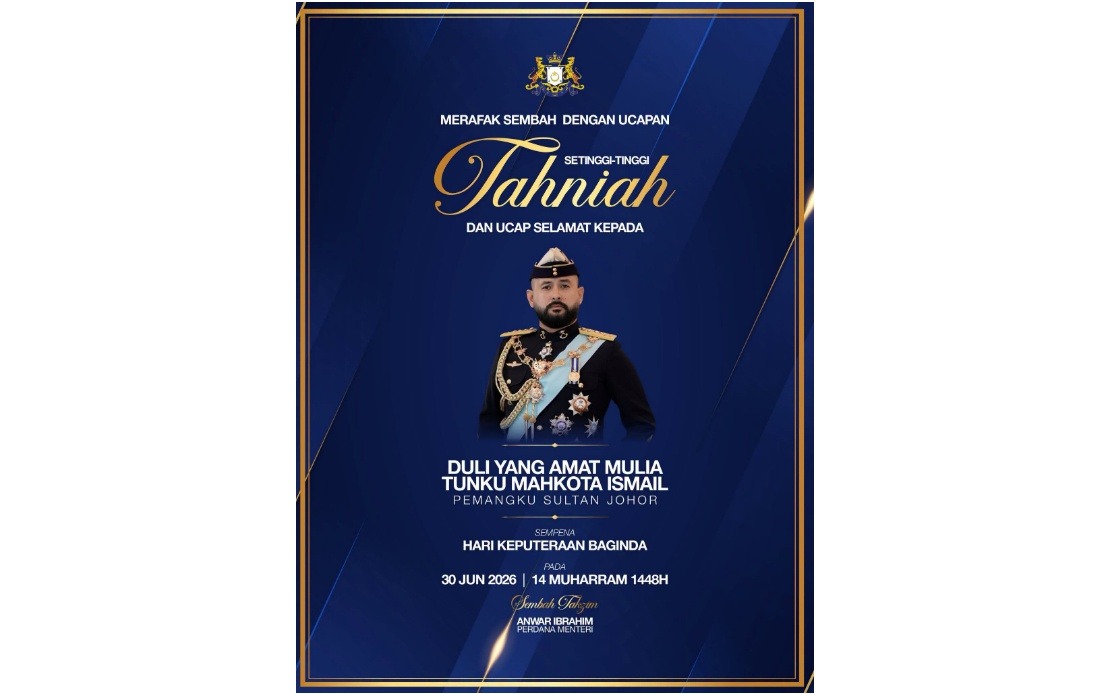
Malaysia's top political leadership has marked the birthday of Tunku Mahkota Ismail, the Regent of Johor, with public expressions of goodwill and prayers for his wellbeing. Prime Minister Datuk Seri Anwar Ibrahim extended formal congratulations on June 30 through social media, accompanying his message with wishes that the royal heir enjoys sustained good health, personal contentment, and divine blessing in his role.
Deputy Prime Minister Datuk Seri Dr Ahmad Zahid Hamidi similarly used Facebook to convey his birthday greetings, framing his message within the context of Islamic faith. His statement specifically petitioned for Allah's continued protection and mercy over the regent, whilst also acknowledging the broader significance of Tunku Mahkota Ismail's position as the custodian of Johor's interests and the welfare of its population.
The simultaneous public acknowledgement from both the Prime Minister and his deputy underscores the ceremonial importance attached to royal observances within Malaysia's constitutional monarchy framework. Such gestures, whilst appearing routine in nature, serve deeper functions within the nation's political culture, reinforcing the bonds between the federal executive and the state's royal institution. The Johor monarchy holds particular prominence within the Malaysian federation, historically wielding considerable influence over state governance and maintaining close ties with federal authorities.
Tunku Mahkota Ismail's position as regent places him in a unique constitutional space. As the designated heir to the Johor throne, he has progressively assumed responsibilities traditionally associated with the sultanate, including ceremonial duties, state development oversight, and representation at national and international forums. The timing and nature of birthday tributes from senior federal figures often signal the strength of centre-state relations, particularly in a state as economically and politically significant as Johor.
Johor's strategic importance to Malaysia extends beyond its territorial size or population demographics. The state serves as a critical economic gateway between Malaysia and Singapore, whilst its port infrastructure and manufacturing sectors contribute substantially to national revenue. Additionally, Johor has historically functioned as a stabilising force in Malaysian politics, with its royal institution commanding respect across ethnic and religious communities. The regent's eventual ascension to the throne will therefore carry implications for federal-state dynamics and national cohesion.
The use of social media platforms for conveying such messages reflects contemporary shifts in how Malaysian political communication operates. Traditional formal channels—official state visits, written correspondence through protocol offices—persist, yet Facebook and similar platforms now serve as primary vehicles for direct public communication. This democratisation of message delivery allows citizens to witness exchanges between political figures and royal institutions in real time, though it also subjects such communications to public scrutiny and commentary.
Zahid's specific mention of divine wisdom granted to the regent carries particular resonance given the spiritual dimensions that inform governance philosophy in Islamic monarchies. The invocation of guidance and discernment suggests an understanding of the regent's future role not merely as ceremonial or administrative, but as fundamentally anchored in religious and moral authority. This framing aligns with Malaysia's constitutional designation as an Islamic state with a paramount ruler system.
The bipartisan nature of these greetings—encompassing both the Prime Minister's Office and the Deputy Premier's Office—indicates a degree of political alignment on matters of state protocol and royal deference. Such moments of convergence stand in contrast to periods when Malaysia's federal structure witnesses tension between different power centres. That Anwar and Zahid both recognised the occasion through similar channels suggests a consensus view on maintaining respectful relations with the Johor palace.
For observers of Malaysian politics, these birthday acknowledgements serve as minor but meaningful data points regarding the health of institutional relationships. The absence of such greetings or their perfunctory nature might signal diplomatic coolness, whereas enthusiastic and warm messages indicate functional alignment. In this instance, the tone and substance of both communications suggest straightforward, cordial relations between Putrajaya's leadership and Johor's royal institution as of mid-2024.
Looking forward, Tunku Mahkota Ismail's eventual succession remains a significant juncture in Malaysian constitutional history. The contemporary relationship he maintains with federal leadership, as evidenced through public exchanges, will likely influence the trajectory of centre-state relations during his reign. His already-extensive involvement in economic development initiatives, infrastructure projects, and regional cooperation frameworks suggests a regent actively preparing for the responsibilities that ascension entails.

